Recommended byHoward Marks
About This Book
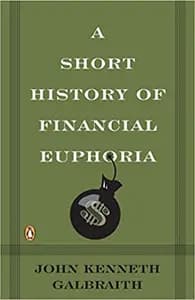
"A Short History of Financial Euphoria" by John Kenneth Galbraith offers a concise exploration of the recurring pattern of financial bubbles throughout history. Galbraith, a renowned economist, delves into the irrational exuberance that propels these bubbles and the inevitable bursts that follow, leading to financial crises.
Through a historical lens, Galbraith analyzes notorious instances of financial euphoria, such as the Dutch Tulip mania in the 17th century, the Mississippi and South Sea bubbles of the 18th century, and the Roaring Twenties stock market boom. He highlights the common factors that contribute to these episodes, including speculative buying, excessive borrowing, and a collective faith in unfounded economic theories.
By examining the psychology behind financial booms and busts, Galbraith sheds light on the human tendency to be swayed by dreams of easy wealth and the disregard for caution when caught up in the frenzy. He explores the role of mass psychology and herd mentality in fueling these speculative episodes, along with the exploitation of human greed by unscrupulous promoters and financiers.
Galbraith argues that the cycle of financial euphoria and subsequent collapse is inherent in the nature of capitalism, as profits and returns on investments perpetuate the belief in further potential gains. His lucid analysis critiques the inadequate regulatory measures in place to prevent history from repeating itself and warns against the dangers of unchecked enthusiasm and speculative excess.
In this succinct yet insightful book, Galbraith offers an accessible examination of the inherent flaws in our financial systems, offering valuable lessons for investors, policymakers, and anyone interested in understanding the cyclical nature of financial markets throughout history.
Through a historical lens, Galbraith analyzes notorious instances of financial euphoria, such as the Dutch Tulip mania in the 17th century, the Mississippi and South Sea bubbles of the 18th century, and the Roaring Twenties stock market boom. He highlights the common factors that contribute to these episodes, including speculative buying, excessive borrowing, and a collective faith in unfounded economic theories.
By examining the psychology behind financial booms and busts, Galbraith sheds light on the human tendency to be swayed by dreams of easy wealth and the disregard for caution when caught up in the frenzy. He explores the role of mass psychology and herd mentality in fueling these speculative episodes, along with the exploitation of human greed by unscrupulous promoters and financiers.
Galbraith argues that the cycle of financial euphoria and subsequent collapse is inherent in the nature of capitalism, as profits and returns on investments perpetuate the belief in further potential gains. His lucid analysis critiques the inadequate regulatory measures in place to prevent history from repeating itself and warns against the dangers of unchecked enthusiasm and speculative excess.
In this succinct yet insightful book, Galbraith offers an accessible examination of the inherent flaws in our financial systems, offering valuable lessons for investors, policymakers, and anyone interested in understanding the cyclical nature of financial markets throughout history.
What People Are Saying
More Praise
Howard Marks: “This book was extremely important for me because it told me about cycles, about euphoria and about the pendulum swing of human psychology. I recommend it to everybody – and it has the added virtue of being a thin book so you can get through it very easily.”
Revisit Your Highlights, Deepen Your Understanding
Import your Kindle highlights to review, organize, and share the ideas that matter most to you.
Get the free browser extension
Share This Book
More Books in Investing
View More
Poor Charlie's Almanack
Charlie Munger

Antifragile
Nassim Nicholas Taleb

Skin In The Game
Nassim Taleb

Thinking In Bets
Annie Duke
Security Analysis
Benjamin Graham
The Dao of Capital
Mark Spitznagel
The Intelligent Investor
Benjamin Graham
The Psychology of Money
Morgan Housel
When Genius Failed
Roger Lowenstein
Bitcoin Billionaires
Ben Mezrich
Secrets of Sand Hill Road
Scott Kupor
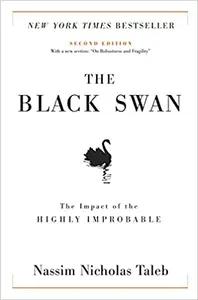
The Black Swan
Nassim Taleb
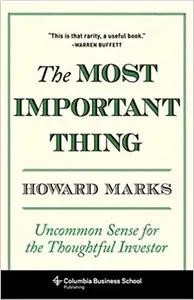
The Most Important Thing
Howard Marks
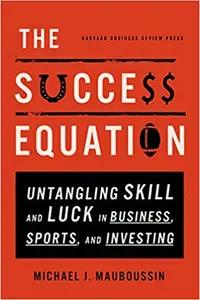
The Success Equation
Michael Mauboussin
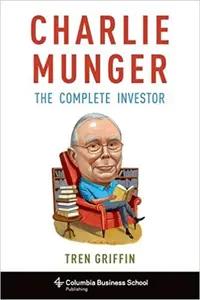
Charlie Munger
Tren Griffin
Expectations Investing
Michael Mauboussin
Fooling Some of the People All of the Time
David Einhorn
Layered Money
Nik Bhatia
Manias, Panics, and Crashes
Robert Aliber

Market Wizards
Jack Schwager
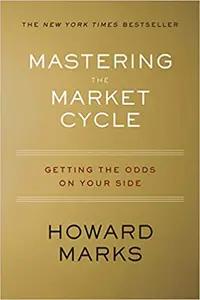
Mastering The Market Cycle
Howard Marks
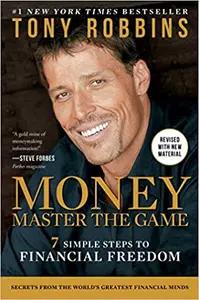
Money
Tony Robbins
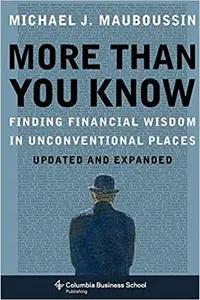
More Than You Know
Michael Mauboussin
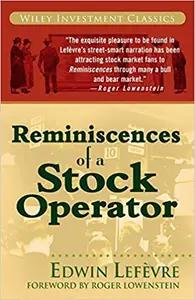
Reminiscences of a Stock Operator
Edwin Lefevre
Stress Test
Timothy Geithner
The (Mis)Behavior of Markets
Benoit Mandelbrot
The Alchemy of Finance
George Soros
The Essays of Warren Buffett
Lawrence Cunningham & Warren Buffett
The Most Important Thing Illuminated
Howard Marks
The Tao of Charlie Munger
David Clark
Popular Books Recommended by Great Minds 📚

Sapiens
Yuval Noah Harari
The Hard Thing About Hard Things
Ben Horowitz
Zero to One
Peter Thiel
High Output Management
Andrew Grove

Principles
Ray Dalio

Shoe Dog
Phil Knight

Snow Crash
Neal Stephenson

Meditations
Marcus Aurelius
Originals
Adam Grant
Poor Charlie's Almanack
Charlie Munger

The Innovators Dilemma
Clayton Christensen
The Lean Startup
Eric Reis
The Sovereign Individual
James Dale Davidson & William Rees-Mogg
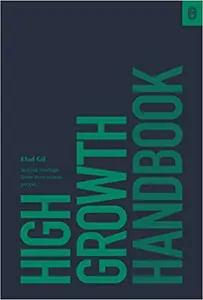
High Growth Handbook
Elad Gil
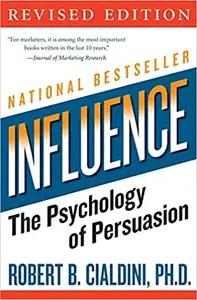
Influence
Robert Cialdini
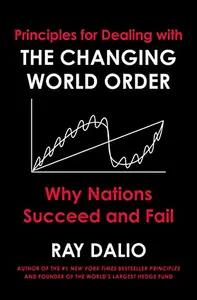
Principles for Dealing With The Changing World Order
Ray Dalio

Rework
Jason Fried

Surely You're Joking Mr. Feynman
Richard Feynman
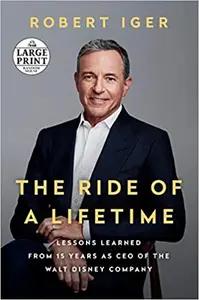
The Ride of a Lifetime
Bob Iger

The Three Body Problem
Cixin Liu
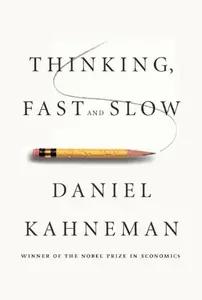
Thinking, Fast and Slow
Daniel Kahneman
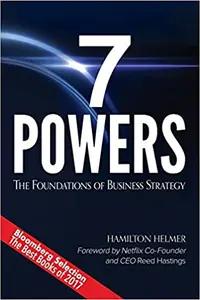
7 Powers
Hamilton Helmer
Antifragile
Nassim Nicholas Taleb
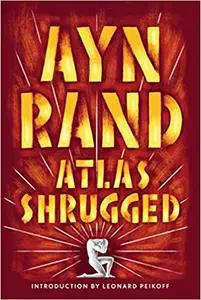
Atlas Shrugged
Ayn Rand
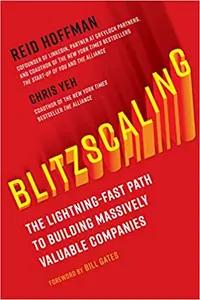
Blitzscaling
Reid Hoffman

Dune
Frank Herbert

Foundation
Isaac Asimov
Good To Great
Jim Collins
Hopping Over The Rabbit Hole
Anthony Scaramucci

Man's Search for Meaning
Viktor Frankl