What Is Unified Diagnostic Services (UDS) and How Does It Work?
TL;DR
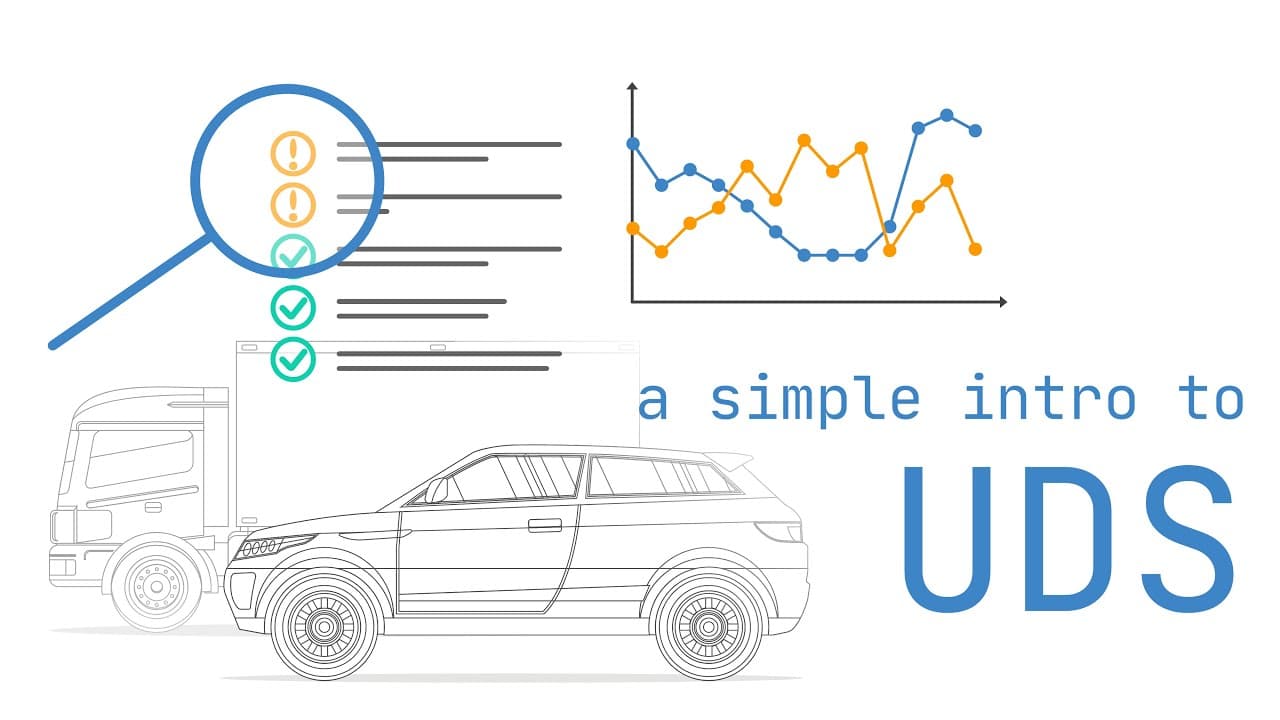
Unified Diagnostic Services (UDS) is a standardized communication protocol used in automotive ECUs for diagnostics, firmware updates, and routine testing. It enables client-server communication between tester tools and vehicle ECUs, allowing for tasks like reading diagnostic trouble codes and extracting parameter data across various bus systems.
Transcript
Need a simple intro to UDS (Unified Diagnostic Services)? In this practical tutorial, we introduce the UDS basics with focus on UDS on CAN bus and Diagnostics over CAN (DoCAN). We also introduce the ISO-TP protocol and explain the difference between UDS, OBD2, WWH-OBD and OBDonUDS. Finally, we explain how to request, record and decode UDS... Read More
Key Insights
- 🚗 Unified Diagnostic Services (UDS) is a communication protocol used in automotive ECUs for diagnostics, firmware updates, and more. It is standardized across manufacturers and standards. UDS is used by all tier 1 OEMs today.
- 🔌 UDS communication is performed in a client-server relationship, with the client being a tester-tool and the server being a vehicle ECU. This enables various use cases such as reading and clearing diagnostic trouble codes, extracting parameter data, initiating diagnostic sessions, and modifying ECU behavior.
- 🌐 UDS is based on the ISO 14229 protocol and can be used on various bus systems like CAN, FlexRay, IP, K-line, and LIN.
- 📟 The UDS message structure includes fields like Protocol Control Information (PCI), UDS Service ID (SID), UDS Sub Function Byte, and UDS Request Data Parameters. These fields are used to configure and control the UDS communication.
- 🔍 ISO-TP (ISO 15765-2) is a transport protocol used in CAN-based vehicle networks to handle larger payloads for diagnostics. It enables segmentation, flow control, and reassembly of CAN data payloads up to 4095 bytes.
- 🔢 UDS messages can be single-frame or multi-frame. Single-frame requests and responses are used when the payload can be contained in a 7-byte frame. Multi-frame requests and responses are used when the payload exceeds 7 bytes and require segmentation and reassembly.
- 🚛 UDS is used in various vehicle diagnostic protocols such as OBD2, World-Wide Harmonized OBD (WWH-OBD), and OBDonUDS. WWH-OBD is a global standard based on UDS, while OBDonUDS is a next-generation OBD2 protocol for US vehicles based on UDS.
- 📊 UDS data can be logged using CANbus data loggers like the CANedge. It can be configured to send UDS requests, record UDS responses, and decode the data using CAN databases (DBC files) or Python API for further analysis.
Install to Summarize YouTube Videos and Get Transcripts
Explore YouTube Video Summarizer or Get YouTube Transcript Extractor
Summary & Key Takeaways
-
UDS is a standardized communication protocol used in automotive ECUs for diagnostics, firmware updates, and routine testing.
-
UDS communication is performed in a client-server relationship, with the client being a tester-tool and the server being a vehicle ECU.
-
UDS enables various use cases such as reading/clearing diagnostic trouble codes, extracting parameter data values, and modifying ECU behavior.
Read in Other Languages (beta)
Share This Summary 📚
Summarize YouTube Videos and Get Video Transcripts with 1-Click
Try YouTube Summary with ChatGPT & Claude or YouTube Transcript Generator
Explore More Summaries from CSS Electronics 📚
![OBD2 Explained - A Simple Intro [v2.0 | 2021] 🌟 thumbnail](/_next/image?url=https%3A%2F%2Fi.ytimg.com%2Fvi%2FYcwBeNQbJ5A%2Fhqdefault.jpg&w=750&q=75)
Summarize YouTube Videos and Get Video Transcripts with 1-Click
Try YouTube Summary with ChatGPT & Claude or YouTube Transcript Generator