How to Use the Limit Comparison Test for Series Convergence
TL;DR
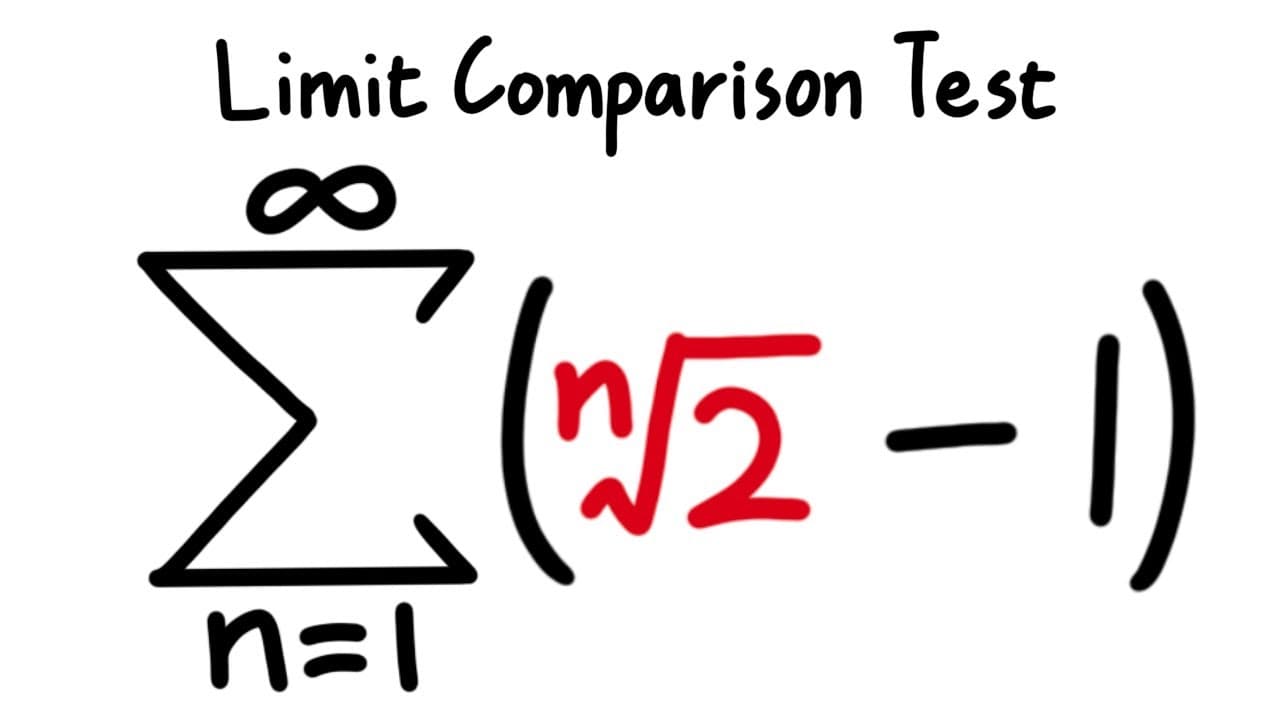
To determine if the series Σ(2^(1/n) - 1) diverges, use the limit comparison test with the harmonic series Σ(1/n). Applying this test shows that both series diverge, confirming that Σ(2^(1/n) - 1) also diverges.
Transcript
converge or diverge Sigma 1 goes from 1 to infinity parentheses and it's root of 2 minus 1 well what can we do first as usual the nth root of something we can look at that as a power this is the same as saying Sigma where n goes from 1 to infinity and 302 is the same as 2 to the 1 over N power not just a user business in calculus almost always look... Read More
Key Insights
- 👻 Representing the nth root as a power allows for easier manipulation and comparison of series.
- 🏆 The test for divergence fails in this case due to resulting in a limit of 0.
- 💨 The limit comparison test provides a way to compare the series with a known divergent series.
- ✊ L'Hopital's rule is used to evaluate a 0/0 situation and determine the limit of 2 to the power of 1/n.
Install to Summarize YouTube Videos and Get Transcripts
Explore YouTube Video Summarizer or Get YouTube Transcript Extractor
Summary & Key Takeaways
-
The content introduces the concept of representing nth root as a power in a series.
-
The test for divergence is attempted, but it fails due to resulting in 0.
-
The limit comparison test is used to compare the series with the harmonic series, concluding that it also diverges.
Read in Other Languages (beta)
Share This Summary 📚
Summarize YouTube Videos and Get Video Transcripts with 1-Click
Try YouTube Summary with ChatGPT & Claude or YouTube Transcript Generator
Explore More Summaries from blackpenredpen 📚
Summarize YouTube Videos and Get Video Transcripts with 1-Click
Try YouTube Summary with ChatGPT & Claude or YouTube Transcript Generator