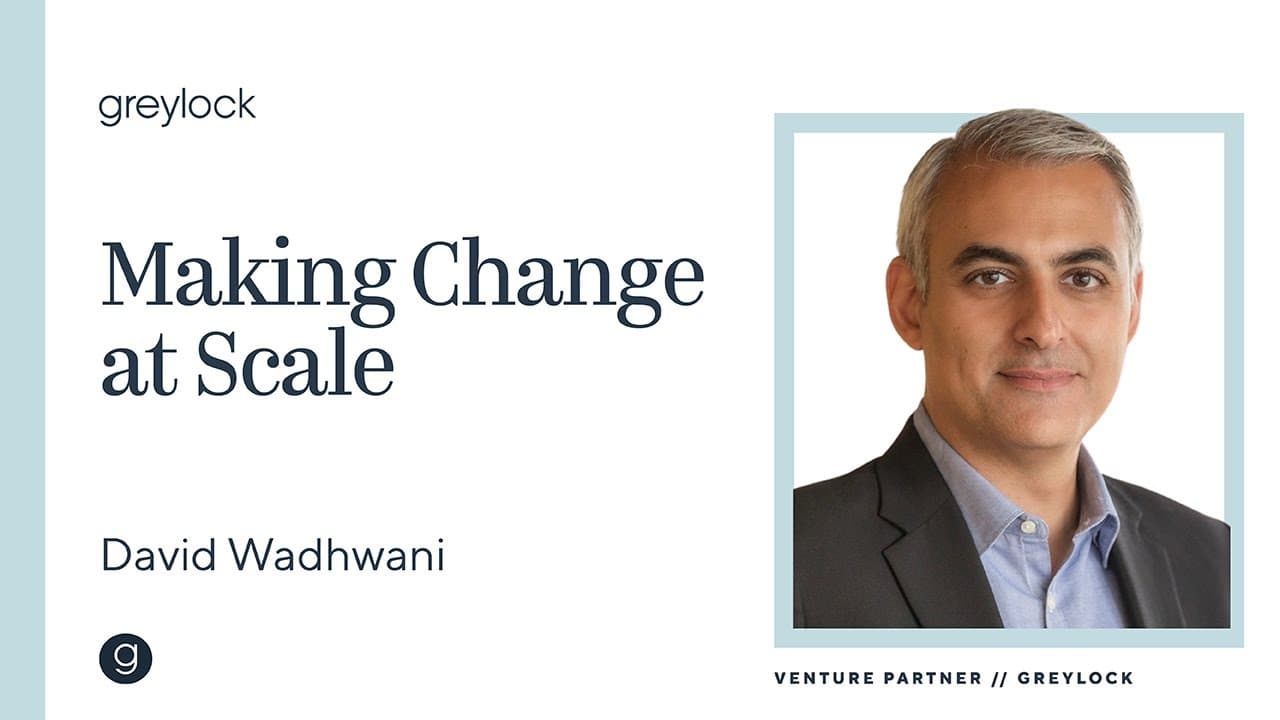
David Wadhwani | Making Change at Scale
Transcript
Read and summarize the transcript of this video on Glasp Reader (beta).
Install to Summarize YouTube Videos and Get Transcripts
Explore YouTube Video Summarizer or Get YouTube Transcript Extractor
Summary
In this video, Greylock Partners Cerigua and David Wadwani discuss the topic of company phase shifts, or major operational changes. David shares his experience guiding businesses through phase shifts and outlines the five must-do's for successful transitions: Simplicity, Conviction, Quick Decisions, Communication, and Community.
Questions & Answers
Q: What is a phase shift?
A phase shift is when one or more major functions of an operating business need to operate differently. It happens at a functional level throughout the organization, and it can take various forms such as changes in deal sizes, customer expectations, marketing strategies, product introductions, or organization size.
Q: Can you provide examples of phase shifts?
Phase shifts can come in different shapes and sizes. For instance, as deal sizes grow, customer success organizations need to shift their approach to handle all customers consistently. Marketing teams may need to evolve from digital-only strategies to a mix of digital and events as deal sizes increase. When organizations move from mid-market to enterprise, the product team may need to rethink field escalations and how they organize themselves. These are just a few examples of phase shifts.
Q: How did Adobe approach the phase shift from traditional software to subscription-based services?
Adobe went through a major transition from traditional box software to subscription-based services. They started by simplifying their offers, moving from over 2 million SKUs to a couple dozen offerings with two price points. They also changed their release schedule, encouraging product teams to release whenever they were ready instead of coordinating multiple products for simultaneous releases. They shifted their messaging to a single unified message of "creativity for all." These changes allowed Adobe to embrace new technologies and business models and reinvent themselves.
Q: How did the pricing changes impact Adobe's revenue?
The transition to subscription pricing initially had a short-term impact on revenue, causing a $700 million revenue decline. However, by simplifying their offerings and aligning their pricing with customer needs, Adobe was able to attract new customers, including non-professionals and previously non-paying customers, leading to long-term growth and reaching a market cap of over $250 billion.
Q: How did Adobe develop conviction in their decisions during the transition?
Developing conviction required challenging the existing decision-making systems and relying not only on data but also on personal beliefs and instincts. When faced with conflicting data, the team at Adobe trusted their instincts and took an iterative approach, launching with the subscription pricing that felt right to them. They continuously evaluated the results and adjusted their strategies based on feedback and market signals.
Q: How did Adobe manage quick decision-making during the transition?
Making quick decisions was a critical aspect of the transition. To accelerate decision-making, Adobe established a small cross-functional team that met daily to address decisions related to the transition. They focused on making five to ten big business decisions every day, sometimes relying on data and sometimes on instincts. They also had a daily meeting with the CEO to address controversial decisions that required higher-level input.
Q: How did Adobe approach communication during the transition?
Adobe emphasized openness, transparency, and consistency in communication. They aimed to have the same communication for all stakeholders, including employees, customers, and investors. They held multiple sessions for employees at all levels of the organization to ensure two-way communication and address concerns and feedback. They also communicated the transition externally through investor days, user conferences, and regional sessions.
Q: How did Adobe build a sense of community during the transition?
Adobe focused on building individual buy-in and creating a sense of community among employees. They invested in retraining engineers and provided training on Lean Startup methodologies to encourage innovation and ownership. They wanted every employee to feel involved and benefited from the transition, so they avoided introducing specialist reps and ensured that everyone had a role to play in selling and supporting the new offerings. The success of the transition relied on creating a shared purpose and belief in the change.
Q: How did David approach phase shifts at AppDynamics?
At AppDynamics, the focus was on continuous transformation due to the nature of being a growth company. One specific phase shift David mentioned was the transition from selling a single product to offering multi-product solutions. They simplified their offerings from application monitoring and analytics to app and business monitoring. They formed cross-functional teams, aligned incentives, and communicated the new direction to the entire organization. This phase shift resulted in significant growth for the business.
Q: How did David maintain team buy-in and belief in the strategy during external challenges?
Maintaining team buy-in and belief during external challenges required continuous work and open communication. David highlighted the importance of having a strong executive team, like Ann Lunas, who provided support and kept everyone focused. It was crucial to remind the team of the bigger vision and purpose behind the changes and show them the positive early signals. Open communication and transparency helped address doubts and concerns throughout the transition journey.
Takeaways
Successful phase shifts require simplicity, conviction, quick decision-making, communication, and community involvement. Simplifying core operations and centralized decision-making are crucial to navigate major changes. Having conviction in the new direction and being willing to make decisions rapidly, even if they may be wrong, is essential. Open and transparent communication, coupled with active involvement of all stakeholders, helps build a sense of community and ownership. Over-communicating and addressing individual concerns are vital to ensure buy-in and successful transition.
Read in Other Languages (beta)
Share This Summary 📚
Summarize YouTube Videos and Get Video Transcripts with 1-Click
Try YouTube Summary with ChatGPT & Claude or YouTube Transcript Generator
Explore More Summaries from Greymatter Podcast (Audio) 📚






Summarize YouTube Videos and Get Video Transcripts with 1-Click
Try YouTube Summary with ChatGPT & Claude or YouTube Transcript Generator