From a Single Store to a Global Brand: The Starbucks CEO's Unshakable Conviction | Howard Schultz's Pour Your Heart Into It Review

Feb 27, 2026
9 min read
5 views
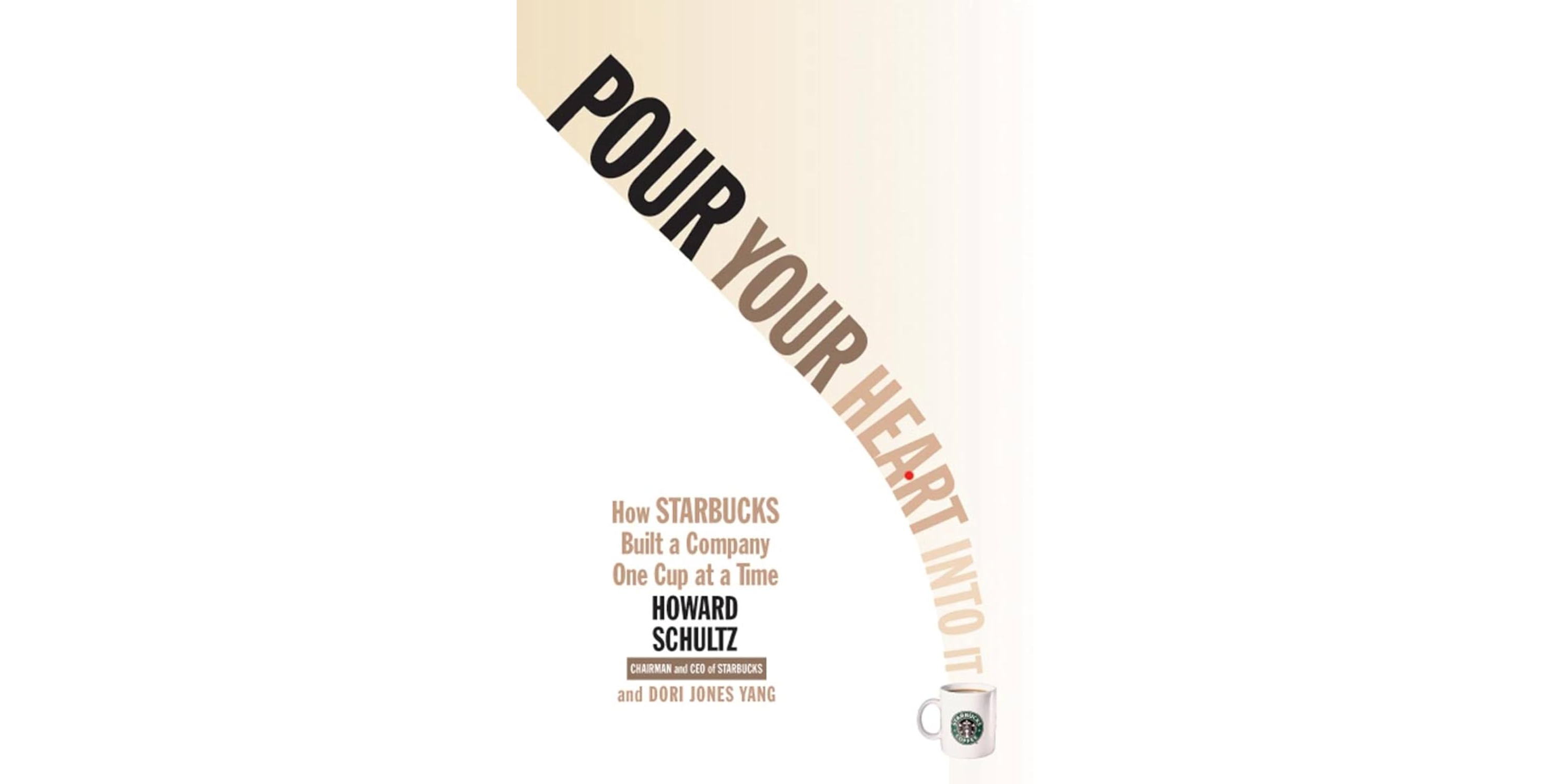
📖 Pour Your Heart Into It: How Starbucks Built a Company One Cup at a Time
Author: Howard Schultz, Dori Jones Yang
How did a tiny coffee bean shop with just five stores become a brand known around the world? This book is a first-person account from Starbucks CEO Howard Schultz, chronicling that remarkable journey. It tells the story of a man who was struck by Italy's espresso culture, brought the experience back to America, and pushed through every obstacle to make his vision a reality — even when everyone around him said it couldn't be done.
What struck me most was his integrity and sense of balance. In our book club, we had just finished reading the Uber founding story, which was pretty wild, so the contrast was enormous. There's no aggressive, win-at-all-costs energy in Schultz's management style. He comes across as someone who carries both the dreamer and the operator within him. He called employees "partners," introduced healthcare benefits and stock options (the Bean Stock program), and resisted franchising for as long as possible. To pull all of that off in the United States — the capital of capitalism — and to have done it over thirty years ago, is genuinely remarkable.
📖 Who should read this book
Anyone who loves startup founding stories
Anyone who wants to think about what it means to run a company that truly values its people
Anyone curious about how a brand's core values are built and sustained
📕 Get it on Amazon:
Pour Your Heart Into It: How Starbucks Built a Company One Cup at a Time
Thoughts
My honest first impression of Starbucks was "just another chain." I had no sense that they were deeply particular about their coffee beans, so seeing the company through Schultz's eyes was genuinely eye-opening. It reminded me how much our perception of something depends on the touchpoints we've had with it. Everyone sees a completely different picture depending on where they've interacted with a brand.
Schultz seems like a genuinely good person. In the Uber book we'd just read, the dreamer side and the operator side were constantly at war — and that imbalance eventually led to implosion. Schultz, by contrast, has both sides in remarkable equilibrium. His writing has none of that aggressive, hustle-culture energy (though that could partly be the translation). He strikes me as a rare example of someone who embodies the best of the visionary and the pragmatist.
Product thinking and people thinking show up everywhere. From the earliest days, he expanded healthcare coverage to employees, created a unique stock option program (Bean Stock), and banned franchising outside of airports. You can see both a fierce commitment to product quality and a deep respect for people running through every decision. Doing this in the most capitalist country on earth, over three decades ago — you simply can't pull that off unless you truly believe that investing in your partners lifts their motivation and contribution, which in turn lifts the entire company.
The immunology researcher story blew my mind. A scientist who had been studying something related to antigens stumbled upon a coffee extraction technique, and Schultz had the awareness to bring that researcher in-house for R&D. The fact that Schultz consistently made the right calls on new product development is a huge part of why Starbucks became what it is.
The coffee bean pricing issue left me with mixed feelings. A documentary I'd seen before took the position that Starbucks was driving down coffee prices. Reading Schultz's perspective felt like watching a plot twist — "Oh, so this is how it looked from their side." It's a powerful reminder that stories change completely depending on whose point of view you're hearing.
One thing that nagged at me, though: compared to the Il Giornale days, what Starbucks delivers to customers has changed dramatically. Frappuccinos, low-fat milk, endless new menu items. The whole thing started because Schultz wanted to honor the Italian espresso tradition — so wasn't there more tension with Peet's Coffee founders over these changes? Because Schultz himself wrote this book, it may be more neatly packaged than the reality was.
The balance between conviction and flexibility is his superpower. He's willing to learn from people smarter than him, yet he also had early convictions — like refusing to use nonfat milk. But eventually, he tried that too. Holding strong initial principles while not being so rigid that you can't adapt — without that flexibility, Starbucks never would have scaled to what it is.
My Starbucks experience in San Francisco was purely transactional — mobile order, quick pickup, basically an IT company selling coffee. But at the original Seattle store, someone carefully explained each coffee variety, and it was overwhelming in the best way. That such wildly different experiences can exist under the same brand speaks to the sheer difficulty of global operations.
Schultz deeply understood the importance of preparation. He pursued growth, but he also understood exactly what infrastructure, talent, and capacity were needed at each stage — and he moved proactively. "We need this management team in place. We need this much manufacturing capacity. Our logistics have to support this volume." He assembled the right people to address each challenge. It's a stark contrast to Uber, which was always playing catch-up.
The fact that Schultz isn't actually Starbucks' founder is fascinating. The original three founders eventually went off to Peet's Coffee. Schultz came from outside, built his own company, then acquired the Starbucks he loved and shaped it into what it is today. I can't help but wonder how those original founders feel about it all now.
Book Club Discussion
Life is a series of near misses
This was the line that everyone in our book club flagged as the most memorable. "I believe life is a series of near misses. A lot of what we ascribe to luck is not luck at all. It's seizing the day and accepting responsibility for your future. It's seeing what other people don't see and pursuing that vision, no matter who tells you not to."
The words carry weight because they come from lived experience. But who says something matters as much as what they say. If a stranger told you this, it might not land at all. Coming from a man who was moved to tears by Italian coffee culture, brought that vision back to America, and pushed through every objection to make it real — that's why it resonates. Context is everything.
The balance between conviction and flexibility
What sustained Starbucks' growth was a commitment to product quality paired with a willingness to evolve. The Frappuccino, for example, didn't fit the original Italian espresso ethos at all — yet it ended up opening the door to an entirely new customer base.
At the same time, there's a disconnect with what Starbucks has become today. No one explains the coffee to you anymore. It feels like an assembly-line operation. When a local, quality-first brand like Blue Bottle shows up, there are areas where global-scale operations simply can't compete. We also discussed questions the book doesn't address: the Frappuccino's margins must be enormous, right? If you're truly about being a "third place," does it even need to be about coffee? And can you really maintain your founding values after going public? These are the conversations that came up.
Integrity as the ultimate competitive advantage
"If I sense that a person lacks integrity or principles, I cut off any dealings with him. In the long run, it's not worth it." That line from Schultz hit hard. Integrity works like a body blow in boxing — it doesn't knock you down immediately, but over time it either builds you up or tears you apart.
His approach to people was equally impressive. Rather than firing underperformers on the spot, he'd sit down and clearly communicate his concerns and expectations. That's what a culture of transparency actually looks like. Whether the person grows from that feedback or ultimately doesn't fit, at least the process was honest. We also talked about how kindness isn't passive — genuinely kind people are always thinking deeply. There's no such thing as someone who is kind without being thoughtful.
Finding your passion makes you one of the lucky ones
Schultz's life-changing trip to Italy — and the fact that he sustained that passion for decades — led to a discussion about how unpredictable life is. Finding something you're overwhelmingly driven to do, something that's both fulfilling and sustainable over the long haul, makes you truly fortunate. Most people go through life without ever finding that thing. Someone with that kind of internal drive, thinking long-term and running without stopping — that's rare.
Someone brought up the Japanese punk rocker Hiroto Komoto from The Blue Hearts, who once said something like: "A musician's dream is to play music, right? Not to get rich. If that's the case, you're all living your dream every single day. And so am I." The idea that doing what you love is itself the realization of a dream — that mindset connects directly to the Starbucks story.
Think aggressively, act with caution
A line from the book that quietly gutted me: "Think aggressively, act with caution." When you're thinking, be wildly ambitious. But when you actually move, be careful. That seemingly contradictory balance is Schultz's management style in a nutshell.
Another passage also stayed with us: "Never underestimate the importance of what signals you send and what values you instill. When you take on a partner, and when you select employees, be sure to choose people who share your passion, commitment, and goals." The people you bring in during the earliest days define the culture of everything that follows. That's not just a startup lesson — it applies to any team, anywhere.
📕 Get it on Amazon:
Pour Your Heart Into It: How Starbucks Built a Company One Cup at a Time
Quotes
I believe life is a series of near misses. A lot of what we ascribe to luck is not luck at all.
If I sense that a person lacks integrity or principles, I cut off any dealings with him. In the long run, it's not worth it.
In those who succeed, you can sense the dedication. Those people take risks wholeheartedly.
In most cases, safety is merely a superstition. In reality, there is no such thing as safety.
Think aggressively, act with caution.
📕 Get it on Amazon:
Pour Your Heart Into It: How Starbucks Built a Company One Cup at a Time
💡 Save and export your book highlights with Glasp!
The quotes in this article were exported using Glasp. If you're interested in exporting your Kindle highlights, check out this guide:
How to Export Kindle Highlights — Notion, Obsidian, AI Integration & More
📚 See what other readers highlighted in this book:
👉 Top Highlights for "Pour Your Heart Into It" on Glasp
Recommended reads if you enjoyed this book
▶ The Man Who Bet Everything on Shoes: 40 Years of Nike | Phil Knight's Shoe Dog Review
▶ The Brothers Who Turned Madness into Flight | David McCullough's The Wright Brothers Review