How Two Bicycle Mechanics Defied Gravity — and What It Teaches Us About Conviction | "The Wright Brothers" by David McCullough

Feb 24, 2026
9 min read
3 views
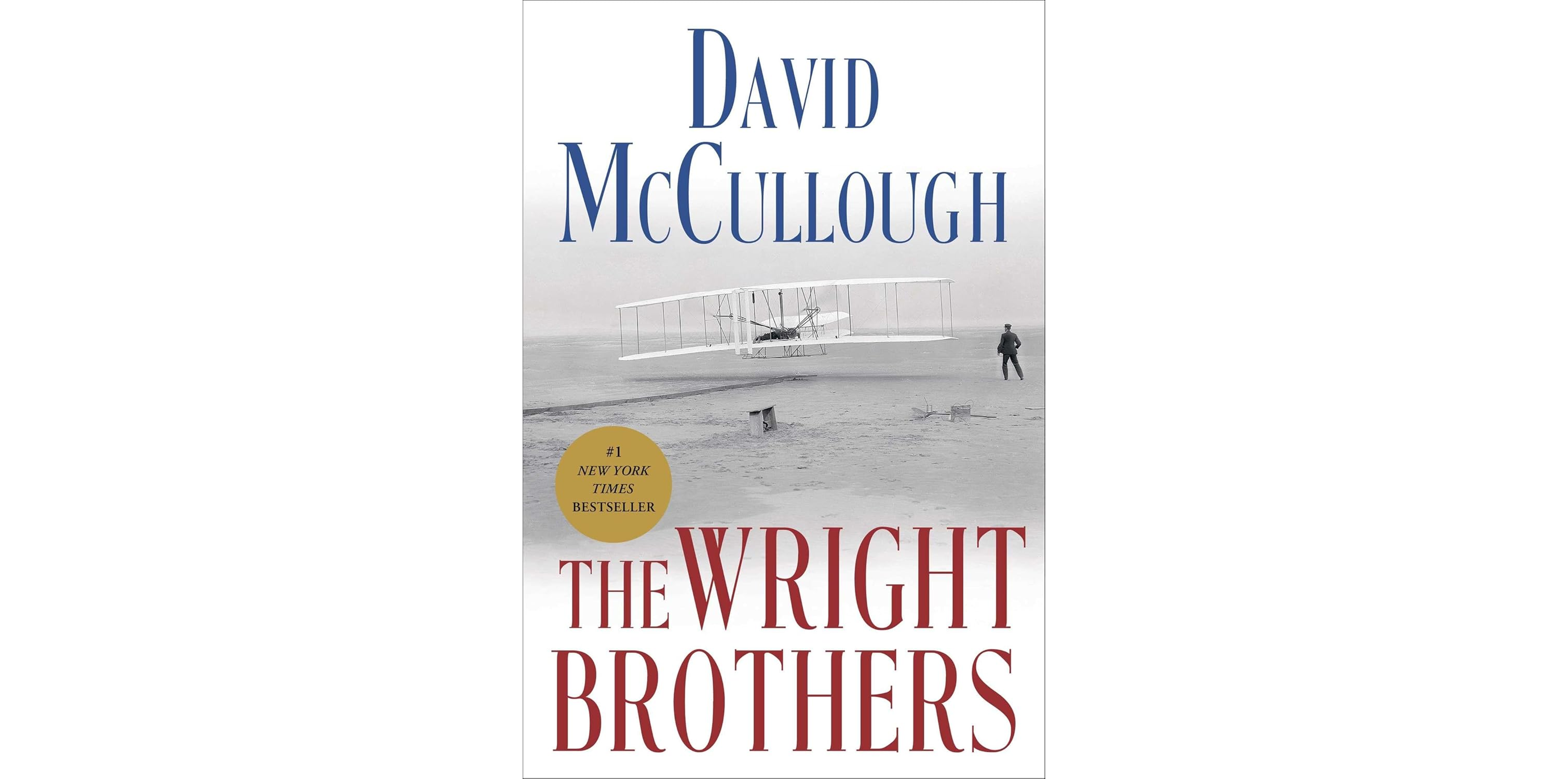
No credentials. No funding. No backing. Wilbur and Orville Wright ran a bicycle shop in Dayton, Ohio — and achieved humanity's first powered flight. Meanwhile, Professor Samuel Langley, armed with $70,000 in government funding and the best minds available, failed. The Wright Brothers built their flying machine for roughly $1,000.
The book's main narrative wraps up around the 65–75% mark, with the rest consisting of an index and bibliography. It reads faster than you'd expect, but the density is overwhelming. Deriving wing design principles from observing birds, independently developing a propeller that no one had researched before, flying again and again while being bitten by mosquitoes — all of it comes alive through meticulous research and diary records.
📖 Who should read this book:
Anyone interested in innovation, invention, and the mindset behind breakthrough achievement
Anyone who wants to understand what separates those who talk about conviction from those who live it
Anyone curious about how two self-taught engineers outperformed an entire government-funded program
📕 Get it on Amazon:
Reflections
This book made me think deeply about the power of conviction.
People will always cite reasons why something can't be done — lack of money, resources, support, credentials. And sure, those things help. But what matters above everything else is will. The Wright Brothers built their flying machine themselves. They had no financial backing. Yet they believed they could do it, and they did.
Flying — defying gravity itself — is perhaps the most counterintuitive thing a human could attempt. That's what makes their achievement so staggering.
The Convergence of Technology, Environment, and Mindset
Otto Lilienthal's influence was enormous. His glider flights shifted public perception from "flying is a fairy tale" to "maybe it's actually possible." That cognitive shift was a prerequisite for everything that followed.
The emergence of engines as a power source mattered too. So did the fact that airships were already in practical use. Individually, none of these developments would have been enough. But together — Lilienthal's proof of concept, engine technology, existing airships — they created the conditions for someone to connect the dots and say, "Maybe we can actually do this."
Ideas are always just connecting dots. And the fact that knowledge and research were shared openly made that connection possible.
The Value of a Discussion Partner
Having someone to think with is crucial. Each person does their best individually, of course — that's a given. But when different perspectives, different ways of thinking, and different ideas come together through dialectical exchange, something new emerges that neither person could have reached alone.
The Habit of Keeping Records
People of this era seemed to keep diaries as a matter of course. The Wright Brothers kept remarkably detailed journals. The habit of reflection — recording what happened and looking back — clearly plays an important role in sustained achievement.
After the Success
Media attention is clearly exhausting. Katharine handled it well, but both brothers struggled. Having to deal with press and public relations on top of their actual work reminded me of the physicist Hideki Yukawa, who faced similar burdens after his Nobel Prize.
Orville's estate was worth roughly $10 million in today's terms. It's clear that money was never the point.
What We Discussed in Our Book Club
Conviction Doesn't Announce Itself
The first thing everyone in our reading group noticed was the sheer force of the brothers' conviction. No money. No institutional support. No government backing. Ridiculed by the public. And yet they just kept going.
One member shared a recent anecdote from an entrepreneurs' gathering. A founder was telling his team, "We need to approach this with real commitment." Another entrepreneur laughed and said: "People who actually have that kind of commitment don't need to say it out loud."
What you say and what you do tend to be inversely correlated. The less someone has internalized something, the more they talk about it. The most successful people we know never use the word "commitment" — it's so deeply embedded that it goes without saying. The Wright Brothers were exactly this type. No matter how much they were mocked or dismissed, they simply kept working. It brought to mind the quote often attributed to Gandhi: "First they ignore you, then they laugh at you, then they fight you, then you win."
Even at conferences, they would slip out at 8 or 9 in the morning to go back to their workshop, attend briefly, then return to work. What other people thought was irrelevant. They just kept doing what they were compelled to do.
Lilienthal Broke the Cognitive Barrier
Before the Wright Brothers, there was Otto Lilienthal — the glider pioneer. His greatest contribution wasn't a specific technology. It was making people believe that flying wasn't an impossible dream. Without him, the world might have kept thinking "humans can't fly" indefinitely.
This has the same structure as the four-minute mile. The moment one person shows it can be done, others follow. Until then, no one could do it. Once someone did, everyone could. First penguins are invaluable to the world. People who stubbornly keep doing something — regardless of whether anyone else believes in it — are rare and precious.
And knowledge must be shared. Lilienthal's research was published and made available to the world. That's why the Wright Brothers could start where he left off. Connecting the dots: Lilienthal's work, engine technology, airships. Ideas are born from connecting existing dots.
The Critical Lack of Observation and Field Experience
One of the most interesting points in our discussion was that most aviation researchers at the time focused overwhelmingly on building their machines. Very few thought to increase actual flying time. Today it seems obvious — if you want to fly, accumulate flight hours and experiment — but that wasn't the prevailing mindset.
The Wright Brothers were different. They didn't just theorize. They observed birds obsessively. They flew again and again and again. Theory and practice had to work as two wheels on the same axle. They risked their lives to keep that cycle going. One passage stuck with me: their assistant reportedly watched them take off each time thinking, "This might be the flight that kills them."
Professor Langley had massive government funding and assembled the best minds available — and still failed. A government-funded program failing while two individuals succeed: the parallel to Elon Musk and SpaceX is hard to miss. Flying in those days was probably the emotional equivalent of going to space today.
Going to France Made Them Global
The American government wouldn't take the Wright Brothers seriously. So they went to France. This turned out to be the pivotal decision. If they had stayed in Dayton, they might have become locally famous — but globally? Doubtful.
France had its own thriving aviation research community. The brothers went to where the excitement was, demonstrated overwhelming capability, and claimed the top spot. From there, the recognition spread worldwide. This was an era without the internet — the value of physically being present was immeasurably higher than it is today. Their success in France was "reverse-imported" back to America, eventually earning them a medal from the President.
If they had stayed in the U.S. and someone in France had achieved flight first, it would have devolved into endless disputes over who really flew first. Choosing where you'll be recognized and strategically going there — this applies directly to startups today.
Inventors Don't Control How Their Inventions Are Used
The discussion grew heated when we reached the topic of the airplane becoming a weapon. Orville's quote is striking: "The airplane is like fire. I don't regret inventing it." He built it because he wanted to fly. He never imagined it would become a tool of war.
Technological progress is inherently good, but people who misuse it will always appear. This echoes Einstein's involvement with the Manhattan Project. Scientists invent; others decide how the invention is used. We can demand ethics from technologists, but when threats exist, defensive technology becomes necessary too. Building deterrence leads to escalation. Diplomacy has limits. As one member put it: "It might seem irrational, but the moment one person in a community says 'I don't care about the rules,' the whole system collapses." In a world where consensus can't be enforced, these dilemmas are unresolvable.
The same argument applies to AI. AI itself doesn't attack anyone directly, but depending on who uses it, it can power fake news, hacking, and information warfare. In every era, the ethics of the user is what matters. It's better for the world when people without malicious intent hold the frontier of technology. But once it's published, those with bad intentions gain access too. Humanity has always navigated this tension, and will continue to do so.
Someone quoted Einstein: "I don't know what weapons World War III will be fought with, but World War IV will be fought with sticks and stones."
Curiosity and "Income-Gain" Learning
One of the most memorable quotes from the book: "The greatest reward for labor was always the desire to know more." This echoes Benjamin Franklin's famous line: "An investment in knowledge pays the best interest." Everyone who has pursued mastery says the same thing.
These are all expressions of what we might call an "income-gain" mindset. You are the asset. From your existence, returns are continuously generated — not through a one-time sale (capital gain), but through the ongoing process of learning itself. The Wright Brothers' curiosity and thirst for knowledge embodied this structure perfectly. You invest time, immerse yourself in something, extract learning from it, and discover you want to go even deeper.
What is the ultimate return on investment? The brothers pursued their curiosity about flight. Whether it would benefit humanity probably wasn't their primary motivation. But by following their own fascination, they ended up influencing the development of aviation and eventually rocketry. Pursuing what genuinely captivates you, watching it unfold and become more fascinating over time, and having that process ultimately benefit humanity — there is no greater return than this.
The Value of Discussion Partners
The Wright Brothers worked as a pair, and they were different types of thinkers. They functioned as true discussion partners — each contributing different perspectives and ideas. When the best of both combined through dialogue, something new emerged.
This connects to Warren Buffett's "orangutan theory," which also appeared in Katharine Graham's autobiography. Thinking becomes clearer through conversation. When you voice your ideas to someone else, new discoveries follow.
Habits matter too. The Wright Brothers kept meticulous diaries. So did Katharine Graham. Recording what happened on a given day, being able to look back and reflect — the habit of reflection improves the quality of every subsequent action.
📕 Get it on Amazon:
Quotes
"Wilbur's powers of concentration were remarkable. Some found it unnerving. He could cut himself off from everyone and everything around him."
"The best dividends on the labor invested have invariably come from seeking more knowledge rather than more skill."
"I once had hopes of inventing something that would bring about lasting peace. We were wrong... I don't have any regrets about my part in the invention of the airplane, though of course nobody could deplore more than I do the destruction it has caused. I feel about the airplane much as I do about fire. That is, I regret all the terrible damage caused by fire, but I think it is good for the human race that someone discovered how to start fires, and that we have learned to put fire to thousands of important uses."
💡 Save and export your book highlights with Glasp!
The quotes in this article were exported using Glasp. If you're interested in exporting your Kindle highlights, check out this guide:
How to Export Kindle Highlights — Notion, Obsidian, AI Integration & More