What It Means to Design Habits | Nir Eyal's Hooked Review

Feb 26, 2026
7 min read
7 views
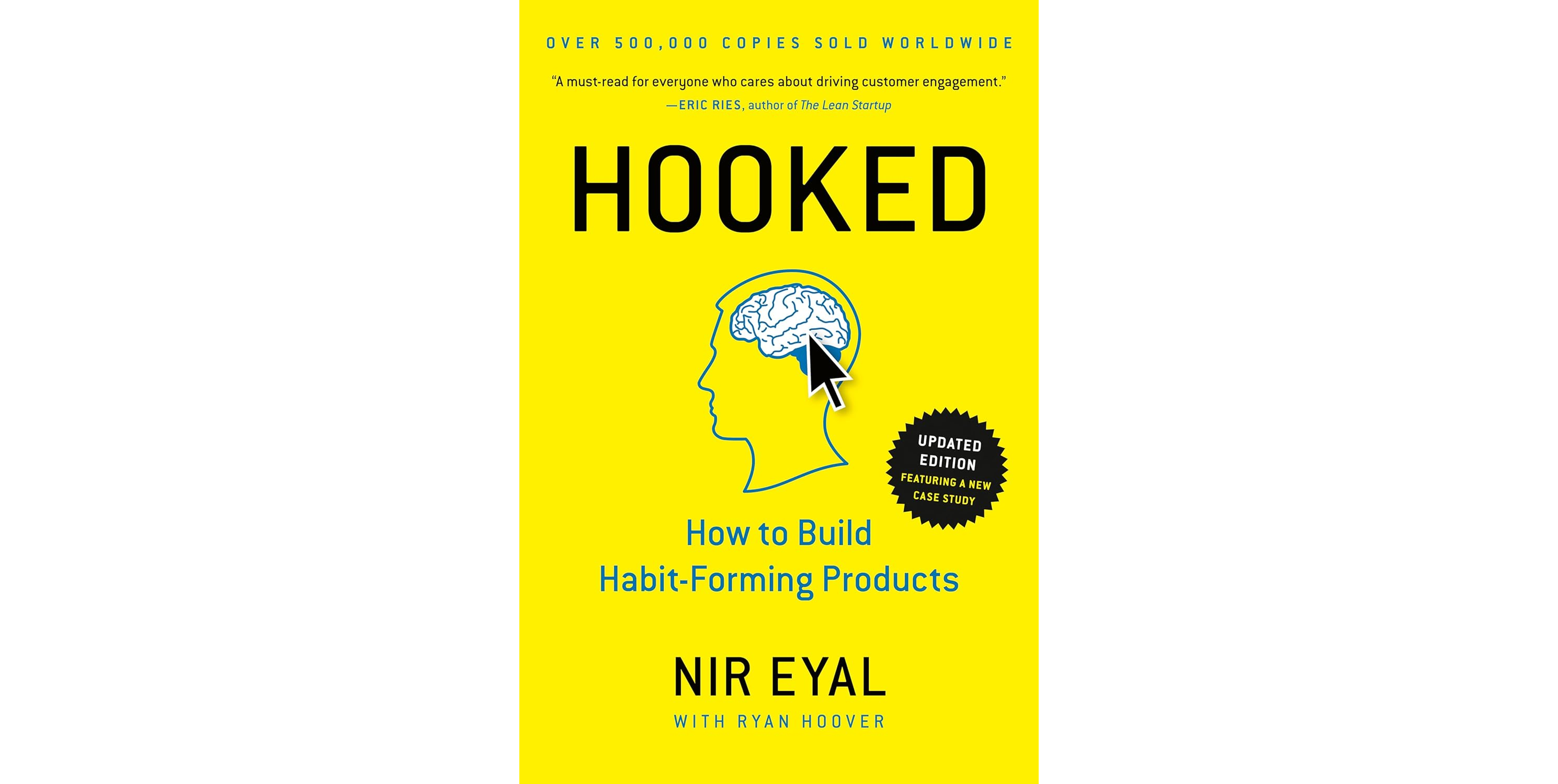
Trigger, Action, Reward, Investment. These four elements spiral upward in a continuous loop, and that's how people get hooked on a product. Every time I revisit this book, I'm struck by how brilliantly the model was constructed. The iPhone, Netflix, Facebook — people say geniuses are controlling human behavior, and this book makes the mechanics visible.
This was my third time reading it since becoming directly involved in product development, and connections that didn't register the first time now jump off the page. The four steps aren't isolated stages — they form a spiral. That bigger picture only clicked once I found myself in the position of designing these systems myself.
📖 Who should read this book
Anyone involved in designing products or services
Anyone struggling with user retention
Anyone fascinated by how habits and human behavior actually work
📕 Get it on Amazon:
Hooked: How to Build Habit-Forming Products
Thoughts
The Hook Model is a genuinely elegant framework. Trigger, Action, Reward, Investment — reducing the phenomenon of "getting hooked on an app" into a four-step cycle that can guide UX design is remarkable. That's my biggest takeaway every time.
Community design is incredibly hard. Applying the model to the product I'm building now, I realize how many forces are at play. There are internal triggers and external triggers. There's the desire for recognition and the desire for connection. Getting that balance right in the design is the real challenge.
Internal vs. external triggers. Internal triggers come from emotions and desires. External triggers are push notifications, emails — stimuli from outside. For community-driven products, the question is: how do you design the trigger that makes someone post? The answer often comes down to crafting the right prompt.
Variable rewards are what keep people coming back. If the experience is too predictable, users learn to anticipate it, and the appeal fades. It's the uncertainty that keeps dopamine flowing. Flip that around, and a product that delivers the same experience every time is a product people will eventually abandon.
The four creator types. Eyal classifies product builders as Facilitators, Peddlers, Entertainers, and Dealers. Which one are you? The underlying message is that habit-forming products should create positive impact rather than harm — and that moral stance is baked into the framework.
Every product starts as a vitamin. Pitch to investors and you'll hear: "That's a vitamin, not a painkiller — users won't stick." But as the book argues, habitual products start as vitamins and evolve into painkillers. Small habits compound until the product becomes essential. For anyone building B2C products, this is a deeply encouraging perspective.
Connections with game design. There's a book by a former Nintendo game designer called The Art of Designing Experiences That Just Make You Do It that maps surprisingly well onto the Hook Model. Humans form hypotheses, and when those hypotheses turn out right, dopamine fires. Move Mario to the right, succeed — that initial win is what starts the loop. Then you layer in variation to prevent boredom. The same logic applies directly to product design.
Book Club Discussion
Should an MVP include the Reward?
From the perspective of building a community product, we debated how much of the Hook Model should be reflected in an MVP. Right now, there's a minimum-viable version: users can post photos and leave comments. But if the Reward layer is missing, and you test with that, all you'll conclude is "this isn't it" — which tells you nothing.
What hypothesis is an MVP supposed to test? If you're testing whether users will take Action in response to a Reward, then without the Reward, you can't even begin. Maybe an MVP only qualifies as one when it can complete a single rotation of the Trigger → Action → Reward → Investment loop. Because the definition of MVP is so broad, you have to decide what you're testing before you build — otherwise you're just spinning your wheels.
The Power of Investment and the IKEA Effect
We spent a lot of time on the Investment phase. When you assemble IKEA furniture yourself, the identical product somehow feels more valuable. LEGO works the same way — you assign more value to what you've built than anyone else would. That gap is stickiness.
A great example came up: a company selling pancake mix — just add water and cook — couldn't move product. Then they added one step: crack an egg into the mix. Sales took off. The end result is essentially the same, but the act of contributing something, and the attachment that comes with it, makes all the difference.
So total automation isn't always the answer. Sometimes leaving a little friction is a strategic choice. Dispo, the camera app that wouldn't show your photos until 9 AM the next day, is another example. It's objectively inconvenient, but that inconvenience wraps itself in emotion and perceived value.
When Habits Break
The Hook Model hums when a product is growing. But every product eventually dies. So we asked: what patterns cause the loop to collapse?
A few emerged. Product-driven failure: a bad update, a design change that alienates users. People-driven failure: a life stage shift that makes the habit irrelevant, or the product simply can't deliver more value. RIZAP (a Japanese fitness chain) can build short-term habits, but the moment someone quits, the hook comes undone.
At the root of it all is habituation and boredom. The initial wonder fades with time. If something fresh comes along, curiosity reignites — but without it, users drift away. That's exactly how new startups chip away at incumbents, and generational turnover happens.
Dopamine and the Mechanics of Uncertain Rewards
The monkey experiment sparked a lively discussion. When pressing a button always produces a banana, the monkey eventually loses interest. But make the banana appear intermittently, and dopamine spikes — the monkey presses endlessly. This is the exact mechanism behind gambling: alternating dopamine and noradrenaline creates dependence.
Sequence matters. You need the success experience first. The monkey has to know bananas come from the button. Only after that foundation is laid does intermittent uncertainty create the hook. If it's stress from the start, no one engages. Translated to product design: first, make sure the user wins. Then layer in deliberate uncertainty.
Someone brought up mobile game ads that show gameplay that looks easy but deliberately fails. "I could do that" — and the trigger fires. The deeper you go into understanding human behavior and designing around it, the more you realize how much depth there is.
Glasp's Own Hook Model
Applying the framework to our own product, there's a virtuous loop: the more you highlight, the more your personal knowledge base grows. The longer you use it, the harder it is to leave. That's a cycle you can design for intentionally.
Looking at the data, users who highlight 30+ passages across 5+ pages tend to come back a year later. How to get users to that magic number is the key retention question. Sending a weekly summary newsletter, surfacing highlights from people you follow — these work as external triggers. If users develop the habit of searching their own page to find information, the motivation to highlight more follows naturally. How to spin up that virtuous cycle is the ongoing challenge.
📕 Get it on Amazon:
Hooked: How to Build Habit-Forming Products
Quotes
What grabs the mind first wins.
Habit-forming products start as "nice-to-haves" (vitamins) and become "must-haves" (painkillers).
For new entrants to stand a chance, it's not enough to be better — you have to be nine times better than what's already there.
Habits aren't created — they're built up, layer by layer.
Buy on Amazon | Try Audible Free
💡 Save and export your book highlights with Glasp!
The quotes in this article were exported using Glasp. If you're interested in exporting your Kindle highlights, check out this guide:
How to Export Kindle Highlights — Notion, Obsidian, AI Integration & More
Recommended reads if you enjoyed this book
▶ Where Does the Essence of Play Live? | Roger Caillois' Man, Play, and Games Review