The Real Answer to "Why Do People Buy Things" | Clayton Christensen's "Competing Against Luck" (Jobs to Be Done)

Feb 24, 2026
7 min read
1 views
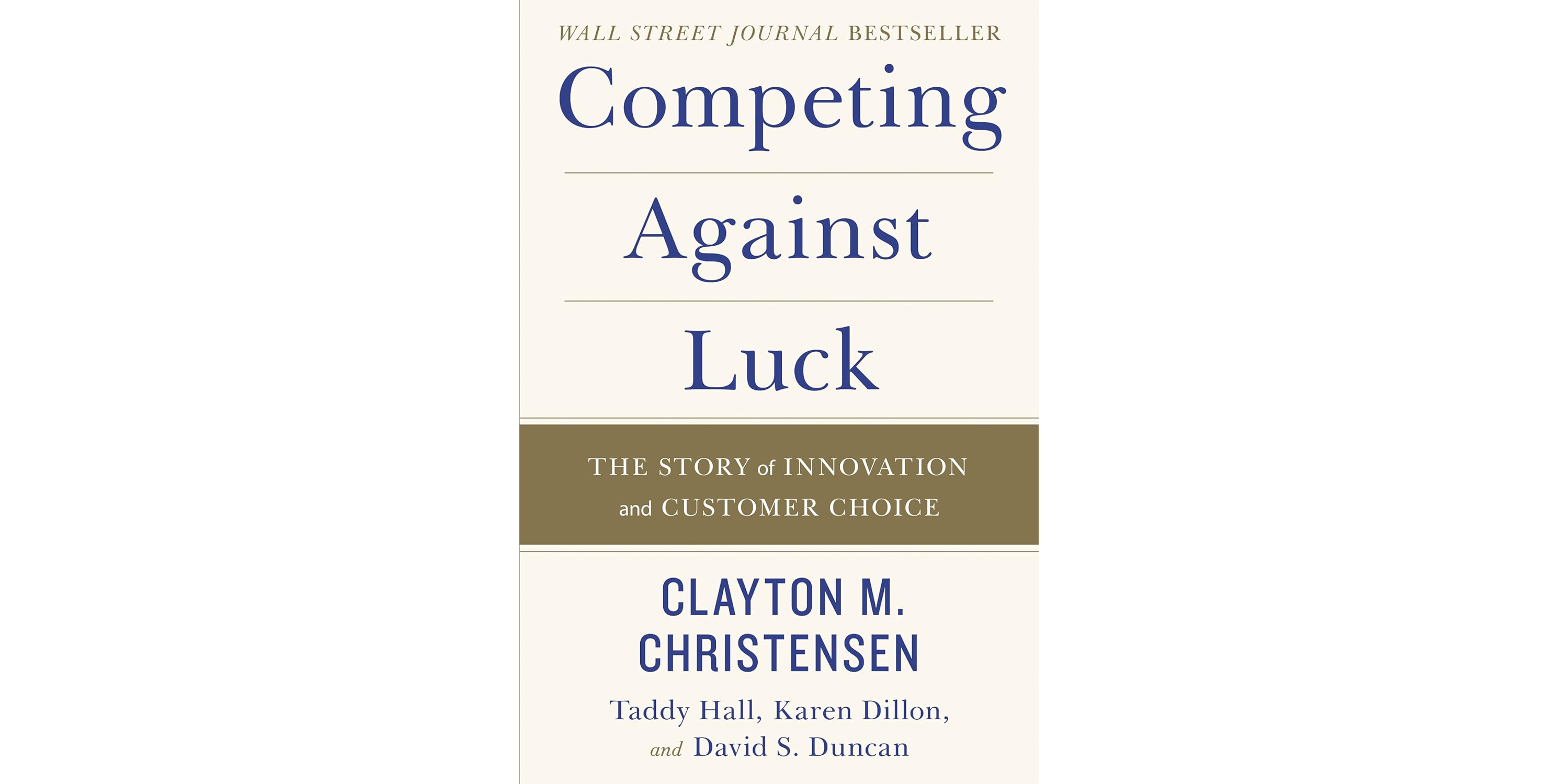
Customers don't "buy" products. They "hire" them. The progress a person is trying to make in a particular circumstance is what Christensen calls a "Job to Be Done." It's not just about function — it includes social and emotional dimensions too. Understanding the full context and causal chain of why someone reaches for a specific product is everything.
That the same mind gave the world both The Innovator's Dilemma and Jobs Theory is remarkable. Christensen passed away in January 2020, but what this book articulates remains one of the most essential perspectives for anyone involved in building products.
📖 Who should read this book:
Anyone involved in product development
Anyone who wants to understand the essence of marketing
Anyone who wants to conduct better user interviews
📕 Get it on Amazon:
Reflections
The biggest takeaway from this book is the importance of understanding context, causality, and workflow. Beyond just features, you need to grasp the full flow — including social and emotional factors — of how someone arrives at a need and what they choose to fulfill it. Jobs are what fill the "I wish I had something for this" feeling that arises within that flow.
The milkshake example is iconic. Long-distance commuters who don't want to get their hands dirty in the car, want to fill a small hunger, want something to wake them up, and want to sip slowly through a thin straw. It doesn't have to be a milkshake — a green smoothie would work just as well. The customer doesn't care about the category. They care about getting the job done. That reframing is the entire point of this book.
The insight about data was equally striking. The book argues that even financial statements aren't truly objective. A person who is 6'7" with size 14 shoes — but that data doesn't explain why they use any particular product. For anyone whose job involves data analysis, this is a fundamentally unsettling challenge to the meaning of what they do.
So many other books connect to this one. Competitive Strategy as Story (Kusunoki Ken), BJ Fogg's Behavior Model (Motivation × Ability × Trigger), N1 marketing analysis, and Peter Thiel's "hidden truth" from Zero to One — which might actually be describing a Job to Be Done by another name.
The discussion of switching costs hit close to home. To overcome loss aversion, the gain needs to be roughly twice the perceived loss. The motivation to change plus the product's appeal must break through the inertia of ingrained habits and the fear of change. Asking yourself whether your product delivers enough value to trigger that switch is enough to make you want to cry.
The QuickBooks story was fascinating. They sold a product with half the features at twice the price of competitors — and won. When you truly align with the job, you don't need to add more features. Reducing features is incredibly hard to do, but there's an optimal amount and presentation for each job. Users pay for certainty. That idea resonates deeply.
Building products is genuinely hard. Reading about the blood, sweat, and countless debates that led to these insights — it was almost enough to bring me to tears.
What We Discussed in Our Book Club
The Hidden Insights Behind Airbnb and Uber
There are insights that only founders can see. Airbnb is the perfect example. Rationally, no one wants to sleep in a stranger's house. But trace the context: travelers want authentic local experiences, they want to know how locals actually live, and they can save money compared to hotels. The need isn't yet visible on the surface, but follow the contextual thread and you arrive at it.
Uber is the same story. Initially, everyone thought, "Is it safe to get in a stranger's car? What if they take me somewhere dangerous?" Now the perception has flipped — taxis feel more dangerous. Overcharging, no rating system. The deepest insights hide inside things that seem counterintuitive at first glance. Services that make people say "won't this cause incidents?" sometimes break through by just persisting — and by relentlessly ensuring safety along the way.
Airbnb matches travelers who want local recommendations with hosts who want to rent out their homes. Uber matches people who need to move with people whose cars are sitting idle. Both sides of the job align perfectly.
American Girl: Emotional and Social Value
The American Girl doll brand was a memorable example. Every competitor makes similar dolls, yet none can dislodge the brand. It's not about features or appearance — it's about emotional and social connection. Grandma had one. Mom had one. So you buy one for your daughter. That's deeply emotional, and no amount of feature-copying can overcome it.
Once a brand establishes itself on the emotional dimension, no second or third entrant can break through. It's the same reason you can't just build another Facebook after Facebook has taken that position. The essence of branding is that the number-one brand in someone's mind carries network effects. Ridesharing means Uber. Search means Google. Getting into the customer's mental "consideration set" is the first act of branding.
The Mattress Interview Technique
The mattress user interview described in the book was extraordinary. Ask someone "What's bothering you?" and they don't know. But fill in the surrounding context — "What do you normally do?" "If this product didn't exist, how would you solve the problem?" — and suddenly the real insight surfaces.
"How long have you been thinking about this?" "Did your wife say anything?" "They said it would last 10 years but it gave out in two." The decision to buy wasn't impulsive — there was a long buildup. For large purchases, switching costs are so high that people only act when they're truly desperate. The length of that backstory is what makes it fascinating.
The Waitlist Paradox
You sign up for a new product's waitlist, but access comes two months later. By then: "Something arrived... what was this product again?" The moment you click "join waitlist" is when your excitement is at its absolute peak. If they just let you install and create an account right then, you'd be hooked. Instead, they waste the best possible moment.
More than two weeks and the experience fades into vague disappointment. Some people forget by the next day. The access email gets flagged as spam. Unless there's an extraordinary reason, the consensus was: don't use waitlists.
There is something to be said for the forgetting curve approach — brands that email you just when you've forgotten them do stick in memory. And data shows that prospective students for online courses tend to choose whichever university responds first to their inquiry. Busy people want to decide quickly, and they go with whoever they understand first.
The Consulting Paradox and Jobs Theory
One member who works at a consulting firm said reading this book shook the foundation of what he does for a living. That was a fascinating moment.
Consultants know many frameworks, so they apply them. But Jobs Theory says every human being is different, and the moment you force-fit a framework, you're missing something. There's a common critique that ex-consultants who become PMs "view markets through accounting frameworks and miss user insights." That's exactly this problem.
Then there's the social dimension: consulting works partly because of its social status. If a member of a criminal organization produced the exact same report, no one would trust it — even if the content were identical. It's social reassurance, not just content quality. Clients often use consulting firms as ammunition to get buy-in internally. In that sense, the client's real job might be "I need to get this past the board," not "I need the best strategy." That itself is a job.
Abstraction vs. Specificity in Product-Job Fit
The book says jobs need a certain level of abstraction, but they also need a certain level of specificity. Even if Notion aims for "everything in one place," it still needs to carve out specific use cases to be memorable. The balance between abstraction and specificity — and whether it matches the product — is where the real difficulty lies. That boundary is hard to articulate, but it's exactly where value is created.
When no alternative exists, or the alternatives are deeply lacking, even a high level of abstraction can satisfy the job. It depends on where you sit within the market landscape.
📕 Get it on Amazon:
Quotes
"We call the progress that a person is trying to make in a particular circumstance a 'Job to Be Done.' A job arises in day-to-day life, and context plays a critical role."
"People don't want a quarter-inch drill. They want a quarter-inch hole."
"But that data doesn't cause anyone to use anything."
💡 Save and export your book highlights with Glasp!
The quotes in this article were exported using Glasp. If you're interested in exporting your Kindle highlights, check out this guide:
How to Export Kindle Highlights — Notion, Obsidian, AI Integration & More
📚 See what other readers highlighted in this book: