Hatching Growth #1: How We Found and Acquired Our First 1,000 Users

Aug 25, 2025
5 min read
138 views
* This post was originally published in the Glasp Newsletter.
Glasp’s note: This is Hatching Growth, a series of articles about how Glasp organically reached millions of users. We've tried more than hundreds of growth hacks and tactics. In this series, we’ll highlight some that worked and some that didn’t, and the lessons we learned along the way. If you have questions about any specific growth hack or tactic, feel free to leave a comment. While we prefer not to use the term "user," please note that we’ll use it here for convenience 🙇♂️
If you want to reread or highlight this newsletter, save it to Glasp.
Why Share This Now?
Although Glasp's mission is to democratize access to other people’s learning and experiences that they have collected throughout their lives as a utilitarian legacy, we realized we’ve rarely shared our own growth story in writing. We've conducted hundreds of growth experiments, but until now, there hasn’t been a single place to document and reflect on those learnings. That’s what Hatching Growth is all about.
MVP to Early Adoption: Where It All Began
Glasp’s first MVP came together around October 2020, and by mid-2021, we had a rough product ready for external feedback. At that point, our users were mostly friends of the founders, with roughly 100 signups, though active usage was uncertain.
We officially began onboarding potential users beyond our network around October 2021. This marked the true beginning of our push to grow from 100 to 1,000 users.
Step 1: Define (and Discover) Who Uses Glasp
From day one, we didn’t know who would use Glasp. Glasp was born from our own needs as founders, people who love learning, highlighting articles, and organizing knowledge. So, we started with people like us.
Our founders had backgrounds in product management and development, which meant we often consumed a lot of content on product management, product strategy, UX, and engineering. We used Glasp heavily to highlight these types of articles.
This gave us a simple idea: share our Glasp profiles, filtered by categories like Product Management, with aspiring PMs or tech professionals. It was a useful, real-world collection of curated content, and it resonated.
Step 2: Manual Outreach in Communities
We began actively reaching out to potential users, especially within US-based product management communities on platforms like Slack, LinkedIn, and various forums.
We shared:
Curated lists of useful PM articles on our Glasp profiles — friendly, genuinely valuable content, personalized to avoid coming across as spam
Post or messages via DM, inviting people to check them out
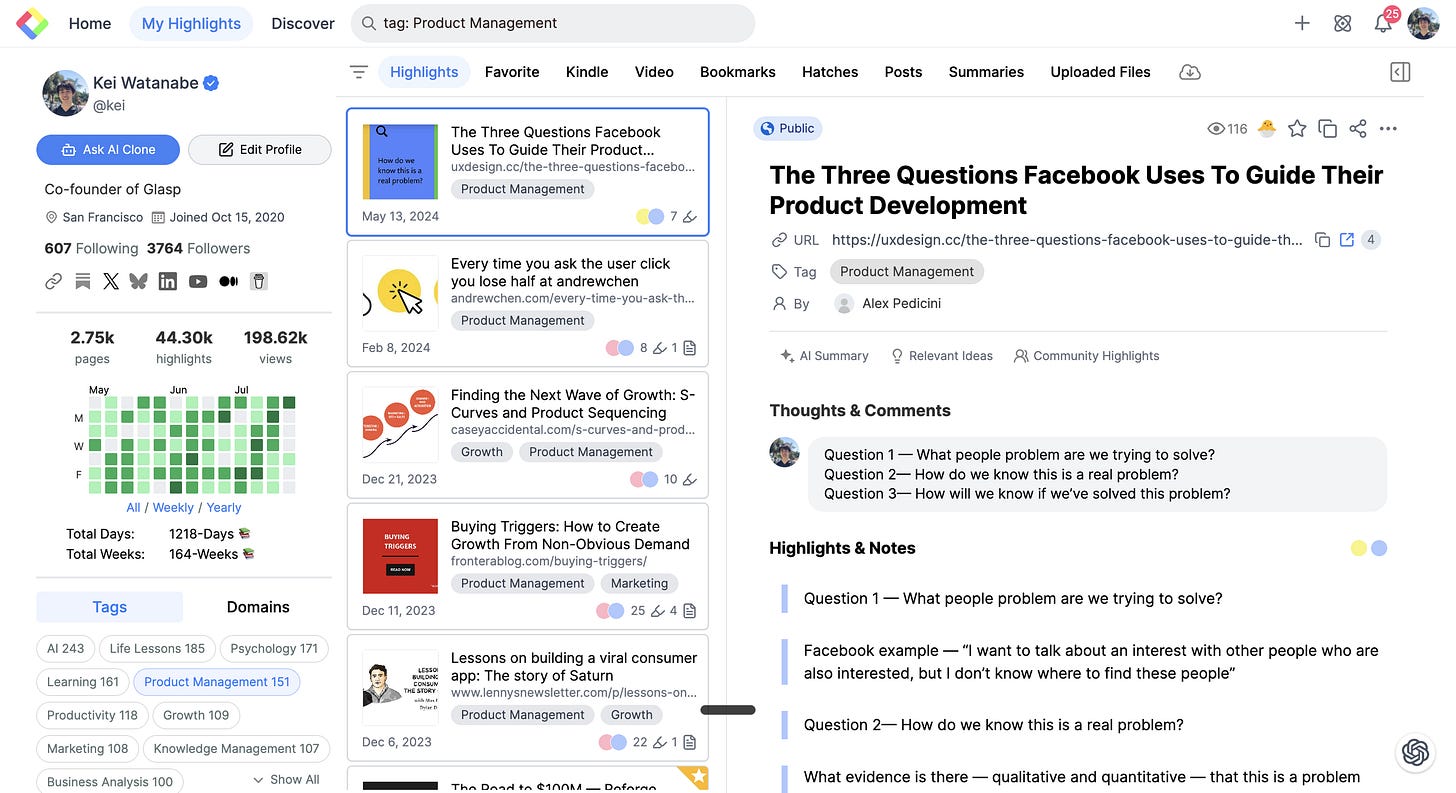
(The UI is different from previous versions, but the key point is that the recipient of the link can still view a curated list of product management articles.)
This manual outreach was time-consuming but effective. We also targeted people who followed tools like Notion, Obsidian, Evernote, and Roam Research — tools that had natural synergy with Glasp.
Step 3: Strategic Targeting via Twitter and DM
We searched for users who followed or engaged with adjacent tools and reached out with personalized messages. A real example is below:
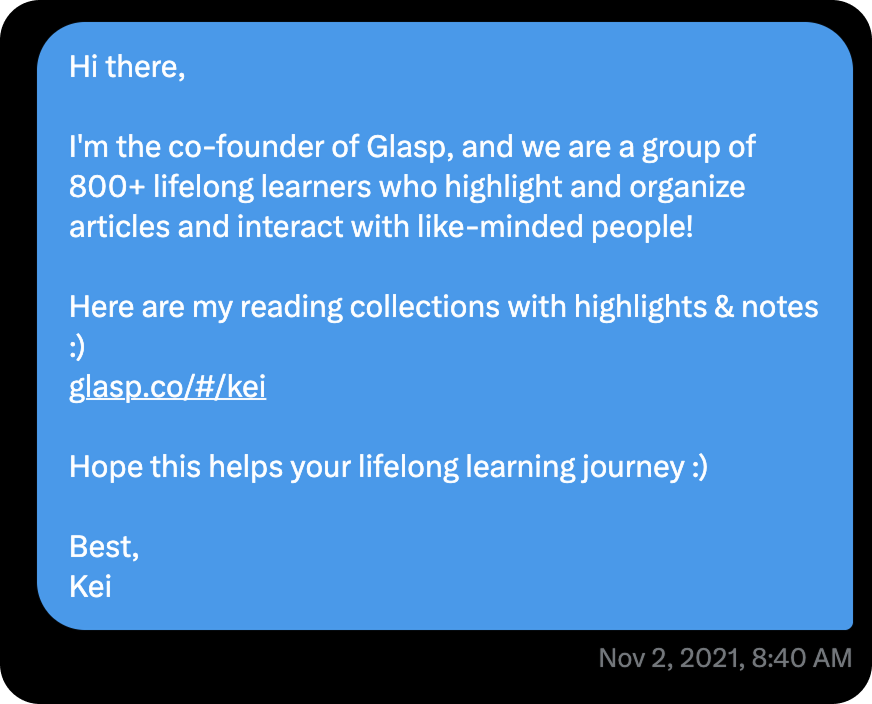
These messages included links to Glasp highlight pages or specific use cases, which helped capture interest.
Step 4: The Waitlist Funnel with a Twist
Once someone expressed interest, we asked them to join a waitlist and input basic info like location, profession, and intended use. This helped us better understand our early audience.
We used a clever trick:
While our website appeared to require waitlist access to sign up,
Our Chrome extension allowed users to sign up directly (we couldn’t fully block this path).
We deliberately avoided building a whole new feature just to restrict access, since we believed that would be a waste of engineering effort. Instead, we used a UI trick, simply making it look like access was limited.
To create exclusivity, we gave interested users a special onboarding URL: glasp.co/secret_signup
This small detail added perceived value and encouraged engagement.
Step 5: 1:1 Zoom Onboarding with Founders
Here’s where it got intense:
Nearly 800 onboarding Zoom calls were conducted by our two co-founders
Each user who joined the waitlist received a calendar link to book a call
During the calls, we:
Shared the mission and founding story of Glasp
Walked them through the onboarding process live
Asked them to screen share so we could observe real usage behavior
This provided immense product insight. Through live screen sharing, we could directly see where users got stuck or confused, which helped us improve onboarding. We also observed what kind of knowledge management (KM) tools they used, how many browser tabs they typically had open, and even how cluttered or organized their bookmarks and toolbars were — all of which offered valuable clues into their behavior and workflows.
Lessons from the First 1,000
Manual onboarding was time-consuming but allowed us to iterate fast.
Many users churned due to bugs or limited features, but...
Some still use Glasp today, and others became vocal champions.
Interestingly, some early users never became active, but they remembered the mission and story. A few continue to send us SEO tips, product ideas, and founder intros for years. We truly appreciate your help 🤝
Beyond the First 1,000: Scaling Our Thinking
After reaching our first 1,000 users through manual work, we had a key realization: this kind of approach, especially DM outreach, only scales linearly. The output is directly proportional to the effort invested, meaning the only ways to grow are to either add more people or make the process more efficient.
We saw this as a turning point. To grow sustainably, we needed to shift our mindset from manual tactics to scalable systems. That meant building products, tools, or assets that could operate on our behalf, continuing to deliver value even when we weren’t actively involved.
This mindset shift informed many of our later decisions and became a foundation for building scalable, compounding growth mechanisms within Glasp.
Summary
Getting to 1,000 users took about three months of focused, manual work:
Targeted outreach in online communities
Sharing curated content based on user personas
DMing potential users in adjacent tool ecosystems
Creating exclusivity with a waitlist and secret signup link
Doing hundreds of live onboarding calls to understand behavior and improve UX
Recognizing the limitations of manual growth efforts and shifting toward scalable systems and product-led growth
If you’re early in your startup journey, we hope this story helps. If you have any questions or want to know more about a specific tactic, leave a comment — we’d love to hear from you.
Stay tuned for the next part of Hatching Growth, where we’ll dive into the next stage of Glasp’s journey beyond 1,000 users and explore other growth hacks we’ve tested along the way.
Partner with Glasp
We currently offer newsletter sponsorships. If you have a product, event, or service you’d like to share with our community of learning enthusiasts, sponsor an edition of our newsletter to reach engaged readers.