Chris Yeh: Blitzscaling in the AI Era – How AI Reshapes Growth and Learning | Glasp Talk #63

Jan 27, 2026
43 min read
76 views
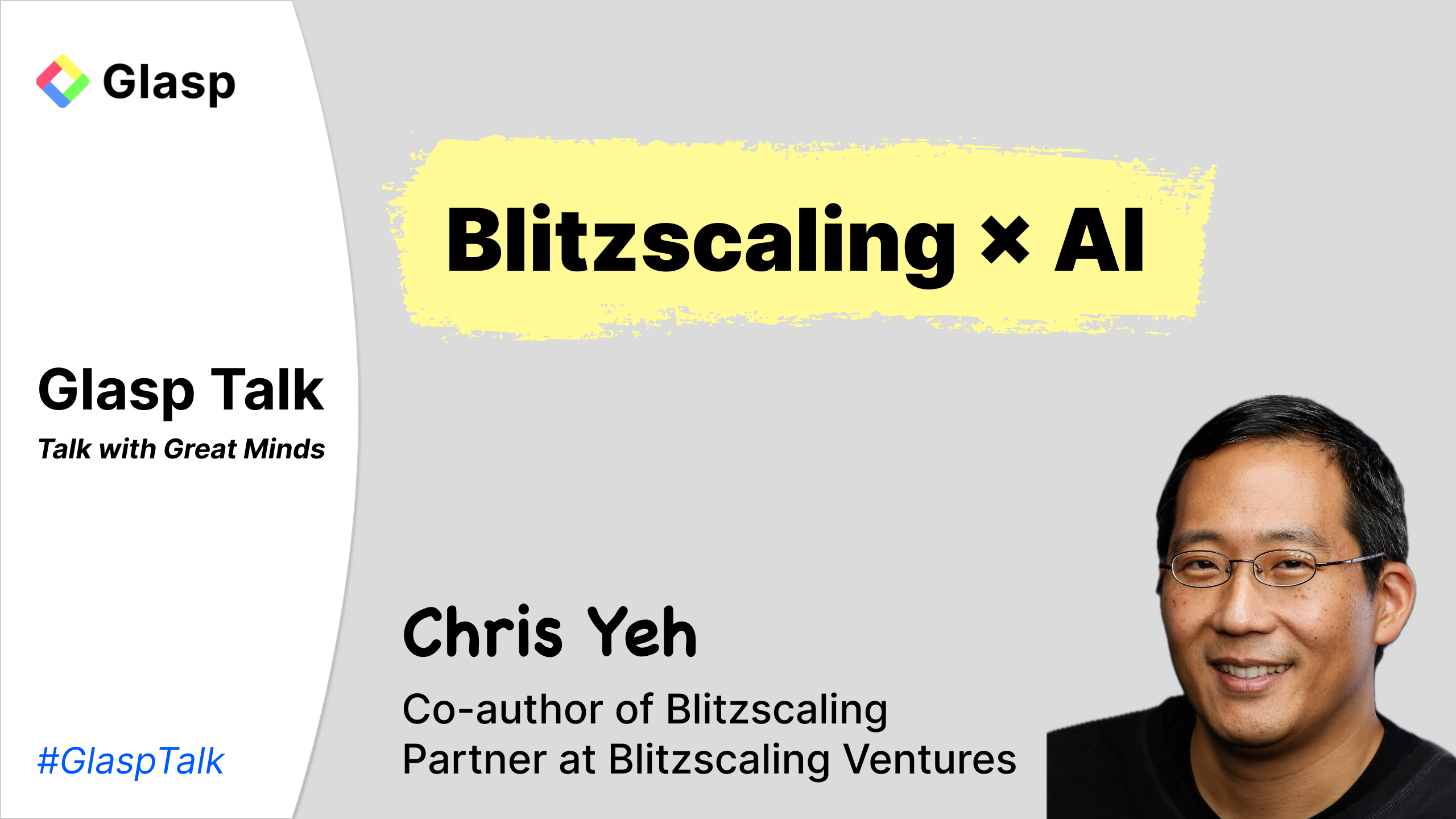
Why AI Is the Biggest Wave in Startup History — and What It Changes About Scale and Moats
In the 63rd episode of Glasp Talk, we sit down with Chris Yeh, entrepreneur, investor, and co-author of the bestselling book Blitzscaling with Reid Hoffman. Chris is a founding partner at Blitzscaling Ventures, teaches entrepreneurship at Stanford University, and shares key lessons from his 15-year collaboration with Reid Hoffman.
Watch the full episode on YouTube
Watch now on YouTube, Apple, and Spotify.
We talked:
(1:39) - How does the AI wave compare to past tech revolutions like the internet or mobile?
(5:36) - How has AI changed blitzscaling and startup growth economics?
(12:10) - If everyone uses similar AI agents, what becomes a startup’s moat?
(18:30) - As an investor, what signals suggest a breakout company?
(21:22) - What is the difference between buying AI and adopting AI?
(26:44) - What patterns are emerging in AI product UX?
(31:29) - How can people develop an infinite learning mindset in the AI era?
(40:15) - If starting today, how would you learn AI and plan your career?
(45:21) - What did you learn from working with Reid Hoffman?
(51:04) - What legacy or impact do you want to leave?
Get a quick overview & summary
✨ Want a concise summary before diving in? Install the YouTube Summary with ChatGPT extension by Glasp for instant video summaries!

Highlights
AI as the Largest Technological Shift and Capability Amplifier Chris Yeh describes AI as the most powerful technological wave of his lifetime, exceeding the internet in impact. While the internet connected people and moved activities online, AI fundamentally expands what humans and organizations are capable of doing. From creative work to industrial processes, AI enables entirely new forms of productivity, and we are still only at the very beginning of this transformation.
Blitzscaling Reimagined Through AI and Smaller Teams AI reshapes the foundations of blitzscaling by dramatically increasing individual productivity. With AI agents supporting each person, companies can grow further with far fewer employees, reducing organizational friction and allowing them to stay nimble longer. While the idea of a single person running a billion-dollar company may be overstated, the shift toward much smaller high-impact teams is already happening.
Context, Adoption, and the Human Edge in the AI Era Chris argues that AI models will not provide lasting differentiation as technical advantages erode quickly. Instead, enduring moats come from context understanding customers’ workflows, unstructured data, and real-world decision-making. He warns that many enterprises mistake buying AI for adopting it, falling into pilot purgatory where tools are never truly used. Success requires staying close to real usage while cultivating an infinite learning mindset where creativity, judgment, and human connection grow more valuable.
Transcripts of YouTube
Chris: It's really the biggest wave that I've seen in my lifetime. And I think that's because of the way it has so much impact on almost every possible business and almost every possible life. The potential for AI to just dramatically change the way we do everything is enormous. And we're still at the very beginning of it. We barely even scratched the surface.
Glasp: Hi, everyone. Welcome back to another episode of Glasp Talk. Today, we are so excited to welcome Chris Yeh. Chris is an entrepreneur, investor, and author with deep experience in Silicon Valley startups. He is the co-author of the best-selling book, Blitzscaling, with Reid Hoffman, sharing how companies grow fast in competitive markets. Chris is also a founding partner at Blitzscaling Ventures and teaches entrepreneurship at Stanford University. Today, we will talk about his journey and his views on scaling companies and the impact of AI. Thank you for joining us today, Chris.
Chris: My pleasure. It's great to be here. Thank you.
Glasp: So first of all, let's talk about AI because it's eating the world. And its impact on businesses and startups is massive and huge. So I think you've been involved in startups since the mid-1990s and have witnessed multiple tech revolutions. And how does this current AI wave compare to earlier eras, like the rise of the internet or mobile? What stands out to you about AI? Could you share about this?
Chris: Absolutely. It's really the biggest wave that I've seen in my lifetime. And I think that's because of the way it has so much impact on almost every possible business and almost every possible life. Now, the internet absolutely was transformative as well. I think it's almost difficult for people who are young to remember that there's a period in time when we weren't all connected together, when it wasn't possible to see what was going on. People literally would spend their entire lives and never actually communicate with people unless they physically saw them face-to-face. So the internet was certainly big. But the reason why AI is potentially even bigger is because of the huge impact it has on the daily activities that we have. So the internet made it possible for us to do things online. AI makes it possible for us to do things that we couldn't do before. Whether it is writing books more quickly, whether it is transforming the way we manufacture things by having AI control robots, or what have you, the potential for AI to just dramatically change the way we do everything is enormous. And we're still at the very beginning of it. We barely even scratched the surface.
Glasp: Yeah. And I can't even imagine living without AI now. I use ChatGPT or Claude for coding and Japanese sometimes. But do you use any AI tools for your daily work or life?
Chris: So I do. I use ChatGPT and Gemini. I also play around with tools like Perplexity and a few other things. I am not using as many as most developers because I don't develop software. And so I'm not using Claude Code or Codex or anything like that right now. Although I do try to follow the developments. Nonetheless, it is 100% something that gets used on a daily basis. For example, just the other day, just two days ago, as a matter of fact, I was working with my editor. And we were working on coming up with book covers for a couple of books that we're going to be publishing. They're going to be self-published books. But obviously, we want good covers for them. And the ability to generate those covers in AI, to work back and forth quickly on them, and refine them, it's quite remarkable. In this case, we were using ChatGPT, but we were also using Canva. They have a fascinating tool. Actually, I'm not even sure if it was Canva. It might have been something else. There was a tool that my editor showed me called FlowState, which just generates images continuously. So you have a prompt, and it just keeps generating images. And you just go through until you spot one that you like. And that's the sort of thing that never could have been done before. It's remarkable.
Glasp: Yeah. And before this interview, you talked about publishing a new book next year, or in 2027. Could you share a little bit about the new book that you're working on, if you can share?
Chris: Yes. Absolutely. So, of course, everyone is very familiar with Blitzscaling, which is a best-selling book, and has been very influential since it came out in 2018. And what Reid and I are working on this year, and probably publishing next year, is a sequel to Blitzscaling. It'll be called Blitzscaling and AI. It'll be focused on how AI has changed Blitzscaling, how Blitzscaling has enabled AI, and how people can Blitzscale the AI companies of the future.
Glasp: Wow. That's the question we exactly wanted to ask next.
Chris: Everyone wants to ask about it, which is why we're going to write the book.
Glasp: Could you share a little bit about how AI changed the idea of Blitzscaling? I remember the book has been... It's been seven years, right? Over seven years since you published it.
Chris: That's right, a little over seven years. So there are so many things that are true. First of all, AI is a technological revolution, and that always produces Blitzscaling, because it creates new markets and new market opportunities. The second thing about AI is that it is also changing the way we Blitzscale by enabling individual people to do so much more. I see smaller teams than ever before. Not just me, a lot of people have commented on this. Smaller teams can accomplish more. They can get further than ever before before they need to raise money or hire new people. So this helps address one of the things that tends to limit Blitzscaling, which is the organizational scalability of a company. There's only so fast that you can hire human beings. It takes a while to find the right people, bring them on board, train them, and get them up to speed. But in a world where you can instead accomplish things with an army of AI agents, all of a sudden, your growth can be even faster than before. And we've seen this in the AI-native companies growing at these tremendous rates.
Glasp: I see, yeah. And in the Blitzscaling book, you were writing about the concept of company scale, starting from family, tribe, society, and nation. In the AI era, how does it change? Also, there is a concept talking about a solopreneur unicorn. Do you think it's going to be ideal or doable in the future?
Chris: Excellent question. So a couple of things. First of all, as you mentioned, in Blitzscaling, we talk about levels of organizational scale. And it goes by orders of magnitude from family to tribe to village to city to nation. And what is true is that as organizations grow through those sizes, they are going to experience the same things that we saw before. Because fundamentally, if an organization has 1,000 human beings working, and if there are certain ways in which they're going to work together, it's just based on the way humans seem to relate. And those things don't really change that much. However, what is different is what you're referring to, which is if each human being is supported by a team of 30 AI agents, even if those AI agents aren't as fully productive as a human being, maybe they're only one-third as productive, each person is effectively doing the work of 10 people. And so companies can grow, and they can grow with much smaller staffs than before. So imagine if, like before, it would have taken 100 people. Now you can do it with 10. And that has a tremendous difference because it allows you to stay informal. It allows you to stay smaller and nimbler longer. And I think it is to the benefit of companies to stay smaller and nimbler longer. Now I do think that saying that three people are going to be able to run a billion-dollar company, or even one person, as Sam Altman and other folks say, I think that's a bit much. I think that if they do that, it'll be by outsourcing a lot of those functions to other companies where there are human beings working. So it's kind of cheating when it comes to getting that one person, one billion-dollar company. But I think it's quite possible that in the past, it would have taken 100 or 1,000 people to get to a billion-dollar company. Maybe instead it takes one-tenth as many. Maybe it takes 10,000 people, and that's 1,000. A 1,000-person company, maybe it's 100. A 100-person company, maybe it's 10. I think a team of 10 can do tremendous things.
Glasp: I see. Yeah, totally. Yeah, and so we are talking about maybe a solopreneur can make a unicorn, but still, there will be unicorns without people in the future.
Chris: And that may very well happen at some point in time, because what will occur is, again, you'll be able to, with a world where so many inputs and outputs are mediated by AI agents and APIs, maybe MCP servers, what have you, you'll be able to create certain kinds of businesses. I started my career in the hedge fund industry at DE Shaw, which is a quantitative hedge fund. If you're building out a quantitative trading platform, you may very well be able to do that without any human beings.
Glasp: Totally. Yeah, thanks much. And I was curious about the concept of blitzscaling. So, because blitzscaling ultimately relies on the assumption that in the software business, marginal cost trends towards zero, and the scale's advantage improves unit economics. So given that, in today's AI era, user growth often drives cost to increase linearly. So, do you think blitzscaling should still be applied?
Chris: So I do think that what we are going to see is a classic pattern that we see throughout all sorts of software and computerization, which is that right now we're seeing a lot of costs to AI because everyone is focused on improving capability. And the race is to improve capability as quickly as possible, regardless of cost. The fact is that the cost of serving like a previous generation model just plummets thanks to the continued drive towards ever more powerful chips. And ever more Moore's law still seems to apply at this point, although Jensen's law is also applying. So if people needed to find a way to make AI more cost-effective, they easily could. They could use smaller models. They could find all sorts of ways to drive that cost down. The fact is, nobody cares right now. That's why the costs are rising. And I think that in the realm of blitzscaling, the point is that over time, it absolutely will be the case that the cost to serve will decline. And that will give us those high margins that we look for.
Glasp: I see. Yeah. It makes sense to invest in AI.
Chris: Absolutely. Because if you don't invest in AI, what exactly are you going to invest in?
Glasp: Right. But as you mentioned, I think in the future, many startups or individual solopreneurs are using an AI agent to do business and to help their business. But in that sense, what can be the new moat? How can a startup differentiate from other startups? Because if everyone use same AI agent and they could do the same thing, right?
Chris: True. Although everyone can use employees, and they do the same thing as well, right? We shouldn't distinguish. Every company could theoretically hire human employees. Well, they're all the same, aren't they? But they're not. So I think that what will be true is that we believe very strongly that the technology moat is not going to last. Even if somebody has the best model today, maybe another model comes out two weeks from now that's better. There's going to be a lot of switching back and forth. And so what we think people need to do is they need to develop other moats. So there are classic moats like the data moat, or I prefer to call it a context moat, right? The data moat, people really talk about data. I'm like, no, it's not really data. Data is just the means to an end. The end is context, understanding the context that allows you to drive greater value. And if you have a context moat and you build up that context moat, you are the only one who's collecting that cutting-edge data that will allow you to really understand the context. That's one of the ways you're going to have a moat. There are also traditional ways, like having a network effect, where the more people who are using a platform, the more valuable that platform is. It doesn't matter whether you are serving that platform with AI agents or human employees. At the end of the day, if that platform becomes more valuable, then people are going to use it. If we think about companies like, for example, an Airbnb, if you have an agent going on to Airbnb to find the Airbnb for you, but you still purchase the Airbnb, what difference does it make? In fact, you might be more willing to use Airbnb because you'll be able to find exactly what you're looking for quickly.
Glasp: I see. But how do you find a context moat then? So yeah, because AI is changing, whether it's a product that is differentiated, then every two weeks, new product launches. How do you keep?
Chris: Well, the context moat is the business context. So, thinking about your business, most of the knowledge about businesses is not in any structured form right now, and it's not easily accessible. Obviously, we've gotten used to AI firms pre-training on the contents of the internet, but all the business context has never existed there. It exists within the walls of the enterprise and even more so within the walls of small businesses. So if you are able to go out and build a product and an organization where you can go into these places where there's all this dark data and actually transform it into useful context, then that's where the value is going to come from. I often tell people, listen, the same AI, the thing that distinguishes the different AI from each other is not going to be which model it is. It's going to be how well you understand the context and how well you can apply, because of that context, AI to real business problems to create value. And so if you understand the context of your customers, of the companies that you serve, and you will add to that context by gathering data from the interactions, from what you're doing to serve them, then you can absolutely still build them out that way.
Glasp: But in that sense, I mean, regarding the data moat and context moat, and eventually, like big companies like Google and Microsoft win, because they have so much data.
Chris: Do they? So let me ask you this question. They have a lot of data. You know, Google has always had a lot of data. Microsoft has a lot now. This is one of the benefits of moving to the cloud, right? Your customers' data is on your servers, as opposed to before, when Microsoft had the data on the computers themselves, a little harder to access. Nonetheless, do they really have access to all the data? Well, it's difficult because they do not have that. Nobody is so standardized that there's just one platform that they use, and where all the data is on that platform. Google may come the closest because of Gmail and Google Drive. But even then, you know, you have on a daily basis, I'm going to use email, I'm going to use Slack, I'm going to use text messaging, I'm going to use WhatsApp, I'm going to use all these different things, which are all run by different companies. And the context only comes together in the company itself, or in the individual itself, not at the level of those current vendors. It's also the case that whenever there is a new technology revolution, they always say, well, the incumbent players are going to win. And the fact is, this is not true, right? This has happened many times in the past. IBM, once upon a time, was a technology company. In fact, the saying was that the industry was IBM and the seven dwarves because IBM was so dominant. And there were seven other companies like Burroughs and NCR and other places like that, that nobody really cares about. And did that persist? Did IBM remain the dominant player? Is IBM the leader in AI today? No, not at all. In fact, IBM was then replaced in people's minds with companies like Microsoft. And by the time I was active in the mid to late 1990s, people were like, oh my God, Microsoft will just dominate. Microsoft will just do everything. Why would you bother building a web browser? Why would you bother building a search engine? Everyone's just going to use Microsoft. That wasn't true either. And then we get to another era, and people are like, oh, well, everyone's just going to use Google forever or Facebook forever. The fact is that as new technologies come along, it's difficult for incumbents to fully dominate and embrace them. They've done a pretty good job. Again, you give a lot of credit to Microsoft for building this relationship with OpenAI, give a lot of credit to Google for being able to really do a lot of pioneering work in AI, and now Gemini has become an extremely strong player. But believing that that means that they're just going to dominate everything forevermore is just incorrect. That hasn't happened in the past, and it won't happen in the future.
Glasp: And in that sense, as an investor, I think your job is to find the next unicorn, next Google, right? So, when you talk to founders, when you see startups, what aspect do you see? Oh, and then figure out, oh, this company or startup will be the next Google. Is there any, yeah, anything?
Chris: Well, so we're always guessing, right? Remember, every venture capitalist makes investments. They never make an investment, saying, well, this money is wasted, but I told them I'd give them money, so here you go, right? They always invest because they believe the company is going to be successful. But the fact is, 90% of them are not. So it's very difficult to know. Now, I will say what we look for in companies: we want to see that there's a winner-take-most market. We want to see there's a reason why there's going to be one big player in five to 10 years, because we want to own that big player. And we look for those network effects that are going to drive one big player to be the winner. We look for the virality that's going to allow them to outgrow the competition, maybe some great distribution or things like that. We look for the ability to charge premium prices and earn high margins in a big market. And we look for the ability to actually scale up the company to serve the customers, because if you fail to do that, your business will fail as well. So we absolutely look for a bunch of things that we hope will help us find the best companies. But at the end of the day, even after we've invested, there are no guarantees. The vast majority of startups will always fail. And the default outcome for any startup is that it's going to die. And the question is, can the founder find a way to pull it off? And that's why the thing that will never go out of style is, can you invest in great people? Is the founding team brilliant and hardworking? Do they have the capability to build something amazing? Do they have special insights into the world that other people don't have?
Glasp: Do you or your team at Blitzscaling Ventures use AI in processing or investing, like deciding which company to invest in?
Chris: Yes. We use AI to help us with the research. We use AI to help us compose investment memos. We use AI to find competitors. We use AI for all of these different things. We still haven't built out our own commercial platform to do this. We're using other people's tools, but we are exploring that. I mean, one of the things I would like to do this year is to spend more time building internal tooling and infrastructure. In fact, this is one of the things that is different about AI. Because AI makes it so easy to build internal tools, you should probably be building more internal tools than you did in the past. We're used to waiting for a commercial software product to come out so we can use it, and that's because it was so hard to build something internally and so hard to maintain it. But in an era of AI, you may very well want to not just... I'm not a big believer in vibe-coding your product, but you may very well want to vibe-code your tooling and use vibe-coding to help you drive much better tooling and much better productivity.
Glasp: Yeah, that reminds me of your recent blog about how too many companies are confused between buying AI and adopting AI. Could you elaborate on this with the audience?
Chris: Absolutely. This is something that we've seen a lot over the past couple of years. There's been tremendous pressure put on companies from the board and from investors to adopt AI. And so what they've done is they've gone out, and they found somebody like Microsoft or Google or some provider, and they bought the AI. And that's great. They got to say, we did something about it. But that's not the same as adopting the AI. In fact, what happens is that the people who are dealing with the board buy the AI. They often don't even bother checking with the actual workers who are going to use the AI, and the AI sits on a shelf. It's never used. That's a big issue because in the end, nobody's going to pay for a product that isn't used. They're going to eventually churn out, and that's going to be a big problem for those companies. There is a saying these days that people are in pilot purgatory. So they've been able to sell pilot projects and build up their revenue that way, but then the pilots don't turn into lasting expansions. And that is the big thing that you have to do as an entrepreneur as well. You cannot mistake that pilot purgatory, that bunch of trials for traction that is going to be lasting. Maybe it'll be lasting, but you have to actually see that pilot turn into a long-standing, long-term contract.
Glasp: Do you have any tips or advice for startup founders who want to turn their product into a lasting product in the enterprise? Is it the building context?
Chris: So there's the context element of it, but the other element is being obsessed with the user behavior patterns and how the users are using the product. It is very easy to say we made this sale, we've got this revenue, we've got this ARR. I'm like, yeah, ARR, that's great, that's fine, but that doesn't tell me that you're going to retain that. The net revenue retention is more important, and you need to be able to make decisions more quickly than waiting a year and seeing if they churn or not. So you need to be able to monitor people's usage of the product and see whether they are continuing to use the product, in which case they're likely to stay, or whether they've stopped using the product, in which case they're likely to go. So the number one advice I have for founders is stay close to what your customers are doing. Make sure that you carefully instrument your product and are tracking the actual level of engagement that occurs, because that's going to be the best proxy for what will eventually matter, which is net revenue retention.
Glasp: I have an interesting story. When I talked with a founder and saw one of my friends selling a B2B product to a company, but he was afraid of how to say, in the future, that the enterprise realizes, oh, we can build this tool by ourselves, so we don't need to buy this product. As you mentioned, AI, the company should explore and leverage AI and build something for itself. So in that sense, if more companies don't buy the AI tools, how does the market shift?
Chris: Well, here's the key. Remember that as people are building things, they're vibe coding them up and what have you, maintenance is a challenge. So vibe coding and all those things are great for tooling, temporary things, things that are not persistent over time, things that don't have to be production-ready. If something requires production-ready software, you still need real software to do it. Now, what I think will occur is that the individual business functions or tasks are going to fall into different categories. There are going to be ones where there is value to standardization, where everyone in the industry does it a certain way. And if that's the case, people are going to gravitate towards commercial software, and people are going to buy that commercial software and have common uses for that software. But it's the idiosyncratic individual internal tooling where it's never going to be viable for an external software vendor to actually produce that. And that's one of the things that AI is enabling, right? These are all the things that they could never hope to actually get a product to buy. Now they can build it themselves. But if there is a product available to buy, they're probably still better off buying that product.
Glasp: Eventually, AI can make a standardized platform or product in the field.
Chris: Eventually. And again, it becomes a case of just like everything else, right? Eventually, with the right human programmers, you could create a product that would be commercial and work in the field. And so it's really a question of your relative speed. Are you able to do that faster than your competitors or not?
Glasp: You mentioned that to make a lasting product, you need to talk to customers closely and check details. So AI product or AI UX is changing too, right? So what is a common pattern in AI? Also, what kind of element or what is the ideal use case or UI for AI? Do you see?
Chris: Yes. So I think what's interesting is, we've seen AI take off first with just a chat interface. And that's largely because it's simple; everyone knows what it is. But it's far from clear to me that it's the right way to do things. I think that there are a number of interesting things happening on the UI side. I think there's a lot of UI that will take advantage of things like voice and maybe even wearables and vision and things like that. Because there's so much context that lies in how we say things or what we're looking at, that right now, with any computer product, you can't capture that, right? You're typing it in, and it's just whatever context you provide. So I think there are a lot of interesting things that will happen on the input side. On the output side, again, I don't think a chat window interface is the best way to provide people with output. It's not like Salesforce CRM is a chat window interface. It's not like Quicken and QuickBooks for accounting are a chat window interface. So increasingly, we're going to see more traditional interfaces that convey information in the right way. But it may very well be that the intake is still going to be the voice or the glasses or something like that, knowing more and more of the context of what you're asking for.
Glasp: Got it. And many people are talking about VR or AR. Do you see the future? Yeah. I'm just curious about your thoughts on VR, Google Glass, or Apple Vision Pro.
Chris: So I think that AR and VR, especially AR, are inevitable at some point in time, but I don't know when. So the fact is that the products aren't good enough. The VR products aren't good enough. They make people feel sick. The AR products aren't good enough. Things like Apple Vision Pro are too heavy, and nobody's going to wear them for an extended period of time. Maybe the next generation of the Meta Ray-Ban glasses will be good enough. I mean, the first generation was useless. It didn't even project anything. It was just basically a convenient way to listen to podcasts. And you could have just bought earbuds for like one-tenth the cost. And now we have cameras built in, and it's improving, but it's still not even close to being what people need. But I do think that they are going to be successful in the long run because our entire world is going to be so much more valuable if I have AR that's telling me information about the world, letting me see it visually as I go through the world, or VR for the sake of entertainment. If I want to watch a program, why should I have to have a 100-inch screen in order to watch it immersively? I should just be able to wear something and have it be super comfortable and just do it. The thing that has held these things back has been the hardware has been insufficient. But with continued innovation, with new technologies, I'm sure we're going to get there eventually.
Glasp: And I think as an investor, you have met and talked to so many founders and startup founders and so on. And have you found any interesting ideas or companies uniquely using AI? I don't know. They could be in stealth mode. So I don't know if you can share, but if you can think of any.
Chris: That's a little tricky. I mean, I can share things that are publicly known. So one of the companies that we've invested in does something which is interesting, which is to use AI to try to bring people together in real life. So the company is tackling this issue of loneliness and people being unable to form social connections. And it's like, well, gosh, isn't AI gonna make it worse as people spend all their time with their AI companions and don't even interact with other human beings? Well, that's one way to look at it. But the other way to look at it is for AI to do the work of figuring out who you should actually connect with and then design experiences where you can connect with that person and begin building an in-person, in real life relationship. Because if you think about it, relationships, and I'm not talking about romantic relations, I'm talking about friendship and getting to know people, it is ultimately a liquidity problem where it's a matching issue, where it's difficult to match with the right people. Well, that seems like something AI can do a lot to help with.
Glasp: Yeah, definitely, yes. Thank you. So let's talk about AI and learning because you and Reid Hoffman often talk about the importance of being an infinite learner, right? In a world where AI and technology are evolving so rapidly, how can founders, professionals, and students cultivate the infinite learning mindset? Do you have any habits or
Chris: Absolutely, so a couple of habits I think are important. The first is that you should be taking in new information on a daily basis, right? We all have to be learning constantly. You're not gonna learn unless you're taking in new information. And so that means collecting information from a variety of sources, hopefully reliable ones, and processing at least a certain amount of it per day. And I, for example, I'm taking in information all the time from news sources, from social media, but from more unusual places as well, podcasts about literary novels or Tolkien or what have you. The whole point is you wanna continue bringing in all this fresh information for your mind to process. It's just like giving training data to an LLM. You need that data. So you need to be taking in that data from a variety of sources and getting new and novel information. The next thing that I think you need to do is you need to, as I like to put it, pay attention to weak signals. So what you need to do is not just wait for someone to tell you, hey, here's the way it is. What you need to do is look for all the things where, as you go through the world, you think to yourself, that's funny or that was unexpected because that is where the process of saying the model I have for how the world works might be outdated, because I'm seeing things that violate that model. And being open to those violations and open to exploring those violations is one of the ways that you update that model instead of just ignoring them, saying, oh, it doesn't fit with the patterns I know, so therefore it's not important, it's an exception. I'm like, yeah, I don't know, maybe that's gonna be more and more the rule of the future. The last thing, as far as being an infinite learner, is we tell people this all the time: You have to be willing to let go of the lessons of your past success. Oftentimes, people are successful for a reason. They can articulate that reason. They can say, here are the things that I did that made me successful. This is my secret sauce. And I'm like, that was your secret sauce for that particular accomplishment. But the world has changed since then. And whatever made you successful five years ago, 10 years ago, 20 years ago, will it make you successful today? I don't know for sure. You need to be willing to, even though it's something you're very proud of, learn and decide that maybe the lessons of the past no longer apply. That doesn't mean they were the wrong lessons. They were the right lessons during the time that they helped you succeed. But the fact that they helped you succeed 20 years ago, it doesn't mean you have to be loyal to them now.
Glasp: Yeah, absolutely, yes. And so you mentioned that you see a lot of news and you check the social media, but do you keep the idea somewhere? Like I know you are writing blogs and it's a long way to keep your memory and ideas, but do you have any other ways to keep your ideas and memory so that you can come back and look back at any time?
Chris: Yes, so there are a couple of things. I actually use a browser extension called DOKKIO, D-O-K-K-I-O, and what it does is it allows me to bookmark, it records all the webpages I go to, but it allows me, in particular, to bookmark webpages and tag them. And then it relates those webpages that I look at to the files and documents that I have in my Google Drive or in my Slack or what have you. So it helps tie together all these different streams, the web browser, the tools that I'm using for communicating, the files that I'm working on, and it ties them all together in context for me. So that's one thing I do that's somewhat unusual. The other thing I do is, again, this is really primitive, but I actually, if thoughts strike me, I have what I call a scratchpad within Google Docs where I just throw in the new thoughts that are interesting to me. And I may not go back to them immediately, but it's really important to me to record that thought, to put it there, both so that I will stop thinking about it, but also so that in the background, I can potentially see how it connects to the other things that I do.
Glasp: And also, you mentioned the weekly signals, but with AI generating millions of blog posts and articles, it feels like the internet is getting noisier and noisier every day. Do you think human creation will become more valuable than AI creation?
Chris: So I think people already clearly value more and more in real-life interaction, meeting people in person, right? Post-pandemic, of course, for a while, there was a surge, and during the pandemic, people said, oh, you know, we're gonna do Zoom, it's so convenient. But after the pandemic, because people missed seeing each other face-to-face, there was a surge in in-person events, and more and more people were gathering and getting together. But that has now outlasted that initial sort of overhang from the pandemic. People want to get together. I see more events happening, more meetups, more conferences than before the pandemic. And it's partially in reaction to the fact that, hey, people want something real, which is that face-to-face interaction.
Glasp: I think some people say, you know, San Francisco is the center of AI. Do you think so?
Chris: I think it is. It's not the only place where AI is occurring. Obviously, you see tremendous efforts and a lot of smart people in all sorts of parts of the world. China is an obvious one, but Japan is as well. I had a chance to meet the founders of Sakana AI at one point in time, and there's quite a cluster of AI companies in Japan. It's happening in Korea. It's happening in the Middle East. So Silicon Valley is not alone, but it is the most prominent. It is the place where people come. And after all, you guys are here.
Glasp: Thank you. Yeah, it was great to meet you in Japan. So, Kazuki met you in San Francisco last time. And so I know the founder of Sakana AI. So yeah, if you need an intro, let me know. And so there are many events happening in your world, but how do you choose which event you go? Because ideally, I want to go to as many events as I can, but at the same time, I need to develop, right?
Chris: Yes, no, and so, and again, the filter that I apply is a question of... so if I'm just going to attend an event, not speak at an event, it'll usually be because it is an attempt to learn about something, a new topic that I really want to get experience with. Because I don't believe that I can learn about some new technology or new thing just by reading about it or reading stories about it, even worse. I want to experience it face-to-face. I want to talk to people who are interested and talk to people who are using it. So there's that. But then the other filter I use is, and again, it's my world, right? Where I'm more of a public intellectual, it's: Am I going to go speak? Am I going to be able to go out there and tell stories and make an impression on a bunch of people at once? Because if I go to an event, I might talk to five people, but if I go speak at the event, all 500 people will see me and hopefully carry away an impression and remember to reach out to me in the future when they're like, oh, something I'm doing fits with what he's doing.
Glasp: I see. I think you can meet anybody in the world, but if you can choose
Chris: Not quite. No, no, no. There are plenty of people whom I haven't been able to meet yet.
Glasp: But so if you can meet anybody in the world, so who will it be? Or maybe, you know, dead, yeah.
Chris: Ooh, that is a difficult question. Somebody who's actually alive today that I could meet that I haven't met yet... or dead figures, yeah, so I mean, there are all sorts of fascinating historical figures I would love to meet. For example, Abraham Lincoln, who is the greatest American president, is one person who springs to mind. Benjamin Franklin, who is perhaps the most famous of the founding fathers, was never president, but, you know, was one of the smartest and most well-known people in the world. There are so many figures throughout history, fascinated, for example, with Alexander the Great, who, you know, lived this insanely intense life, where he conquered the Persian Empire and the rest of the known world by the time he was 32. So there are so many people who would be interesting. Here in real life, I'm trying to think... I don't know, I've had a chance to meet most of the people I want to meet in real life, which is nice.
Glasp: Yeah. Okay. This is just out of my curiosity, but of course, it seems from my perspective, you are very successful. But what's your next goal or dream you're aiming for at this moment, like in five years, 10 years?
Chris: Excellent question. So, you know, I think that, you know, I've had the kind of success that matters to me. So there are other forms of success that I don't have. I'm not a billionaire. People sometimes say, are you a billionaire? And I'm like, no, no, no, I work with billionaires. I am definitely not a billionaire, nowhere even close. You know, it's all as possibly richer and all those things. But to me, what is interesting is: Can I continue to meet really smart and interesting people who then go on to make the world better? To me, the most interesting thing is meeting the entrepreneurs or meeting the thinkers who are moving the world forward. So I want to continue doing more of that over the next five to 10 years. I think that beyond that, you know, I think that there are still other things I want to do. I want to continue writing more books. Maybe at some point in time, I'll be able to go and do a course of study on something that... like, there are areas I don't know enough about, like biology and what have you. But really, the most important thing to me is just meeting smart and interesting people.
Glasp: Yes. And I think a lot of younger people in the younger generation are afraid of, like, AI taking jobs, I think. If you were starting a career today, how would you learn AI? What would you do?
Chris: There are several things. The first is that I would very enthusiastically adopt AI because the people who adopt AI and get the most out of it are going to outcompete the ones who don't, the laggards. I think the other thing I would do is I would look towards learning the kinds of skills that AI does not necessarily provide. So I feel very lucky that when I was studying at Stanford University, I didn't just study my academic studies. I also studied public speaking and taught public speaking. I also studied improvisational comedy and did improv comedy for many years. All these things contributed to my being able to really connect with people and learn and listen and accomplish things face to face, which, as we've discussed, has just become more and more important. The other thing, of course, is that AI is very good at dealing with things where there's patterns already, but has more difficulty creating things that are truly novel and new, which is why it's like: Great, continue to take these things in and develop your ability to create, to push in directions, to be curious about things that don't make sense, to really go and continue to be the driving force behind learning more, doing more, making the world better.
Glasp: Yeah. Yeah, totally. Yes. And so our audience is like founders or writers, creators. Do you have any advice for them, like those who feel pressure to use AI, but don't know where to start?
Chris: Yes, I do. So, and again, this is an important sort of nuance around how you use AI. I think that, of course, everyone should use AI, but you shouldn't necessarily just sort of say, I need to use AI to do the most important thing. The most important thing may remain your act of creation, having that insight, having that novel thing. Like when I write, I still write myself. I may use AI to help me research it, but I'm still going to write on my own. And oftentimes what I'll do is I'll write something and then just to see, I'll ask AI to write it for me, not with what I've written, but just on its own. And sometimes I learn, and I see things that I'm like, wow, I wish I'd thought of that. But usually there's a bunch of things where I'm like, well, I'm glad I did this, and AI did not. It will be interesting to see what happens when, in the future, we are able to have personalized AI that really understands all of our own context, because that's the advantage we all have right now when it comes to AI. Our personal context is so rich and so massive that it's impossible when it comes to something personalized for AI to compete. You can't go to ChatGPT and say, "ChatGPT, rank my favorite classmates from the third grade," because ChatGPT doesn't know that. That's super personal. And so I think that that is something that you need to do. You need to think about how AI is able to help you with the things that are impersonal or generic, but really still dive deep into doing the work yourself for all those things that make you unique.
Glasp: And before asking the last question, and since you have been working with Reid Hoffman for over, I don't know, 10 years or more, I guess?
Chris: Almost 15. It's almost 15 years now. It's been a while.
Glasp: So what stood out to you about Reid, and what did you learn from Reid Hoffman? How's the experience working with Reid Hoffman?
Chris: So it's an incredible experience, and there are an assortment of things, so many things I've learned. I'll try to distill them down to the most important lessons and the most important things I've learned. The first, and the thing that Reid is most famous for, is sort of saying, you know, life is a team sport. And so it's all about the network and calling upon the resources that you know, not just trying to do everything yourself. And so Reid really does learn so much from the people around him. He's always looking, always has curiosity. He wants to learn from anyone. It doesn't matter. I mean, obviously, if Reid had to wait to learn from people who knew more than him, it would be difficult. He knows so much. But he's always looking at whoever he's sitting across from to learn from them. And that I think is a really important lesson. I think that one of the things I've really benefited from is that Reid thinks big, right? He thinks ambitiously. He thinks about how I make things bigger. How can I make things have a greater impact? I think in this world, many of us, maybe for rational reasons, think cautiously. Try to think about, well, what's the safest thing I could do? Reid never thinks that. Reid thinks: What's the most impactful thing I could do? What's the biggest thing I could do? So that is another huge thing. And then finally, there is a clarity to Reid's thought that is based on following a couple of principles. One of the principles I always remember is that if you're thinking about doing something, the primary reason for doing it, the primary motivation, has to be enough to justify it. You cannot get there with a bunch of secondary motivations. And so if you're like, should I do this? Should I not? And you say, well, there's this, and this, and this, and this, and therefore I should do it. No. That number one reason needs to be enough. Now, of course, you want to add those other reasons as well. But having that criterion really helps you think about the decisions you need to make much more clearly.
Glasp: From working with him for 15 years, have you seen any changes in him, like a thought process, how he deals with problems, or how he treats people, or was he the same all the time?
Chris: So pretty similar, pretty similar the whole time. I would say that if I were to come up with any differences at all, it would probably be along the lines of just the different tools that he uses now. He continues to seek out new ways to learn. And of course, part of that comes with success and things like that. Like now, for example, he has this wonderful guy, Parth Patel, who's sort of his technical advisor on using AI. He uses AI all the time and shows Reid the cutting-edge applications. That's an example of how you can leverage a person. And Reid has sort of brought people like that into his life to help him. That wasn't as much the case 15 years ago.
Glasp: Yeah, actually, we welcomed Parth Patel in the past interview.
Chris: He's incredible, isn't he?
Glasp: Did you use Reid AI for sure? Did you use it?
Chris: We've used Reid AI a couple of times, though, primarily for events where Reid couldn't go. And so, as a chance for people to hear from Reid, they always enjoy that. But I think that there will be more in the future. I have a friend, for example, who's an entrepreneur. He uses AI and has his own AI board of advisors. And he has Reid, and he has me, and Steve Jobs, and Clay Christensen, and all these other people. Again, I don't know how accurate AI is at simulating all of us, but he actually gets a lot out of talking to all of them. I find it very flattering that he was willing to include me in that board of directors. I'm like, ah, you know, I don't think I belong on that list, but I'm glad to be included.
Glasp: And I hope they don't conflict with each other in the board meeting.
Chris: Well, sometimes they do disagree, but that's OK, right? It's good to have a board of directors that sometimes disagrees and has different inputs because your goal is not just to do whatever they say as a consensus. Your goal is to take all the different advice and make the best decision you can.
Glasp: Yes, yeah, and we are happy to welcome Reid AI to this Glasp Talk.
Chris: Fantastic. In the future, yeah. Absolutely. We'll find a way to make that happen.
Glasp: Yeah, yeah, yeah. And so from your perspective, what is Reid's primary vision or reason to keep doing what he's doing?
Chris: Oh, it's very simple. Reid believes that we all have an obligation, a responsibility, to help make humanity better. He wants the world, he wants humanity as a whole to do better. And so AI is one of those tools. And it's helping humanity do better by achieving its dreams. It's also helping humanity do better by, for example, maybe finding cures for diseases or allowing us to live longer, healthier lives. And so that's his primary motivation. And of course, it just happens to be that if you create that kind of value in the world, well, fortunately enough, you're usually able to make some money along the way.
Glasp: Beautiful, yeah. So this is the time, time is running out, so this is the last question. So, since Glasp is a platform where people share what they are reading and learning as their digital legacy, we want to ask this question. So what legacy or impact do you want to leave behind for future generations?
Chris: Well, this is an interesting one because not too long ago, just last year, I had my... no, a year and a half ago, I had my 50th birthday. And for my 50th birthday, I actually used a product called Tribute, where you can go and collect video tributes from people saying nice things about you. And I wanted to do that because usually you have to wait until you're dead for everyone to say those nice things, or maybe if you win an award or something like that. But you know, why not do it for your birthday? And what I was really pleased with in terms of the legacy was the number of people who talked about how I was, how I showed them kindness, and how I tried to help them. And I think that, you know, obviously it's really cool to have books and things like that and create a word that hopefully will persist for many decades and people will be using it out into the future. But I also want people to remember and say, you know what? He was somebody who was kind. And he was somebody who tried to help me and made my life better. And I love hearing those things, most of all.
Glasp: Thank you, and definitely you are already. Thank you. But thank you so much for taking the time. And we learned a lot from you today.
Chris: It was my pleasure. I'm so glad I could take part in this. And now I have to run back and check out your Parth episode because I can never get enough of hearing Parth speak.