Veronica Saron: Why Taste Can’t Be Automated — The Human Edge in Marketing and AI | Glasp Talk #62

Oct 15, 2025
54 min read
97 views
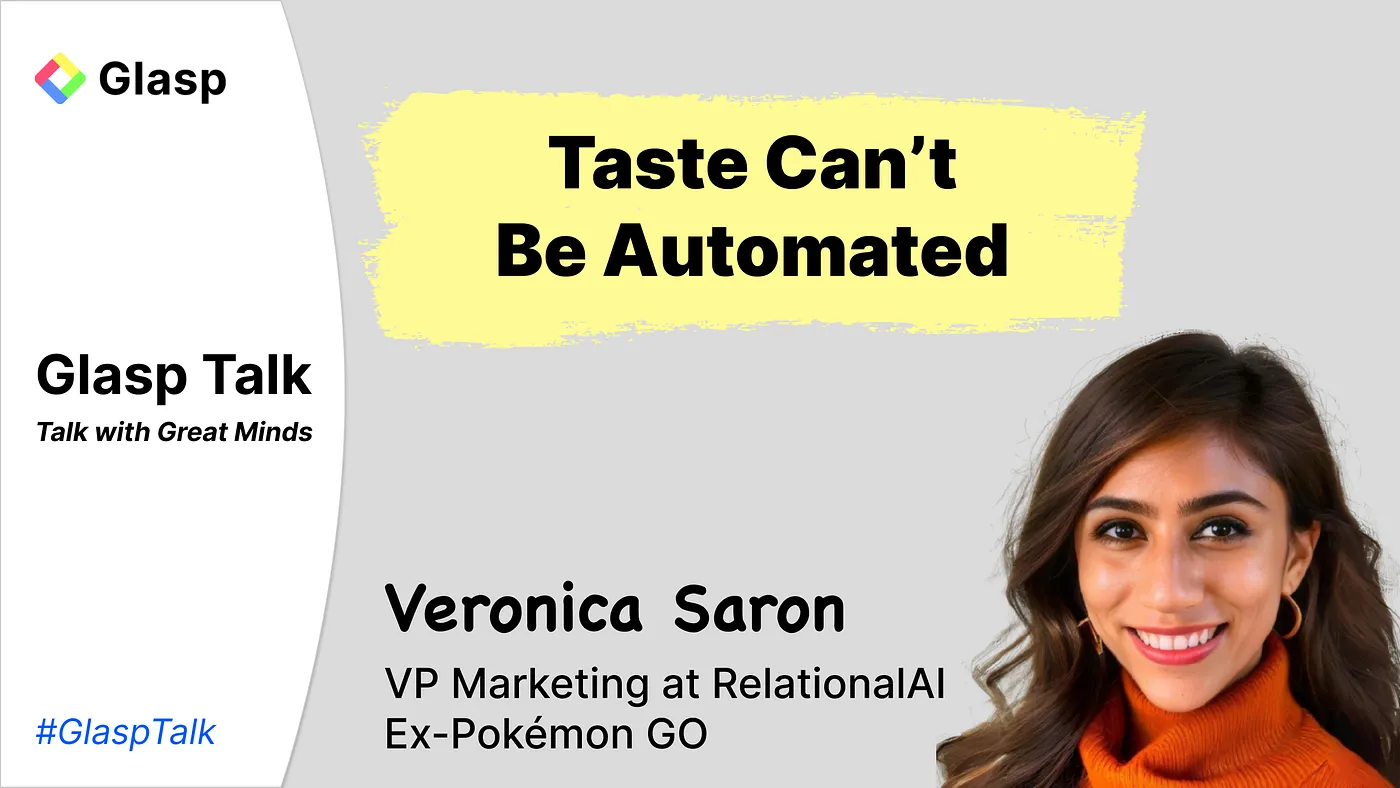
How does narrative precision drive marketing in the age of AI?
In the 62nd episode of Glasp Talk, we sit down with Veronica Saron, VP of Marketing at RelationalAI and a Forbes 30 Under 30 honoree. Veronica previously led marketing at Neeva, helping grow it to over 2 million users, and through its acquisition by Snowflake, and earlier helped turn Pokémon GO into a global phenomenon while at Niantic.
Watch the full episode on YouTube
Watch now on YouTube, Apple, and Spotify.
We talked:
(05:28) - Can B2B marketers become B2C marketers thanks to AI?
(12:30) - How can marketers cultivate taste and originality in the AI era?
(26:55) - What was the biggest challenge in marketing for Pokémon GO?
(33:53) - How did you manage such rapid growth with only around 70 people in the early days?
(38:40) - What did she learn about building trust and community at Neeva?
(42:27) - What was the atmosphere like at Neeva when the team learned about the Snowflake acquisition?
(46:03) - What can founders learn from elite Olympic athletes?
(1:01:00) - What’s your single best piece of advice for marketers navigating the AI era?
(1:02:24) - What legacy does she hope to leave behind?
Get a quick overview & summary
✨ Want a concise summary before diving in? Install the YouTube Summary with ChatGPT extension by Glasp for instant video summaries!

Highlights
From Silicon Valley Product Teams to Human-Centered Marketing Veronica Saron reflects on her journey from leading growth at companies like Niantic and Neeva to becoming VP of Marketing at RelationalAI. Her career has been defined by a commitment to blending technical insight with emotional intelligence. She champions the idea that marketing is not just about distribution but also about building trust, authenticity, and human connection in an age increasingly shaped by automation.
Taste, Trust, and the Changing Role of Marketers In a world where AI can mass-produce content at scale, Veronica emphasizes the enduring value of human taste, intuition, and creative judgment. She warns against letting AI flatten brand voices and argues that marketers must actively cultivate their own point of view. Through intentional content selection, community feedback, and reflection, she believes marketers can build brands that stand out and remain relatable.
Leadership, Parenthood, and Redefining Success As a new mother and tech leader, Veronica shares her perspective on balancing ambition with care. Her personal experience has reshaped how she thinks about time, purpose, and legacy. She underscores the importance of designing careers and teams that honor both performance and humanity. For Veronica, being present for her daughter is not a limitation but a foundation from which a deeper sense of legacy and impact can emerge.
Transcripts of YouTube
Veronica: I actually would argue that marketing jobs and customer-facing jobs are going to be way, way, way more protected than software engineering jobs. Because you used to have software engineers just able to code up the next front-end or deploy a backend skill that's very niche, that isn't very democratized. But because of the way that AI operates, you can collapse down software engineering so much more than the human elements that come behind demand generation. So now building an app is not nearly as hard as getting people to actually use that app.
Glasp: Hi, everyone. Welcome back to another episode of Glasp Talk. Today, we are very excited to have Veronica Saron with us. So Veronica is a VP of marketing at RelationalAI and a Forbes 30 under 30 honoree. She previously led marketing at Niva and helped grow it to 2 million users, and through its acquisition by Snowflake. And before that, she helped turn Pokémon Go into a global phenomenon at Niantic, driving record active users and award-winning campaigns. And beyond her day job, she's a fractional CMO for startups and an LP at MKT1 Capital, advising and investing in early-stage companies. And she writes at the intersection of ambition, identity, and marketing, and even collaborates with the US Olympic Foundation to study elite performance mindsets. And today, we will explore Veronica's journey across search, AR, and enterprise AI, and how narrative precision can turn obscurity into breakout growth. Thank you for joining us today, Veronica.
Veronica: Thank you. That was quite the introduction. Thank you so much, Kazuki.
Glasp: Thank you. So, yeah, first of all, I briefly introduced you to you, but did I miss anything, or could you introduce you if I missed anything?
Veronica: Probably the big bit that didn't really get updated on my public persona is just that I recently had a baby. So we had our first daughter three months ago, and that's been a wild ride. I consider that my most important promotion and most important job to date. So that's new. I'm a mom, and my husband is the co-founder and CEO of a battery tech startup. And so he and I are constantly working and chatting, and collaborating on all things, startup and tech ecosystem. So it's quite the journey together. And then also having a new daughter on the way that we get to live this life in Silicon Valley together.
Glasp: Yeah. First of all, congratulations.
Veronica: Thank you.
Glasp: You must be having a hectic day and nights.
Veronica: Yeah. Oh, yeah. Sleep loss is real.
Glasp: Yes. So, yeah. So, you know, as you know, like AI is crazy now, you know, and OpenAI had a dev day a couple of days ago, and people are crazy about using AI, leveraging AI and technology. And I think it's also in marketing as well. So in that sense, what role do you think marketing plays in shaping public understanding and trust? Like, you know, how, yeah, how AI changes marketing. Sorry. Yeah.
Veronica: Yes, absolutely. So I think the main thing I actually wrote about this today on LinkedIn, and this is more about the risks of AI from a brand perspective, is that there are a lot of topics we could talk about, probably, and how AI is affecting marketing and changing everything. But one of the things that I've thought about is not just how it's collapsing down the role of a marketer because it's empowering any given marketer with so many more tools, but it's also making brands and voice so much more bland because more people are using AI to determine what they want to do or to generate content or generate copy. And so I'm noticing that more and more brands, small and large, are just starting to look very much the same. They're using the same voice. They're using different variations of that voice. So that's like one of the negative sides when it comes to marketing specifically. But then, because you can learn so quickly and do so much more with AI at any given moment, what used to be that T-shaped marketer in a hiring chart of like, hey, you want to hire marketers who, especially your first hires at a startup, should be somebody who's very broad but is very deep on one given subject. That's more like, hey, a given marketer should be able to speak very well to all of these different topics. And it kind of doesn't matter if they're T-shaped and if they're really deep on one given topic, as long as they can context switch very quickly. So the expectations of any given marketer are definitely going to go up, or you just become a crazy, crazy specialist because AI can't provide those contexts. So I would say that there's an impact on companies and their brands, but then also, as I just mentioned, on teams because of generative AI and what it has done for everybody.
Glasp: I see. And do you think AI opened opportunities for B2B marketers, B2C marketers, or which is more? I think, I mean, how to say? Can a B2B marketer become a B2C marketer, or is it because of AI or thanks to AI?
Veronica: That's a really good question. I have both, yeah. So I actually think that if we take AI out of the picture, and it comes, when you go from like B2B versus B2C or back and forth, somebody who is a B2C marketer is going to be much more like a salesperson, I found, than somebody who's a B2B marketer. A B2B marketer is going to be collaborating a lot more with a bigger part of the go-to-market organization. So, for example, you have in B2B, you have the sales org, you have the ops org, you have folks who are working together in any given. So I'll talk about the difference between B2B and B2C in tech. So, without AI, in a B2C org, the marketing team has a lot of impact on revenue very directly. If you're working with the growth team, the product team, especially, you're pulling a lot of levers together within a tech product to make the revenue go up. Or if you have a very, very small, if you're working with companies in a B2B way, where if you're working with other smaller companies, then you're doing much more of a PLG, like product-led growth motion, that can also mimic B2C. So that's going to create a certain set of skill sets for a B2C marketer versus a B2B marketer. They're not going to work with the customers directly; the larger the customer is. So if you're selling to a bunch of enterprises, you might be talking to the customers here and there. But functionally, what you're doing is you're serving as the glue among operations, sales, and product to create collateral and generate demand for a product rather than actually doing that direct motion, like you might as a B2C marketer. And so the only way I think that AI impacts both of those things, or both B2C and B2B marketers, is in accelerating those loops that a marketer would be going through anyway. So, B2B marketer, you're generating demand, you're coming up with content collateral, you're building outa pipeline, AI can play a role in helping you do that. And then on the B2C side, maybe you're figuring out different campaigns to convince people to make that purchase a lot faster. AI will help you with that. Or if you're selling in e-commerce, AI might help you build out ads. So that's where AI has a role. It's just accelerating the skill set that any given marketer already has. And then maybe if you're a B2C marketer and you really want to get into B2B, you could learn a lot faster by making that jump over. So in my experience, I worked at enough companies as a B2C marketer where we had a B2B motion as well. That's where I learned a lot of my B2B skills. And then eventually I came into the position I am now, which is entirely a B2B enterprise company because we work with Snowflake Data, and because our customers are larger organizations, and it's a longer sales cycle. So a lot of the work that I do with AI with my team has to do with not only generating content and working on that together, but also making sure that we're aligned internally. And AI can do a lot of that job with and for us.
Glasp: I see. Yeah. In that sense, do you think that in the future, eventually AI will take all the marketing jobs in B2C, and so there will be no human marketers in the team? So that's going to happen, or what's the value of it?
Veronica: I think what's going on across the board when it comes to hiring, especially on the engineering side, is that the jobs are collapsing down, and you can do a lot more with one person. I actually would argue that marketing jobs and customer-facing jobs are going to be way, way, way more protected than software engineering jobs because you used to have software engineers just able to code up the next front end or deploy a backend skill that's very niche, that isn't very democratized. But because of the way that AI operates, there's just way more that you can... You can collapse down software engineering so much more than the human elements that come behind demand generation. So now building an app is... not nearly as hard as getting people to actually use that app.
Glasp: I see, yeah. And you mentioned that, you know, in the first question, you mentioned that, you know, people use AI so that, like, people have the same tone, same voice nowadays. And so it's kind of a little bit boring, but I think what differentiates us from others is like a taste of marketers, right? So, how should marketers nurture their taste, grow their taste?
Veronica: That's such a good question. That is like, that is the question, I think. So I use AI a lot. I mean, just in terms of my own workflow, my own life improvement, I'm always using ChatGPT. But when it comes to things that I'm putting out in the world or selecting, there's a little bit more effort that you need to do when you're actually developing that taste. So you can still go back and forth with an AI to understand why you might be making a certain decision, either in your app or in your home, when it comes to design and taste. But I think to develop it, you kind of have to do what we've always done, which is put together what you like and talk to other people who have things that you like and understand how they're thinking. So, for example, I gave the example of decorating a house just because it's more physical. If you're gonna be making decisions about the objects that are going into your house, what are you gonna do? What do we do in the modern era? We still spin up Pinterest boards, and we read design blogs, and we might even pick out a book that has different design elements that we really like. So if we're starting to ask those questions of what we like and why we like them, that exercise in and of itself is gonna help you develop taste. So I'm actually curious, since you've asked this question of other folks too, how have you found that taste has to be developed not only for you guys, but for what other people have said?
Glasp: Yeah, some people said, they try to use a lot of applications so that they can sense and they can understand what UX is good, and then in the AI era, and so on. So that they can gather the insights and data about the user flow and user experience. And some people say it's all about trials and errors. And some said, Oh, someday, when I was taking a shower, inspiration comes to me, It depends on the person, but yeah.
Veronica: Absolutely, yeah. I mean, I think a lot of it is recognizing that, although creativity and ingenuity are also based on anything that ever was, which AI has been trained upon, right? AI is trained on anything that ever was in the past, and that's ultimately what you're going to build the future on. So understanding that is important, having that is important. But anything that's net new, AI won't necessarily come up with. You have to have a human in the loop to come up with something that's net new. And I think the standards of what it means to create something new from a design and taste perspective are just going to go up. But one thing I just thought of, somebody wrote that music in the 2020s is very much a postmodern phenomenon, even more than it ever was. So when you talk to say like Olivia Rodrigo, I don't know who's cool now, but there was a quote from Olivia Rodrigo where she was talking about how her inspirations, and this is a Gen Z pop star, her inspirations are from all across the board. It's like Aretha Franklin, oh my God, Aretha Franklin all the way through, like Avril Lavigne, and you have like Taylor Swift. So she just has this wide range of influences on her taste and her craft across all these different artists versus let's say we're in the 70s right now, like the 1970s. Your taste and craft are going to be influenced very linearly based on what's going on around you. But now that you can pick whatever you are drawing your taste and your influences from, because we have Spotify, we have the internet, we have all these things, you're going to come up with something that's influenced by all these different things that would have never been combined before. So AI is doing that already, just like we would as a human. However, those two things together, I think, are what are going to provide that next layer of design and craft and taste in the coming years.
Glasp: Yeah. So, are you optimistic about the future of AI or marketing?
Veronica: I'm like, you saw my face there. I'm a mix of both. I think there's a lot of potential that we just don't see. And I've always been excited about the future, which is why I've worked in tech as long as I have and will continue to. But at the same time, I think the speed at which things are going is just so crazy, and our brains are just not ready for it. Just the things that I'm seeing behind the scenes and the things that are coming out at rapid fire, it's not the same type of tech revolution as what we've had with the Claude computing revolution or the mobile revolution. This is like completely different in terms of the implications. When you talk to an AI and it learns all these things about you, and you continue to talk to it and work with it, it's kind of scary how personalized and targeted it can be with you, in just understanding you and working with you and giving you what you need. It's like, okay, this is so incredible, but so scary. Because what does that mean for the way that things ever were? And that's what innovation feels like. On the other hand, I think I might just be feeling like this because I'm a new parent, and every new generation of parents just feels that way about their kids and where their kids are gonna go in the future. And so I think my natural optimism about where we're going and where tech is going is being tempered by the fact that I just had a kid, and it makes me feel very uneasy. So that's kind of where I'm thinking.
Glasp: And also, there are so many things happening nowadays because of AI. People can launch anything and launch an application quickly, faster than ever. And also content as well. I was curious, how do you catch up with news and things going on in the AI era? Because I need to code. I need to catch up news. And sometimes I don't have time because I have only 24 hours. Oh my God, yeah. I was curious. I'm curious how you would catch up? How do you catch up?
Veronica: I have the same question for you. But for my part, the way that I've been handling it, I suppose, is I do look to put guardrails on my time. So if I have a 30-minute block and I wanna catch up on where things are going in AI, I have to be extremely intentional about that time because otherwise the algorithms and AI itself will just pull you in. So if I have a 30-minute block and I'm about to go research AI, I have to tell myself, okay, I want to read this article. This article is by a trusted source and somebody who probably didn't use AI to write it. Like they did the research, they did the net new investigation. So this is going to be high quality, and I'm gonna spend the 30 minutes reading this article. I'm not gonna spend these 30 minutes scrolling Twitter for the latest hypey crap or scrolling LinkedIn and surfing in there. Or maybe I do tell myself, hey, the next 30 minutes, I am just going to like scroll through LinkedIn. And as long as I say it's for these 30 minutes and I'll just pick out little nuggets, that's something I will do. And then the other thing that I make sure I do is I just write. I try to write in Notes in Apple Notes or this app that I use called Day One, which I've been using for years. And I try to just synthesize what's going on for myself rather than taking what I'm reading at face value. Because then it just gets that thinking brain going when we could just outsource that thinking to AI, but I want to make sure that I keep my brain on that thinking track. Otherwise, I'll just like, it's use it or lose it. So that's what I do. What do you do?
Glasp: Actually, it's funny because I do the same thing. I mean, I put one hour and 30 minutes or one hour and block the calendar, my calendar. Oh, this is time for a workout, time to read, time to catch up on emails, something like this. Something like this. And I started doing this like a couple of weeks ago because my work was so messy, and I couldn't catch up. Yeah, I feel that. I need to allocate my time and resources well. So, but that's actually working. So, and I think, yeah, same as you.
Veronica: Absolutely, and I feel that way with the calendar blocks even more again, like because I have a kid. And so versus before, I think I could just sit there for three hours and like get a bunch of work done or just wander the internet or wander TikTok or wander Instagram and see what was the latest hypey thing. But I don't feel like I have that anymore. And it's actually kind of nice that I have that course function to follow the calendar and block things out and to be more intentional about my time and attention.
Glasp: Yeah, definitely. Yeah, same, totally. And do you share the newsletter or article? So, within the team or organization? So, yeah, to determine the direction or like product direction, marketing direction, you need to share, so updates with teams, right? So how do you do it? How do I share things? Or do I share? Yeah, how do you share in the team? So how do you, how do team members catch up with what you're reading or in the
Veronica: Yeah, that's a really good question, too. I love getting recommendations for things to read from folks. Like it's one thing to just pass around different tweets and different small posts. Yeah. Yeah, yeah. But I prefer the Meteor stuff. It just feels like it's endorsed by someone like, Hey, you should read this. This is really important and interesting. That feels so much more important as an endorsement. That endorsement feels so much more important than it ever did before. Because now there's just so much more content and so much more information that can even be tailored toward you, that for someone to say, No, no, no, this is good, I want to read it. I do want to read that if somebody makes that recommendation. Versus before, I think I would have had a lot more patience to just wade through a bunch of stuff. Now the volume is so much higher. So in terms of what I share, to be honest, lately, I haven't found anything in the AI space where I'm like, Oh, you must read this. But I have been reading more things, and there's an email newsletter I subscribed to that's just like what you should read instead of scrolling this week. And that newsletter is on Substack. I forgot the creator, but that has been very good. Because then I'd carve out that time to read those things. And it feels like it changes my perspective more than if I were just needlessly scrolling.
Glasp: I see. Yeah. It would be nice if you could share the newsletter name. So yeah, after the recording. I'm interested.
Veronica: Yeah.
Glasp: Yeah. And I actually have a similar workflow, but I started, how to say, not using what catters, but using my friends and network as a filter for the content. Yeah. So if the content really matters, it eventually comes back to me again and again, so that I, oh, okay, it's time to read, or time to consume, or time to read it and spend time on this. And yeah.
Veronica: Yeah, I feel that. Yeah.
Glasp: Also, yeah, if you cannot share, we'll cut it out. But so in the AI era, everything is changing so rapidly, quickly, right? But working as a team, we need to have one direction where we can catch up all many AI news. So, what is the best way to work with a team in this era?
Veronica: Given AI?
Glasp: Yeah. Because many startups and products need to be updated, or team members need to catch up with AI news. So yeah, the computer is doing something, so we need to update. But we need to work as a team, right?
Veronica: So I'll talk about internal workflow, and then I think that'll satisfy the question. So I know a lot of teams are using, they're using ChatGPT for teams, or Claude for teams, or Claude Code and the like. I've only, I actually don't think any of those apps have really figured out how to do team collaboration effectively. There's another app that I've been using personally, which at some point I want to implement for my team, but probably not yet, until they hit a couple more milestones, called Interface Zero. What it is, it's really good. And it's really, really good. Basically, what it i, is an interface, but on it, you can switch between models as you talk to it. And it's multi-modal. So you can email it, you can WhatsApp it, and then it collects everything that you've been talking about, and then it filters it through a very particular way of operating called artifacts. So it'll create these artifacts, and then you can use those to do more with these models, and you can switch between the models. So usually, if I want to do something that's more analytical, I like to use Grok more. And then if I want to do something that's more creative, I'll use Claude. If I want something that's just a jack of all trades that can really get it all done, I'll use ChatGPT. But in Interface Zero, I can not only use all the different models, but we also create things called artifacts, and those artifacts can be used across different problem sets. So, for example, let's say I have an artifact for the positioning statements for my company, and I want to use that to create new email workflows, or I want to use that for website copy, or I want to use that and update it, and then put it into a different model. I don't need to copy and paste and refactor it and all that. This tool will create an actual artifact that you can use, and then you tag it in, and then you tag in a prompt. And so that type of interaction model, those sorts of interaction modes, just makes it way more valuable for teamwork than what I think ChatGPT or Claude have. So I'm one of the early beta testers for this, and I think it would be amazing to use within a team, because right now what ends up happening is that everybody's using all these different prompts in all these different locations, and this would give you the ability to basically create more like a spider web of different abilities and different workflows, which doesn't exist right now for teams, I think, in the larger companies, especially because you can't use different models within those interfaces. So that's my recommendation, but the caveat is that that's not really how my team's been working. We've been struggling with the different models and people working off different things and making sure that we're staying consistent and aligned, which are problems anyway, even if you're in a company pre-AI era.
Glasp: Actually, you were the second person who recommended Interface Zero. No way, really? Because John Waddy, we interviewed in the past in Glasp Talk, and he's the founder of Inception Studio. It's like an AI founder community, and he recommended this. And I remember Interface Zero was built by the founder of the community, Inception Studio, the AI founder community. And that's how I knew, yeah, Inception Studio is like an AI founder community, which I went to. I was a part of then.
Veronica: Oh my gosh, he was in it. Yeah, it's-
Glasp: Yeah, it's a small world.
Veronica: That's so funny. Yeah, I definitely recommend it.
Glasp: Thank you, yeah. Thank you. Yeah, anyway, yeah. I'd like to switch the topic to your past experience, and especially Pokémon Go, because you were a huge contributor to the global phenomenon and success. So you were a part of the team that helped scale Pokémon Go, and what was the biggest challenge in marketing, such as a cultural phenomenon?
Veronica: Yeah, that's actually a really, that's great question. So it's, everybody knows Pokémon Go, unless you live under a rock. So the biggest challenge was actually not the launch or anything like that. As the company went going and was continuing along, the problem was sustaining the product and making sure that people were excited and continued to be excited and kept revisiting Pokémon Go. Because there was a certain point in 2019 where people were like, Pokemon Go, people still play that? And then people would scoff a little bit. And the truth was that there were plenty of people playing Pokémon Go and spending tons of money on Pokémon Go. We still made like, we made a billion dollars in 2020. That's crazy. So when people would say that to me, I'd be like, Yes, people play Pokémon Go, we were making a lot of money. And so it's funny to hear that. But the thing is that you needed to do work around actually sustaining and maintaining and changing the growth of the company, rather than just riding off of whatever it was that you were doing at the very beginning. And so I was really adamant about that and making sure that we were always finding new audiences or existing audiences that may have used Pokémon Go and enjoyed Pokémon Go, but needed to come back into the game. Like reactivating people who maybe tried it for two days in 2016. And now maybe they have a family, and they want some fun things to do with their family on the weekend. Okay. Pokémon Go community day is the way to go and to reactivate this audience. So that's really what the biggest challenge was. And for a lot of startups, that's something that people don't expect because most startups have a moment where everybody is using their product. Oh my God, we have so many users. We have so much going on. And that's a great problem to have, but then the real challenge is how do you take that momentum and bring it forward in a real way? What do you do? And so most startups actually don't die with not able to get customers. Maybe you've got some customers, but can you actually grow it? Can you actually sustain it?
Glasp: In that sense, localization was a key element, I think, in the marketing.
Veronica: What do you mean by localization? You mean like translation or?
Glasp: Yeah, like including translation and the messaging and so on, narratives. Because I think, I mean, so in case of ex-Twitter and the US is the number one country, but Japan is number two, and so on. But each country, different countries have different use cases, different usage and expectations, and so on, I think, I assume.
Veronica: Yeah, you're totally right. You're totally right. But I think that actually, so I'll speak to that a little bit, and then I'll give an overview of how we actually thought through the regionalization. So, because Pokémon is a global brand with an IP owner, the Pokémon company, we actually already had the mandate to do all the localization that needed to be done. So from the very beginning, we had translations across all these different languages and entities in all of these different countries. So it was launched over time in each country where we were available. I wouldn't necessarily say that that was the source of the growth. I would say that the source of any given growth is whether you can actually take that localization forward and meet the needs that are unique to each country, which is different from localization. I would say that that's much more about knowing your variety of different customers and making sure that you're available for them. So we had different growth scouts who were available in Latin America. They were making sure that we were seeing to the specific needs and interests of folks in Brazil, whether that was just, can you get the time zone to be correct for an event in Brazil, all the way down through, hey, people in Latin America are really excited about community, even more so than other parts of the world. Can you make that more of a thing? I would say, though, in terms of growth, we spent a lot more time thinking about different personas. So, for example, families, families playing Pokémon Go is a very different persona from the core gamer who just loves to min-max all of the shiny collection for their Pokémon Go game when they've always been like playing all of the time, every Pokémon game. So that was the richness and the variety of different customers or different players, I should say, who are on Pokémon Go; that's what we were really needing to meet over the course of time. And this became even more complicated during COVID.
Glasp: By the way, I was a user, so you can see I'm a 38 level, so I used to
Veronica: Oh man, you've got to get up to 40. Come on, the game's been out for almost 10 years.
Glasp: 10 years, yeah, 40. Now the maximum level is 45 or 50, right? So-
Veronica: Levels happen above 40, yeah, now it is.
Glasp: Yeah, it used to be 40, but so I gave it up at 38, but I was curious, like, which country or region was difficult, so in terms of user acquisition and retention?
Veronica: So the reason why I'm stopping on that is that different countries were hard for different reasons. So, for example, we had obviously a very strong presence in Japan and a lot of assistance in partnership with the Pokémon company in Tokyo. So it's not as though that audience was hard for us to reach, but something hard for us to do as a company is knowing that there's different expectations and different flavors and vibes to how you would do marketing in Japan that's very different from what you would do in Brazil and that would be very different from what you do in the UK. So we actually had different agencies working in different regions, and just operationally, that made it hard to implement a global campaign when everybody is doing different things, and ultimately, although you want to regionalize things, everybody can see everything because we're all on the internet. And so that was something that was very tricky for us.
Glasp: And I remember when you joined Pokémon Go, I mean, Niantic, and there were only 70 people, right?
Veronica: Yeah, yeah.
Glasp: Pokémon Go was crazy popular at the time, and then when you left, you know, there were the team grew to 1,000 or over 1,000 people.
Veronica: That's right, yeah.
Glasp: How did you, I was curious, early days, how did you handle that like a super growth and with only 70 people, yeah.
Veronica: Yeah, yeah. You do a lot of firefighting. You do a lot of that, but then what I found was that the team did very well on, and this is not; I can't take full credit for this. This is what the company was like as I was very junior at the company, and then I became more senior at the company. The company did a very good job early on of hiring people who could just run with things. So not people who, you know, would create problems, not people who would create blockers. You just had to run and take whatever ball was thrown at you and just go. So I think that when a company is actually experiencing hyper growth on one of their products and you have people who are like that, you can really, really drive it home, which is great. But I think the problem that a lot of other companies run into is that they'll hire more people before they're ready to hire people or they won't hire people who are at the right stage for that time, which has definitely happened plenty of times before, where you'll have people hired up and they're more suited for a larger company and they can't just run with it. That happens very often because you're like, Oh, I wanna hire people who know what they're doing. You hire people who have really good names on their resume, and then they don't necessarily know how to run at that speed early on. So that's something that happens at a lot of companies. I think Niantic did a very good job early on of making sure that that balance was there of people who could just run with things, given the speed, given the size of the company.
Glasp: Would you do things differently, especially like hiring, because hiring takes time, and because some people are working for other companies, but you want them, but they can't join your team, and so on and so forth, but how, yeah. I'm curious, how did you handle your team hiring and managing them? I mean, did it work well as you expected, or was there any challenge? I mean-
Veronica: There were definitely challenges. There were definitely challenges. I wouldn't necessarily say like, I am lucky to be able to say that everybody that I hired, I was very happy with. I thought that the people who reported me were incredible. They're all doing amazing things now, whether they're still at Niantic or otherwise. And so I also really enjoyed the folks who were on the product counterparts. So people were on product, people were in engineering. I truly enjoyed the majority of the people that I worked with. Were there some problems, people? Of course, that happens at every company once the company starts getting larger. Would I necessarily say I would have done anything differently? Not really. I think it was a wonderful experience, and the teams were largely just incredible. And I had so many amazing mentors at the company, like I can't even start to name them. That's really where I cut my teeth in understanding and knowing marketing. And so I owe a lot to Niantic and the people that I got to meet there.
Glasp: I see. When you joined the company, there were 70 people, right? So, how was the team structure? So, how many people are working for marketing? How many people were developers?
Veronica: I don't even really remember. I barely remember. There were also a lot of people who were, a lot of people in marketing, and we had to like double as product people. And some of the product people would double as engineering, would double to the code base. It was pretty rough. I mean, rough as in like the overlapping responsibilities were pretty heavy, especially early on. But of course, we had like marketing team, we had engineering, we had product, we had operations, and finance. I'd say that those are the major buckets of people. And then those just grew from there. And you had some very strong executives who were overseeing those elements. The company really grew, though, when we had more games and more products. So that's where the majority of the growth came in, especially around the platform for Niantic. And now you'll actually see that the platform has really exploded, or it did explode. And then the company spun that out. So earlier this year, Niantic was found, was sold. The games unit was sold to Scopely, which is another big gaming company. And the platform side of the business spun out into its own entity. So you'll probably be able to look back and see how that happened. But essentially the people who were all involved in games are still working on the games now, but it grew to be a lot more than it is, than it was when I joined, of course.
Glasp: I see. Then after Niantic, you moved to Neeva and-
Veronica: Yes. I think that's where you and I met, actually, through that community.
Glasp: Yeah, exactly, yes. And we'd love to learn about the experience at Neeva, and what key lessons did you take away about building trust and community in tech?
Veronica: 100%. Awesome, yeah. Yeah, so actually, when it comes to Neeva and that period of time in my career, when I left Niantic, I actually went fractional. So I started working for a variety of different companies, and what a fractional chief marketing officer is is somebody who comes in either for a certain period of time or for a very specific mandate with the team and does leadership for the marketing efforts, but again, for that period of time or for that particular mandate. And I was working in crypto at the time, this is 2021. So I was serving as the head of growth for a variety of different projects. That was a lot of fun for me, just mostly for the learning aspect of it. I wanted to understand more about community marketing, given what I saw in gaming and how powerful that was. So it was in those efforts that I met Sridhar, and from working with Sridhar as an advisor, I was a paid growth advisor for a long time at Neeva. That's how I ultimately slotted in and became the head of marketing at Neeva. So, as the head of marketing at Neeva, that was right around when we were starting to move more explicitly into AI efforts. And that was really what I had the opportunity to own, which was the positioning, the marketing, the storytelling. Around our search story and our AI integration. Ultimately, that's what led to Neva getting acquired by Snowflake, which happened in 2023. That was an extremely cool experience to be a part of, just being part of a Silicon Valley acquisition. And then seeing that all come to fruition. Now, Sridhar, who was my mentor, my boss, my leader at Neva, the co-founder of Neva, now he is now the CEO of Snowflake. So it's very cool that not only is he the CEO of Snowflake, but I get to be VP of marketing at a company that is very active in the Snowflake community and actually works directly with him in the context of being a partner. So that's like how a lot of these elements in Silicon Valley will just come and circle back. And as you mentioned, he's also an active angel investor in a lot of startups as well. So everybody is getting to know and work with each other in this world.
Glasp: Yeah, that's amazing. But you know, Sridhar, he was also a former senior vice president at Google and Google and Google Ads, right? Yeah. And he's a famous figure in the Silicon Valley tech industry. And so I would say, does it, did it help you work as a marketer at Neva? I mean, thanks to like, because founders are famous and tech media featured Neva and sectors, AI50 company, and so on. Does it? Yeah.
Veronica: Oh my God, yes, absolutely. It helps. So I think like a lot of things when you do, especially when you do marketing or when you're involved in different development communities, just success begets success. You get to meet more people who are doing really cool things, learn from them, collaborate with them, and the like. And so I would definitely say that the work that I did with Neva, even though it was, again, a lot of it was in the capacity of being a paid growth advisor, that really allowed me to continue to understand what it looks like to succeed in different ways and what success looks like in different ways. So definitely helps.
Glasp: And as a personal curiosity, I'm curious about how the team or company, how to say, atmosphere was when you knew the acquisition by Snowflake? Did you know? Okay, if you can tell -
Veronica: I kind of knew. The story is actually, it's very long. Every acquisition story has its own different, substantial pieces that the media never actually talks about. This one was pretty insane. But I will say that anytime there's an acquisition that happens for a startup, there's going to be a lot of anxiety at the company because until the money is in the bank and everything is signed, sealed, and delivered, you just don't know if the deal is going to go through, no matter if your CEO is Sridhar Ramaswamy. It doesn't matter. It's just, is this all going to work out? Is something going to derail the deal? And so that's the first question that happens when it comes to that atmosphere. And the second question is whether people worry about whether they're going to have a job or not. That's just straight up what it is. Now, for me, what I ended up doing is I did my very best to find a role for almost everybody on my team, as long as they met the requirements of what Snowflake had. But when it came to me, and if I was going to go over with the acquisition, it actually made a lot more sense for me not to, because of a variety of reasons. But one of them was that I had a change of control clause. So, personally speaking, it made more sense for me not to necessarily jump over. But also, I wanted to make sure that I was doing things with my career that aligned with what I wanted to do. If I joined Snowflake, I wasn't necessarily going to get to work on AI or work with the team that I had really enjoyed working with. It's just the way that a larger company works, even if you are absorbed into the company. And then the other piece, which probably just shows where all I've been, is that I enjoyed being a fractional chief marketing officer. Plus, my younger brother was going for a spot on the US Olympic team for Paris 2024. I wanted the ability to actually be with my brother and to help him out and to help him grow his presence after he made the team. So that was important to me. And I was able to prioritize that because I did not go to Snowflake immediately. But now that I'm at the AI startup that I'm at, I can be in the Snowflake ecosystem. I'm actually working with a lot of the same people that I worked with before, but the timing is a lot better for me. The role is a lot better for me. And I've just really been enjoying that all this time.
Glasp: Yeah. It's a little bit off topic, but I was so impressed to know that your brother is an Olympian. And I saw your post on LinkedIn. And so it's a really hard process and tough process.
Veronica: Crazy. Yeah. And people always ask him, Hey, are you gonna go for LA 28? Are you gonna be on the LA team? And he's like, gotta make it first. Every time the American sports are putting together a team for the Olympics, you actually need to make the team first. And so that requires that you perform really well in the trials, or you perform really well in the qualification year. It's not a shoo-in versus in other countries; they might just be like, well, this is our star player. We're just gonna put them on the team no matter what. It's not the way it works in American sports. In American sports, it's going to be that meritocratic, but also very high-intensity, like only the best survive type of situation when it comes to them picking out the team.
Glasp: And then, I remember you wrote about the article, collaborated with the US Olympic Foundation to study like elite performance mindset. What's your takeaway, or what's the key advice for learning you could share with us? I mean, not athletes, but normal people.
Veronica: Yeah, of course. So, I just have a little bit of background on that. So after my brother was on the team, I actually joined the US Olympic Foundation. And the reason why that foundation exists is that not all American athletes are getting any government funding. And so, instead of other countries where you get government funding as part of being an Olympic athlete, all of the money has to come from private donors. And so the foundation's job is to raise money in the name of not only funding the athletes, but also making sure that their performance is top-notch. And that's part of what I get an inside look into with my work with them. So I sit on the board, and it's a lot of fun. But to answer your question, the thing that I've learned actually is that the excellence that the athletes experience when you're an Olympic athlete, it takes so much effort, just so much time, effort, focus, attention, determination. You have to be a little bit delusional. It's very much like startup founders. You have to have that excellence in you. But then the piece that a lot of people miss is that the lights always go down at some point. So either you sell your startup, or you wind down your startup, or you IPO your startup, or you leave your startup. The same thing happens with athletes. At some point, they have to retire. And what happens after that? Like, where do you direct that energy? How do you figure out how to continue to be really, really great even when you can't use your body as part of that greatness? So the process of actually figuring out what you are and who you want to be and how you want to drive your life forward, that continuous process of reflection, is something that absolutely every single person needs to be able to master. Because even if you're a gold medalist at the Olympics, that only lasts for a moment. And then what? So you have to be really good at answering the question, and then what? That's what I found.
Glasp: The team. It lasts at least four years, right?
Veronica: Yeah, that's true. It lasts four years, but then you get the rest of your life. So you have to figure out how to answer that question each time.
Glasp: Thank you. Yeah, so again, yeah. So thank you so much. Yeah, but yeah. Get back to Neeva and... Awesome. But how did you end up walking? How is walking for radiation AI? Could you share that story? You were working as a fractional CMO for.
Veronica: Yeah, exactly. So, as my brother was qualifying for the Olympics, I was working for a variety of different companies while he was on that qualification journey. And so just through that process, you meet different people, you end up working for different companies, and different folks will pass you on to the next person. So when it came to relational AI, a friend who is acquainted with the CEO of the company had said, Hey, they're looking for new marketing leadership. And I said, Look, I could do it in a fractional capacity if they're willing to take me on. And they were, because they had a lot of things that were going on on the marketing front and the things they wanted to change about the company and how they positioned themselves and how they showed up at events, that sort of thing. So those were all the tactical things that I was really focused on, but that's how I got the introduction originally. And the other piece is that because I had worked indirectly with the Snowflake ecosystem, it was very valuable to the team and continues to be valuable to the team, especially with my experience in AI and at Neeva, et cetera. So I've had the opportunity to work with the company now since the beginning of this year, and they had made me, the CEO had made me an offer, a full-time offer, but I said, Look, I've been doing fractional work. I've been a contractor. I've been enjoying it a lot. If you want me to join, you should know that I'm pregnant. And my plan was to continue to do work as needed, but then take time off once I give birth. If you can give me maternity leave, I'll join you full-time, and I'll go full steam ahead and do everything that I can to help the company. And he was willing to give me maternity leave, even though I was joining a mere few months before I would have needed to take leave. So that's how and why I ended up joining, but that's also why I'm very adamant that companies do what they can for high-talent women and parental leave so that you can continue to retain and bring on great talent. That's something that I'll always make sure that I'm doing for my teams going forward.
Glasp: So I, I'm curious, like, you know, during your maternity, before that, did you prepare something for your team and like a handle of some, how to say, some tasks?
Veronica: And I will say AI was very helpful for that because I had a list of things I needed to do, and I knew I had that. And I went into ChatGPT, and this was like a week after Snowflake Summit. So I had to pull together Snowflake Summit, work with my team, make sure that the event happened, make sure that we had all of our customers connected, with pull together a lead sheet. And then the week after, I was starting to put together my maternity leave plan and all the things that my team would need. And then my daughter showed up three weeks early. So thank God for AI, because I was able to pull together the plan a lot faster because of it. And that was enough of a skeleton for my team to continue running, while I was out. And then the product team, of course, stepped in, and they were really amazing with helping the marketing team just get, get their boots under them. And even though I wasn't necessarily there, they did an awesome job, and I was really happy with it.
Glasp: That's amazing. Wow. But do you have any advice or recommendations for people? I mean, there are so many women in tech nowadays, and so some people need to take maternity leave. And do you have any other advice, or anything you would have known before you wanted to know before leaving?
Veronica: So I will say I was very, I think I was very lucky with the team that I had the opportunity to meet and join because they've been so incredible when it comes to my needing to take leave and the like. Um, I would say that for any women who are starting a family now or looking to start a family in the future, I would say don't compromise the type of company that you would want to work for so that you can get what you need because that's, because that's how you're going to be able to keep going. And you think you don't want to take that time off, but once you have your baby, it's going to be really important for you to recover, for you to get your life reconfigured, your life, basically, around welcoming a new human being into your family. I did not realize that taking maternity leave was going to be absolutely crucial for me. Like, I work extraordinarily hard. I like to think that I'm pretty smart, and I don't think that I don't deserve that time off. I like to work, but I need to make sure, and anybody who is going to be a parent needs to make sure that they have that time because you need that time to physically recover after you give birth. Your body is so different. So that's one. And then two, you need to bring the new human into your family. And that takes a lot of effort and new, new brain connections for yourself, for your family, for your baby, that's all being formed, and you need that time off. So don't think that time off isn't important. It is.
Glasp: Yeah. And also, yeah, companies and partners, you know, support that they need to support them. Yeah. Yeah.
Veronica: Don't, don't compromise on findings, finding a company and a team that is willing to give you that time off and work with you to make sure that you get what you need because you're ultimately still going to want to work hard. I know I do, but this is just the fact of life. We give birth to kids. We grow our families. You need that time to recover.
Glasp: Yeah. Yes. Definitely. Yes. And so, so through the experience working with, working as a fraction of CMO, did you find anything like a, like a misunderstanding, like a, something like people often misunderstand about marketing or branding, brand building?
Veronica: Oh, that's a great question. Yes. I was thinking about this earlier today. Most people think that because they are marketed to, they can do marketing. And it's similar to just because I can vibe code an app doesn't mean I can be an engineer. So people tend to underestimate what marketing actually takes. And when I say that to people, they get really offended because they're like, like, How hard could it be? And how like you got, how are you really that great? And it's like, no, no, I'm, I'm not really that great. It's just that people who've done marketing are going to think about things a little bit differently. Just as an engineer is going to think about things a little bit differently, just as an operations person is going to think about things differently. So if that's not the way that your brain is configured, then don't just think that you can, you can do it, but everybody gets marketed to. So everybody thinks that they have all these great marketing ideas. And there are tons of reasons. There are more reasons why something won't work than that something will, but you need to find the thing that will, and then drive it forward. And that isn't always the way that people go about marketing. So I've really only found like, like, I've just found that that's the case in a lot of companies. And so there's a lot of effort around needing to market the marketing. There's a lot of effort around needing to make sure that everybody's consistent, that it's not just a situation where everybody thinks they can do marketing. And you have a bunch of four-year-olds chasing a soccer ball around. In order to be strategic, you have to have people working together, but also knowing what they're really good at versus what they're not.
Glasp: Do you have any companies or people, so you look up to as a marketer? So in the beginning, yeah, you, yeah, you mentioned a marketing taste, but so what's your curation? Yeah.
Veronica: So I'm a little bit biased here, but my favorite marketer is actually a woman named Emily Kramer. And Emily Kramer is one of the GPs of the MKT1 fund that I'm an LP in. And she just comes up with the most incredible frameworks and breakdowns of how to do marketing, especially on the B2B side. She has had a lot of really amazing experiences in B2B marketing, and she invests. So she just really gets it. And I find myself when I'm reading her newsletters, I'm always like, yeah, yeah, yeah, yeah. That puts exactly into words what I was thinking about. And she does an amazing job of that. So I recommend that everybody follow her, especially if you are a marketer.
Glasp: I see. Yeah. Sometimes I read that newsletter.
Veronica: It's so good. It's so good. And the best thing is that sometimes I will think like, Oh, this is a problem in marketing. I don't know how to solve it. And she will know how to solve it. She'll write something. It's like, and here's the solution. And here's how you have to think about it. It's very action-oriented. And it's not just like, you know, some marketers I think will just like complain, kind of like I just did. They'll complain that, like, ah, people don't know what they're doing. And you know, that's fine. But it's like, what's the actual solution? Emily's got it. Anytime I need to know what the solution is, I can find it in that newsletter.
Glasp: Yeah. Thank you. And if you met a startup founder at so very early stage, but has a strong mission and vision, also funding the story or the founder's experience. So, but so yeah, if you help them, so what would you start with?
Veronica: That's an awesome question. So this wasn't necessarily my answer five to 10 years ago, but it's my answer now. Founder-led marketing is probably the most important thing in the sea of tons and tons of repetitive apps and content, and crap out there. And so starting one's own personal brand and making sure that you're posting and making sure that you're speaking to the problem and the solution and your customers from the point of view of the founder is more important than it ever was before. People are looking for that more than they were before.
Glasp: I see. And you also mentioned narrative precision, right? Yeah. Could you share about it?
Veronica: So basically, this is something that I think about a lot and I talk about a lot. Being able to speak to what your personal narrative is or what your company's narrative is, those can be more powerful than you think when it comes to starting a company and actually being able to scale your company up. So the main thing about it, though, is I will caveat that it is really important to have it down and really important to outline. However, it is also really important that you actually be able to speak to how you can help somebody else with your product. So I've known some founders who get really obsessed with telling the story of their company over and over again, and that works really, really well for investors. But that story also needs to be tailored toward the person you're actually selling to. And that doesn't always happen. People don't always buy the product because you have this great big vision. People will buy because of why, but it also needs to be like, How are you actually going to solve this problem for me? Otherwise, they're not just going to come out of the woodwork because you have an amazing story to tell investors.
Glasp: Yeah, it's kind of related to jobs. Jobs to be done theory.
Veronica: Yes, exactly. Jobs to be done is so good. I should have mentioned that with Emily Kramer. You need to actually, you're hiring the product to do the job for you. What is that job? And sometimes people are just like, oh, but I just really love working in this space because it's so important. It's like, OK, you and everybody else.
Glasp: And I sometimes see the post on, I mean, people nowadays, startups post on, like, oh, we placed $10 million, $5 million, but at $100 million valuation or something. But some people say it doesn't matter to your customers.
Veronica: Yeah, no, they don't care. They don't care, exactly. Bring the value to the table, right?
Glasp: Exactly. Anyway, so yeah, sorry, time is, I think time, sorry, it's been a while. But two things, and one is advice. If you could just do one piece of advice for marketers navigating the AI era, what would it be? Two pieces of advice.
Veronica: One, do not let AI-generated writing invade every channel that you write on because that's just going to get really bland, really boring. It's just not going to stand out. Anything and everything that you can do to humanize yourself and humanize your brand, whether it's you as a brand or the brand that you work on, is super important. And that requires that you build out taste outside of AI, even if you do use AI to facilitate execution. You need to make sure that you are developing that voice and that brand and that identity. So that's one. And two, that being said, make sure you're using AI in your workflows. You have to actually play with it, use different tools, explore, try them out, and not just use them in a shallow way but actually integrate them into your workflows. But then, at the end, make sure that you're not getting that AI effect of everything just getting dulled down and looking like the same as every other person's writing. So those would be my two pieces of advice.
Glasp: Thank you. That's amazing. Awesome. Good. And then the last question. And since this is a little bit heavy, tough question, but since Glasp is a platform where people share what they're reading and learning as their digital legacy, we want to ask you this question. What legacy or impact do you hope to leave behind for future generations?
Veronica: That is a heavy question. So I would say that I've been thinking about this a lot because I just had a daughter, which I keep talking about. And we hope to have more kids. And we want to have a great family. And so I think the legacy to leave behind, oh my goodness. The thing about it is, I think that a lot of people think about the big, big, big legacy that they want to leave behind. They think about changing the world or changing the entirety of everything and building something that people get really excited about, building something that changes lives. And I've worked on those things. And I've been excited about those things. But there's a quote that goes like this that I'm going to butcher. When you're young, you think about changing the world. As you get older, you think about changing your town. As you get older than that, you may think about changing your family. And then, as you're a lot older, you think about changing yourself. I just dreamt of changing myself because you start big. And then you start to be like, oh, well, what if I just changed myself? I think right now the legacy that I want to leave behind is just to make sure that my daughter is really happy, fulfilled, and excellent. And everything else I do on top of that, amazing. But if I can't get that right and if I can't get that right for my kids, then what's the point? So I want to get that right and then use that as a basis and a foundation to get the rest of the legacy correct. But what those things are, I think I'm still trying to figure that out. I'm just having a good time, man.
Glasp: Yeah, beautiful, yeah. I totally resonate with you. And yeah, again, thank you so much for joining today.
Veronica: Oh, my goodness. Thank you for having me. It was awesome. Thank you. All right, y'all. Take care.
Glasp: I was curious about your Pokémon level. So are you 45?
Veronica: I think I'm 42. OK. Because the thing is that after you hit the level cap, there's all this shit that they ask you to do. And it's like, OK, I don't know if I want to do all this stuff. Even though I've worked on the game, I'm kind of like, I just want to catch cool Pokémon.
Glasp: Did you put so much money into Pokémon Go?
Veronica: Well, I've got to be honest with you. I've got to be honest with you. I would do this thing on the back end because, like I said, people would be marketers and product managers. So I could go into the console and I could change things. I really just gave myself a bunch of Pokémon Pokecoins. So I did that on day one, and I was like, Oops, look at that. And then once I left, when I was about to leave, I literally went into my profile and I just gave a lot more.
Glasp: Yeah, yeah, I know. So many people put so much money into it. So after like one month, two months, they launch at 40, or already.
Veronica: Yeah, yeah, yeah. No, I put in a bunch of money, and I wasn't supposed to do that. You can put that into the show if you want, if you want that to be your hook. I swear, you can take that. You can take that like just that, I did that. I don't care. The company doesn't exist anymore. I already got my IQ.
Glasp: I like this part, yeah. I was a loyal user, but I didn't put any money intoPokémonn Go.
Veronica: That's really good. You're a free player. That's very honorable. That's honorable as heck. Yeah, I also didn't put any money into Pokémon Go. I just gave myself money. I was basically the IMF.
Glasp: Oh, yeah. That's already, yeah. I stopped at level 20, but yeah, anyway. OK. Anyway. OK, yeah. Thanks. Thanks.