Why the Best Companies Fail | The Mechanics of Destruction and Creation in "The Innovator's Dilemma"

Feb 25, 2026
8 min read
6 views
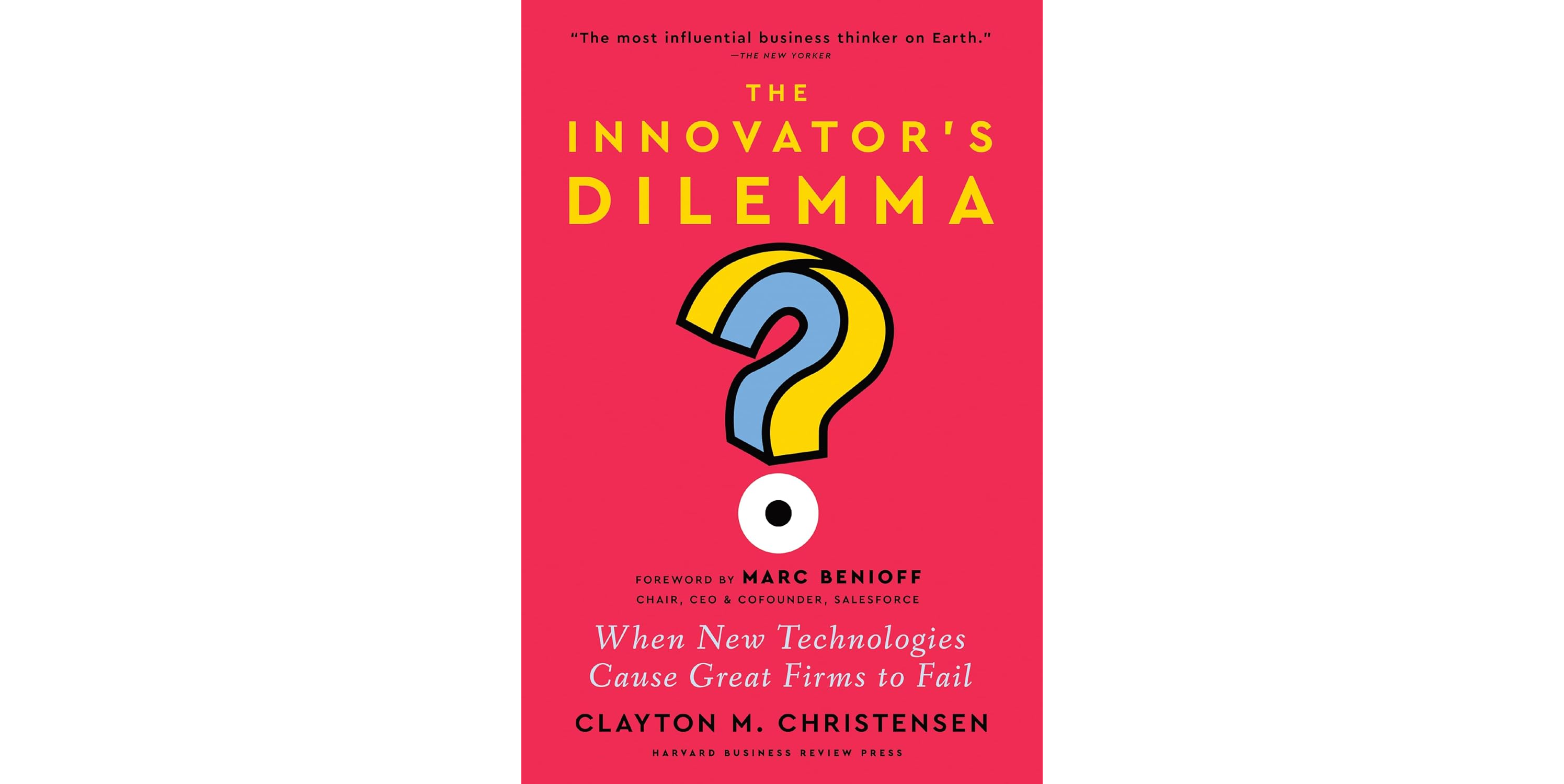
They listened to their customers. They invested in the most profitable innovations. They relentlessly improved quality. So why did these excellent companies lose their markets? Clayton Christensen's The Innovator's Dilemma, published in 1997, gave a clear theoretical framework to this paradoxical question. Disruptive technologies start small, simple, and low-margin. That's precisely why well-run companies rationally ignore them. But technology advances faster than market demand — and eventually swallows the mainstream whole.
📖 Who should read this book:
Startup founders and product managers
Anyone driving innovation inside a large company
Anyone who wants to structurally understand why good companies lose
📕 Get it on Amazon:
The Innovator's Dilemma, with a New Foreword: When New Technologies Cause Great Firms to Fail
Reflections
Your greatest strength can become your greatest weakness — that single idea summarizes the entire book. It's precisely because an organization excels at sustaining innovation that it can't respond to disruptive innovation.
Disruptive technologies shouldn't be shelved until core customers demand them. They require marketing to create entirely new markets. This brought me back to the foundational truth that marketing is an act of market creation.
The difficulty of organizations hit hard. Even people who are individually flexible become constrained when embedded in an organization — processes and values ossify and become culture. The framework that "the central factors defining an organization's capabilities and disabilities shift over time from resources to processes and values, and then to culture" finally made clear to me what culture actually is.
This book helped me understand the purpose of independent labs like Amazon Lab126 and Walmart Labs. Let researchers pursue technical breakthroughs without worrying about budgets. Physically separate them from the main organization. But research alone isn't enough — without alignment with marketing, it's meaningless.
It also taught me why perfect efficiency is dangerous. It connects to the finding that only 70% of ants in a colony are working at any given time. Pursue efficiency too aggressively and you eliminate the redundancy needed to adapt to change.
The purchasing hierarchy framework (Function → Reliability → Convenience → Price) is immediately practical. Where is our product on this ladder? Have we sufficiently delivered on function? Is reliability the next priority? It directly informs daily decision-making.
Every disruptive technology was smaller, simpler, and more convenient than what it replaced. This insight connects directly to the "start with a niche" philosophy.
The insulin case study was vivid. If increasing purity makes doctors happy and that's the only KPI, there's no mechanism to notice that the majority of the market doesn't need that level of purity.
The hardest part is how to apply these frameworks. In hindsight, disruption is obvious. Making the right call while you're in the middle of it is an entirely different problem.
I was curious about how this theory adapts to the software era. Hardware is expensive and slow to develop, making it vulnerable to disruption. But Facebook and Google aren't being disrupted — because software has zero marginal production cost, enabling rapid adaptation. That flexibility is the real moat.
The scariest insight is that disruptive technologies are technically "easy." Easy enough to be underestimated. Easy enough for new entrants to build.
What We Discussed in Our Book Club
The True Nature of Culture — Processes and Values
"Culture matters" has been repeated in Built to Last and countless other books, but what culture actually is had always been vague. This book finally made it concrete. Culture is the aggregate of processes (how work gets done) and values (the criteria for what gets prioritized). Once you break culture into these two components, it becomes something visible.
But strong culture also carries danger. To adapt to changing markets, a meta-level growth mindset — "when the market changes, we must change too" — needs to be baked into the culture itself. Darwinian adaptability. But even that isn't enough. You also need to spin off independent organizations to pursue different things. Both axes have to move simultaneously.
Netflix's Madness — The Courage to Kill a Growing Business
The most heated discussion centered on Netflix. Their physical DVD rental business was growing — potentially enough to rival Blockbuster — when they made the decision to go all-in on streaming, which was barely gaining traction at the time. Reed Hastings and Marc Randolph on an airplane deciding "which one do we kill?" and choosing to kill rentals. That scene deserves its own movie.
Without physical inventory, there's no warehouse cost. Warehousing was Netflix's biggest expense. From there, the logic may have been: "If we drop physical, we can do anything." The courage to abandon short-term profits — not just any profits, but a growing business. This was the rare company that did the opposite of The Innovator's Dilemma.
Why Facebook and Google Aren't Being Disrupted
The book's case studies focus on physical products like hard drives and excavators. So why are internet-era software companies so resistant to disruption? Hardware requires time, capital, and once built, it's hard to change. Software has zero marginal production cost, lives on a screen, and can move from investment to action almost instantly. Network effects help, but fundamentally, software's flexibility is the defensive wall.
But disruption still happens in software. Excel was disrupted by Google Sheets. If Excel had kept evolving, Notion and Airtable might never have existed. Microsoft's core customers are aging legacy users, and raising their learning costs creates no incentive to build something new. That's the Innovator's Dilemma in pure form.
Why Apple Escapes the Dilemma
An interesting observation emerged. The dilemma's core mechanism is that companies ignore disruptive technology because existing customers say they don't want it. But when Apple launches something new, existing customers don't leave. Brand power insulates them from price competition, and they continue to skim the most profitable segment. Ben Thompson's Stratechery has cited Apple as a case where Christensen's theory breaks down.
So what is Apple's brand, exactly? Cool design, simplicity, the Jobs narrative — but it's more than that. Using Apple products creates a social signal: "This person probably designs cool things." Apple engineers how others perceive its users. Product design, retail experience, advertising — everything is consistent. The discussion went as far as whether Apple is essentially a religion at this point.
ChargeSPOT — Disruptive Tech Is Technically Trivial
Japan's fast-growing mobile battery sharing service ChargeSPOT came up as a modern example of disruption. The technology is nothing new — portable batteries have existed for years. But placing them in convenience stores and train stations, creating a rent-anywhere/return-anywhere system, and capturing 96% market share in Japan at ¥150 per rental (actual electricity cost: a fraction of a yen) — that's the business model innovation.
Why now? You can construct post-hoc explanations: women carry mini bags now and don't want to carry a battery. But honestly, why this market is exploding right now can't be fully explained. There's an element of luck — shades of Fooled by Randomness. What is certain is that the book's claim holds: disruptive technology is technically unremarkable. VC Komori-san has also said that emerging companies taking new markets aren't necessarily technologically advanced.
The iPhone Truth — Sony Had the Prototype First
Extending the "technically trivial" thread, the iPhone story came up. Sony had actually developed a prototype before the iPhone — a touch device roughly the size of today's smartphones that could do something similar to i-mode mobile internet. But they never considered bringing it to market. Jobs saw a prototype that engineers had casually built and thought: "Why not make this a phone?"
The instinct to connect technology with a market — that's the most important capability in disruptive innovation. Show an existing customer a 1.8-inch hard drive and they say "we don't need it." But a student realizes it could work as a car GPS. The person who creates the technology, the person who discovers the use case, and the person who can scale it — ideally one person possesses all three, but realistically, a team has to cover the gaps.
Social Capital Is Stronger Than Cash
From ChargeSPOT and Pinterest, the discussion evolved to: "If people don't know you exist, nothing starts." No matter how good the product, if the people who need it can't imagine it, it won't sell. Social capital — influence, impressions — unlike cash, doesn't deplete when you spend it. It actually compounds. If you stay active on a platform, something always comes back.
Pinterest before its Series A had a technical co-founder who was barely contributing part-time. VCs called it a "red flag." It's now worth over $30 billion. Whether you're technically superior isn't the deciding factor. Snapchat's origin story allegedly involves grabbing high school girls off the street to demo the app (accuracy unknown). In the end, technology matters less than marketing, packaging, and storytelling. Winning the awareness game is what wins the market.
📕 Get it on Amazon:
The Innovator's Dilemma, with a New Foreword: When New Technologies Cause Great Firms to Fail
Quotes
"Your greatest strength can become your greatest weakness."
"Disruptive technologies are typically simpler, cheaper, and more convenient than established products."
"The factors that define an organization's capabilities and disabilities shift over time — from resources, to processes and values, and ultimately to culture."
💡 Save and export your book highlights with Glasp!
The quotes in this article were exported using Glasp. If you're interested in exporting your Kindle highlights, check out this guide:
How to Export Kindle Highlights — Notion, Obsidian, AI Integration & More