Don't Mistake Dots for Lines | Taleb's "Fooled by Randomness" and the Monster of Probability

Feb 24, 2026
7 min read
5 views
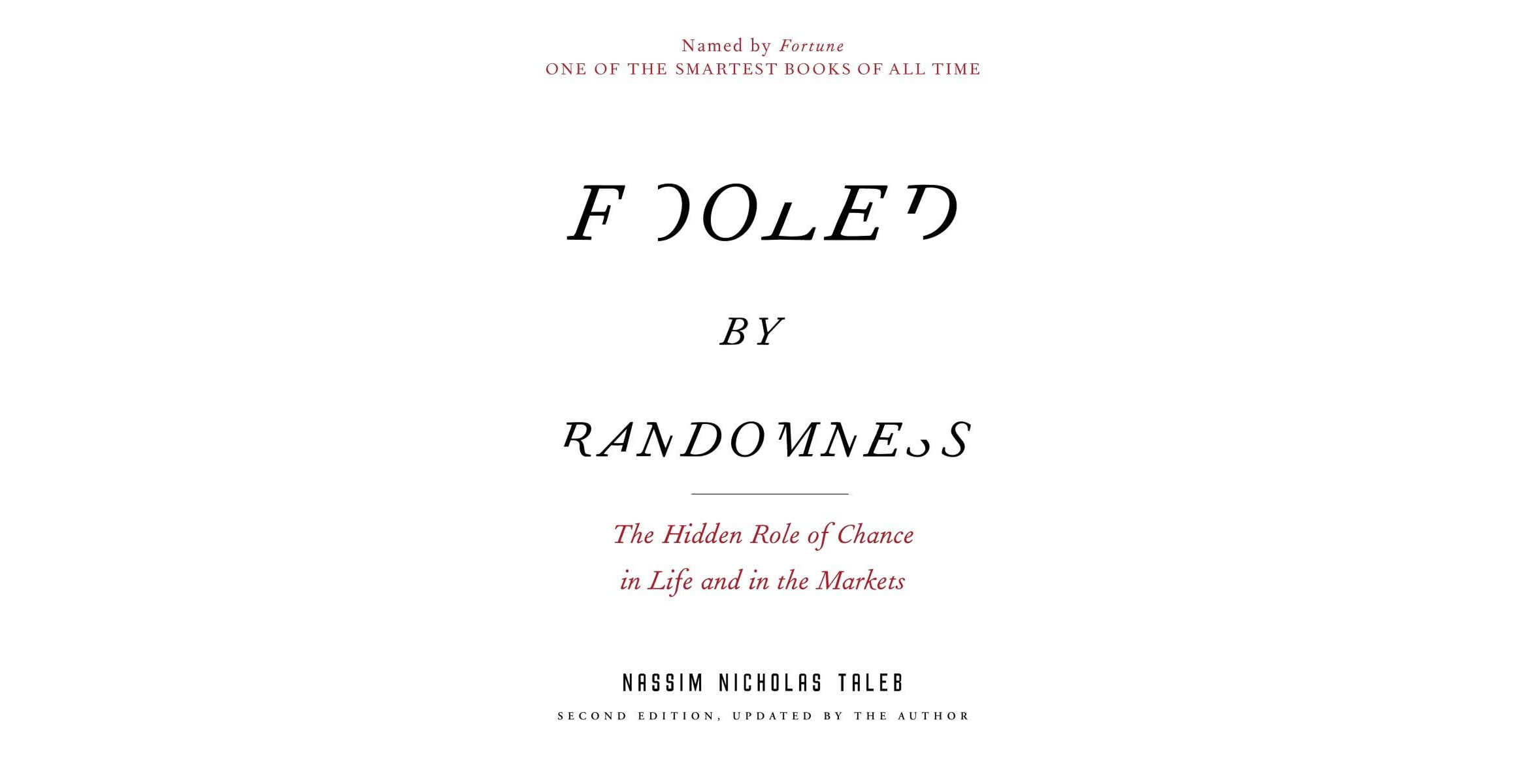
Mistaking luck for skill. Assuming coincidence is causation. Finding common traits among successful people and copying them — Nassim Nicholas Taleb's Fooled by Randomness exposes how spectacularly humans are deceived by randomness, told through real stories from Wall Street trading floors. If the last book I reviewed made me laugh every time I saw a banknote, this one makes me break into a cold sweat every time I look at my portfolio.
📖 Who should read this book:
Anyone involved in investing or trading
Startup founders and decision-makers
Everyone who thinks "I'm different"
📕 Get it on Amazon:
Fooled by Randomness: The Hidden Role of Chance in Life and in the Markets (Incerto)
Reflections
Your greatest strength can become your greatest weakness — a phrase that also appears in The Innovator's Dilemma — but in this book it takes the form of "your greatest success can become your greatest risk." You misattribute your success to your own ability, and without realizing it, your risk exposure keeps growing.
"It is wrong to use statistics without theoretical backing. But the reverse is not wrong." This single line in the opening pages encapsulates the entire book. The danger of presenting specific data as though it were established fact.
Don't confuse being right with being understandable. Something that can be summarized in one sentence isn't necessarily true. This hits hard when you think about crafting a company's "Why" — its mission statement.
"Mathematics is not a tool for computation. It is a tool for deep thinking." Even if you're terrible at math, this reframing itself is an insight.
The human brain doesn't "think" about risk — it "feels" risk. We process it through the emotional centers, not the rational ones. That's why we misjudge it. And people who are purely rational tend to have abnormalities in their amygdala, impairing the capacity for attachment. In other words, it's precisely because we have emotions that we're irrational. That's what makes us human.
If enough monkeys bang on typewriters, one will produce Shakespeare. Given a large enough sample size. Investing and startups work the same way — the only way to improve your odds is to increase the number of attempts.
The difference in happiness between someone who checks their trading results once a day versus once a year — and yet the author himself checks every day. Knowing we're imperfect while remaining imperfect. This person's greatest strength is knowing his own weakness. Awareness is the first stage; translating that into behavior requires entirely different discipline.
What's characteristic of traders who blow up is that they understand their world so well that they convince themselves disaster can't happen to them. They're not brave — they simply don't understand.
A hero is not a hero because of the outcome. A hero is a hero because of heroic action.
You shouldn't mistake luck for skill — but it's equally wrong to dismiss luck as worthless. That balance is incredibly hard to maintain.
What We Discussed in Our Book Club
You Can Only Increase the Sample Size — Startups and Probability Theory
The infinite monkeys and Shakespeare thought experiment led us to conclude that startups operate under the same logic. To produce a specific outcome, you can only increase the number of attempts. You can't control timing or luck, but you can increase the number of swings you take.
The complication is non-linearity. You might be one step away from explosive growth, but most people quit just before that threshold. Then again, blind persistence is its own problem. This judgment call is the hardest part of all. Our conclusion: "Stay healthy, live long, and keep swinging. That's everything." Even if you stop painfully close two or three times, catching the right wave on your fourth attempt can still work out.
The True Nature of Risk — The Risks You Don't See
What does "risk" actually mean in this book? Through discussion, we arrived at a distinction: there are risks you're aware of and risks you're not. Taking a known risk is a strategic decision. But when past success inflates your confidence and you unknowingly accumulate more risk — that's the real danger this book warns about.
One passage stayed with everyone: "In real life, the revolver is invisible. The generator can rarely be observed with the naked eye. So people give their Russian roulette a low-risk name and pull the trigger." We take real risks and either pretend they don't exist or relabel them to make them seem smaller. Our brains force this on us.
The Irony of Charisma — Impressions Without Substance
"People don't become leaders because they're competent. They become leaders because their physical signals create an entirely unsubstantiated impression on others." One member had a visceral reaction to this line, and the discussion became heated.
We concluded that this is Taleb's irony. The person who gives great presentations gets promoted. The CEO with a big social media following gets called "charismatic." But none of that is actual leadership. It's the polar opposite of what Jim Collins calls "Level 5 Leadership" in Good to Great. Yet the ability to present yourself well does attract people — and as social animals, that's its own kind of reality. If someone tells you "You have real charisma," be careful — it might mean they sense there's no substance behind it.
How Much Advice Should You Take? — The Founder's Eternal Question
This was the longest debate of the session. When advice from an experienced mentor collides with your own conviction, which do you follow?
One position: If someone more experienced is operating at a higher level than you, swallowing your discomfort and following their lead accelerates growth. We discussed a case from M&A Center — the person who became the youngest top performer did so by copying everything from a senior colleague. Meanwhile, highly credentialed peers who insisted on doing things their own way fell behind.
The counter-position: Advisors only see a fraction of your full picture. If they know 3 out of 10 pieces, their optimal advice based on those 3 pieces may not match the optimal decision based on all 10. Product feedback from non-users can be pure noise. Someone also raised the question: "If these advisors are so good, why haven't they achieved the level of success you're aiming for?"
The landing point was a set of distinctions. Advice about a founder's mindset and way of being — relatively safe to accept. Advice about your product — weight it by the advisor's domain expertise and whether they've actually used the product. A CEO's job is to receive all kinds of advice and ultimately make the call themselves. That freedom and responsibility is what makes being a CEO worthwhile.
Someone shared the story of Kunio Yonenaga, a Japanese chess (shogi) master who told his teacher: "If I keep following your advice, I can never surpass you. I'm aiming to be the best in Japan." He went on to become exactly that. If you truly have the ability, people will gravitate toward you and lift you up. If that's not happening yet, maybe you're still in the phase where you should be listening.
Short-Term Noise vs. Long-Term Truth
Everyone agreed with Taleb's observation that "in the long run, a person's true nature reveals itself." The hard part is defining what counts as "noise." Balancing the strength of conviction with the humility to listen is extraordinarily difficult. And believing "I've thought about this more deeply than the experienced person advising me" might itself be exactly the overconfidence this book warns against.
We didn't reach a conclusion, but someone connected it to the data showing that founders between 35 and 45 have the highest success rates. The hypothesis: in your twenties, you're sharp and insist on doing things your way but can't get results. In your mid-thirties to forties, you develop the judgment for subtle calibration — and that's when breakthroughs happen.
Is Entrepreneurship Science or Gambling?
Stock markets are highly random. Dentists and pianists can reliably improve through practice. So where does entrepreneurship fall on this spectrum? There's a scientific component, but when 98% of ventures fail, the structure might be closer to monkeys on typewriters.
People say it's "Science × Art." The science part — reproducible practices — is where mentors' advice has genuine value. The art part — timing, luck, personality — can't be controlled, and advice doesn't help. Whether a founder can actually separate these two domains in real time might be the ultimate test of their capability.
📕 Get it on Amazon:
Fooled by Randomness: The Hidden Role of Chance in Life and in the Markets (Incerto)
Quotes
"It is wrong to use statistics without theoretical backing. But the reverse is not wrong."
"Mathematics is not a tool for computation. It is a tool for deep thinking."
"Heroes are heroes because they are heroic in behavior, not because they won or lost."
💡 Save and export your book highlights with Glasp!
The quotes in this article were exported using Glasp. If you're interested in exporting your Kindle highlights, check out this guide:
How to Export Kindle Highlights — Notion, Obsidian, AI Integration & More
📚 See what other readers highlighted in this book: