Half a Century of Fighting | The Journey of Katharine Graham, America's Most Powerful Female Publisher

Feb 25, 2026
7 min read
7 views
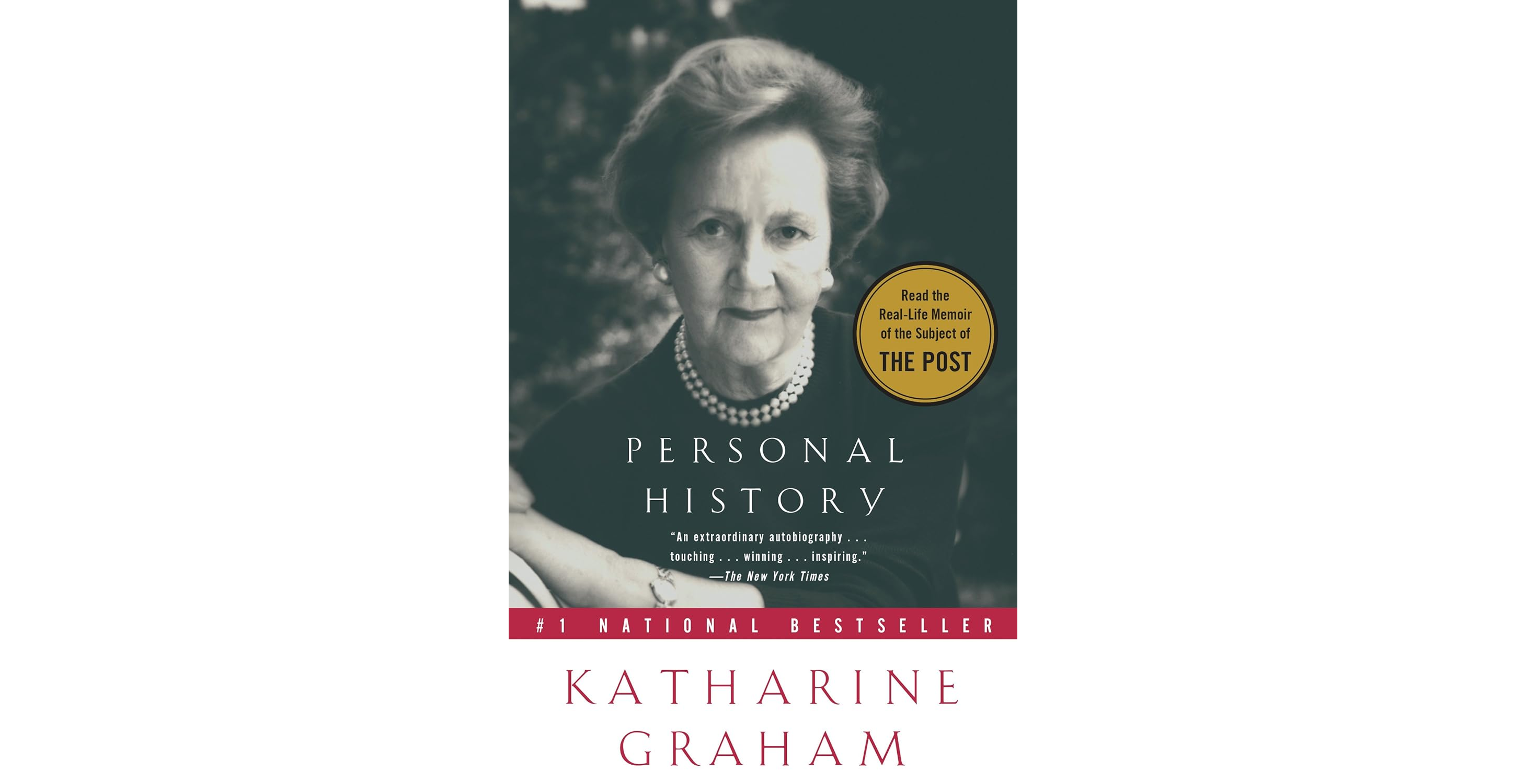
At 900 pages, I braced myself. But once I started reading, it was over in a flash. Well, not a flash — but far faster than I expected. Graham wrote it herself, and since she came from a journalism background, the depth is extraordinary. She traces back to her parents' origins with remarkable detail. She barely touches her own children's lives out of respect for their privacy, yet writes about her parents with astonishing frankness.
This is a book about a woman's rise to power in a male-dominated era, the battle between journalism and authority, and one person's life woven into a larger history. She became the head of a major newspaper in America — in the toughest possible domain: journalism. And yet things worked out. I believe that ultimately came down to who she was as a person.
📖 Who should read this book:
Anyone interested in the lives of women in leadership
Anyone who wants to understand American media history and its relationship with politics
Anyone thinking about the strengths and limits of family-owned businesses
📕 Get it on Amazon:
Reflections
What stands out most is her ability to trust people. She had good judgment in choosing whom to trust, and she genuinely was a trusting person. That matters enormously in running an organization. Whether it was Watergate or the Pentagon Papers, she believed in her paper. That belief was rooted in what her father and Phil had built — a commitment to journalism's mission. They didn't publish based on a single source; they painstakingly verified from multiple angles before going to press. Being able to trust that process, and the people executing it, is immensely powerful. Good people gravitate toward someone like that, and it creates the collective will to push forward together.
Her insistence on quality was equally striking. She cared deeply about the truthfulness and quality of the articles. Having confidence in what you publish is a fundamental principle of business. Reading this reinforced that conviction.
I was surprised that she left for a European trip just one week after Phil's death — leaving her children behind. It apparently worked out, but people around her must have had thoughts about it. The fact that she then continued as a business leader is remarkable in itself.
It was shocking to learn that the treatment for depression at the time was electroshock therapy. From today's perspective, it seems unthinkable — but that was the medical standard of the era.
Throughout the book, the prevailing tone is "I should have done more" and "I was so ignorant at the time." She may have been the type who used regret as fuel. Perhaps that's why her drive was so strong. I think her mother's influence shaped this pattern of thinking.
Warren Buffett's mention of Charlie Munger's "Orangutan Theory" was amusing — the idea that thinking becomes organized through the act of speaking. I was also surprised to learn that Buffett sat on Katharine's board, and that he'd been the only student to earn an A in a notoriously difficult university course. The signs were there from the beginning.
The Washington Post was eventually sold to Jeff Bezos for roughly $250 million. In Graham's era, newspapers and radio were the primary information channels. That landscape has fundamentally shifted. Watching a company that built an era's worth of history pass into someone else's hands carries both sadness and the inevitability of changing times.
How people encounter information keeps evolving. Newspapers, radio, TV — then social media made everyone an editor. Now AI answers any question instantly. Factoring in VR and beyond, how people will access information and how it will be archived is a genuinely open question.
That someone like Katharine Graham left behind such a thorough personal record at this level of quality is extraordinary. Today, anyone can publish on Twitter, Note, or Medium — but no one writes at this depth. If more people doing interesting work left behind records like this, they would become inspiration for generations to come.
What We Discussed in Our Book Club
Family Business Success and the Three-Generation Curse
In Japan, family businesses often conjure images of internal power struggles. But the Graham family represents a successful case of family management — at least for a certain period. The foundation, however, was enormous inherited wealth. Her father poured money into the paper again and again to revive it. The entire family was well-educated and trusted in the business world. That credibility was essential.
"Family businesses usually end by the third generation" is a well-known principle, and the Washington Post followed that pattern. As generations pass, the founder's original entrepreneurial drive fades. For media companies especially, the challenge of adapting to changing times compounds this. Drawing from our earlier reading of a book on Suntory, the question of whether and how to bring in outside leadership is one that requires extreme care.
When her father acquired the Post after the Times-Herald, he bought it for $800,000 — down from the original $5 million asking price — and invested heavily from personal funds to make it viable. The sheer difficulty of building a newspaper from near-ruin was eye-opening.
The Deep Connection Between Media and Politics
Presidents appear throughout the book. It reinforced just how tightly intertwined politics and media are. From the president's perspective, having a trusted media partner who won't distort your message is valuable. From the media side, having direct access to information is invaluable. It's a mutually beneficial relationship — but one that exists under constant tension: the truth must never be compromised.
In Japan, it's not the establishment newspapers that break scandals — it's tabloids like Shukan Bunshun. The mechanisms for challenging authority differ between the two countries. How media will evolve from here became a topic of genuine curiosity for the group.
The Culture of Preserving Family History
We marveled at how thoroughly Americans document their family histories. In Japan, few families keep genealogical records at home. NHK's Family History program featuring actor Masao Kusakari became famous partly because Japanese-side records were almost nonexistent. In contrast, American military and civic records preserve individual histories going back generations.
Most members had no knowledge of their family beyond their grandparents' generation. Some old families in Kyoto maintain genealogical records, but that's the exception. This cultural difference in preservation was fascinating to discuss.
The Visceral Experience of Watergate
Graham herself wrote that she was "groping in the dark from a distance" during Watergate. But her psychological state during that period is something we can only imagine. As the leader, she wasn't conducting the investigation — her reporters were. She was being asked "What's happening?" from all sides while maintaining her social and business obligations. That lived experience is ultimately unknowable from the outside — but the fact that she kept trusting her paper and her reporters throughout is a testament to her strength.
The Power of Writing Your Own Story
We've read many biographies, but memoirs written by the person themselves hit differently. Biographies written by skilled journalists are excellent, but only the author can reveal what they were actually thinking, the context behind their decisions, and the psychology of each moment.
That said, a memoir only shows Katharine's perspective. Watching how she relates to her children, you can't help but wonder whether they would give her a very different evaluation.
The Human Capital Behind the Business
When Phil died and Katharine took over, the business infrastructure was already solid. Outstanding journalists were in place, Buffett was on the board, and her father had built the foundation. Even though Katharine knew very little, each function was already operating effectively, surrounded by capable allies.
The structure — protect the top through bloodline while filling every operational role with excellent talent — echoes certain Chinese governance philosophies. No organization can exceed the character of the people running it. That truth applies universally.
📕 Get it on Amazon:
Quotes
"Journalism is the first rough draft of history."
"An investment in knowledge pays the best interest." — Benjamin Franklin (quoted in the text)
💡 Save and export your book highlights with Glasp!
The quotes in this article were exported using Glasp. If you're interested in exporting your Kindle highlights, check out this guide:
How to Export Kindle Highlights — Notion, Obsidian, AI Integration & More