How Do You Highlight Text on a Web Page?
To highlight text on a web page and keep it, install a highlighter extension such as Glasp's web highlighter, select the text, and click a color. The extension saves the passage to your account and paints it back onto the page every time you return. Browsers mostly can't do that on their own: Chrome, Edge, Firefox, and Safari can copy a link that highlights one passage for whoever opens it, and only Safari on a Mac can keep a highlight, through Quick Note.
The longer answer depends on what you mean by "highlight", because people use the word for at least five different jobs.
| What you want to do | Fastest method | Is anything saved? |
|---|---|---|
| Select text so you can copy it | Drag across it, double-click a word, triple-click a paragraph, or press Ctrl+A (Cmd+A on a Mac) for the whole page | No |
| Point someone to one passage | Select it, right-click, and copy a link to the highlight (Chrome, Edge, Safari 18.2 and later, desktop Firefox 145 and later) | No, you get a URL |
| Keep highlights you can come back to | A highlighter extension such as Glasp, Hypothesis, or Web Highlights | Yes, stored by the extension |
| Mark up a PDF in the browser | The built-in PDF viewer in Chrome, Edge, or Firefox, or an extension | Only in the file you download, unless an extension stores it |
| Highlight on a phone | Glasp's Safari extension on iPhone and iPad, an extension in Firefox or Edge on Android, or an app with its own reader | Depends on the tool |
How to Highlight (Select) Text or a Whole Page with a Mouse or Keyboard
On a computer, "highlight" often just means selecting text, the shaded block you get right before you copy something. These moves work in every desktop browser:
- Click and drag across the words you want.
- Double-click a word to select it, or triple-click to select a whole paragraph.
- Click at the start, then Shift-click at the end to grab a long passage without dragging.
- Press Ctrl+A (Cmd+A on a Mac) to select everything on the page.
On a phone, press and hold a word, then drag the handles until they cover the passage you want.
What Each Browser Can Do Without an Extension
Every major browser can link to a passage, three of them have built-in PDF highlighting, and only Safari can keep a highlight on an ordinary web page, through Quick Note on a Mac.
Google Chrome
Chrome has no built-in way to save highlights on web pages. What it does have is Copy link to highlight: select some text, right-click, and choose Copy link to highlight. Chrome copies the page's address plus a text fragment (the part after #:~:text=). Whoever opens that link lands on the passage, scrolled into view and highlighted, and can right-click to remove the highlight.
It's handy for sending a colleague the one paragraph that matters. But nothing is stored for you. Close the tab and the highlight is gone, and Chrome keeps no list of the passages you've linked.
PDFs are a different story. Chrome's built-in PDF viewer has a Draw tool with a pen and a highlighter (you choose the thickness and color), and in February 2026 Google announced that you can highlight text and add notes to a PDF right in the browser. To keep your marks, download the file and choose to save it with your changes.
Microsoft Edge
Edge doesn't highlight ordinary web pages either, though it offers the same Copy link to highlight option on the right-click menu. Its PDF reader is stronger: select text, right-click, choose Highlight, and pick a color. You can also add comments and draw with a pen. Edge's Screenshot tool (called Web capture until 2024) lets you draw on a capture of a page, but that's an image, not a highlight on the page itself.
Apple Safari
Safari is the one browser with a built-in highlight that survives a revisit, thanks to Quick Note. On a Mac running macOS Monterey or later, select text, Control-click, and choose Add to Quick Note. The text is highlighted in Safari, and Apple's guide says that when you revisit the website, "your highlight is still there." On iPad (iPadOS 15 and later) and iPhone (iOS 16 and later), Quick Note can save passages from Safari too, but Apple only promises a thumbnail of your note when you come back, not the highlight on the page.
The catch is that these highlights live inside Apple Notes and Safari. They won't follow you to Chrome, to a Windows PC, or into a notes app of your choice.
On iPhone and iPad, Safari has one more trick: tap Share, then Markup, and you can highlight and draw on the page. The result is saved as a PDF copy, though, not marked on the live page.
Safari also understands text-fragment links. It has opened them since Safari 16.1 (October 2022), and since Safari 18.2 (December 2024) you can right-click selected text and choose Copy Link with Highlight.
Don't confuse any of this with Highlights, a Safari 18 feature that uses machine learning to surface things like directions, summaries, and quick links for the page you're on. Despite the name, it isn't something you draw on the page.
Mozilla Firefox
Firefox arrived last. It started opening text-fragment links in Firefox 131 (October 2024) and added its own Copy Link to Highlight to the desktop right-click menu in Firefox 145 (November 2025). Its built-in PDF viewer has had a highlight tool since Firefox 125 (April 2024), and Firefox 145 added comments on PDFs. For ordinary web pages, there's still no native way to save highlights.
| Browser | Saves highlights on web pages | Copy a link to a passage | Highlight PDFs | Extensions on phones |
|---|---|---|---|---|
| Chrome | No | Yes (desktop, Android, iPhone) | Yes, built-in viewer | No |
| Edge | No | Yes | Yes, with colors | Android, a curated list since 2025 |
| Safari | Mac only, via Quick Note | Yes, since Safari 18.2 | Not in Safari (Preview on a Mac, Markup on iPhone and iPad) | iPhone and iPad, through App Store apps |
| Firefox | No | Yes, desktop since Firefox 145 | Yes, since Firefox 125 | Android, for add-ons marked Android-compatible (since December 2023) |
So unless you're using Quick Note on a Mac, highlights that are still there next week take an extension or a bookmarklet.
How to Highlight Any Web Page with a Browser Extension
A highlighter extension, often called an online or website highlighter, adds a thin layer on top of whatever page you're reading. When you select text and choose a color, it records the text and its position on the page, then saves both to your account. Next time you open the same URL, it finds the passage and repaints it. The steps below use Glasp, a free social web highlighter.
Step 1: Install the Extension and Create an Account
Glasp's highlighter works in all four major desktop browsers:
- 👉 Chrome Web Store (also for Brave, Opera, and other Chromium browsers)
- 👉 Microsoft Edge Add-ons
- 👉 Firefox Add-ons
- 👉 Safari for Mac (Mac App Store)
Then create a free Glasp account and pin the Glasp icon to your toolbar so the sidebar is one click away.
Step 2: Select Text and Pick a Color
Open any article and select a sentence. A small menu appears with four colors: pink (the default), yellow, green, and blue. Click one and the text is highlighted instantly, and it shows up in the Glasp sidebar too. Click any highlight to add a note, and tag the page so you can find it by topic later.
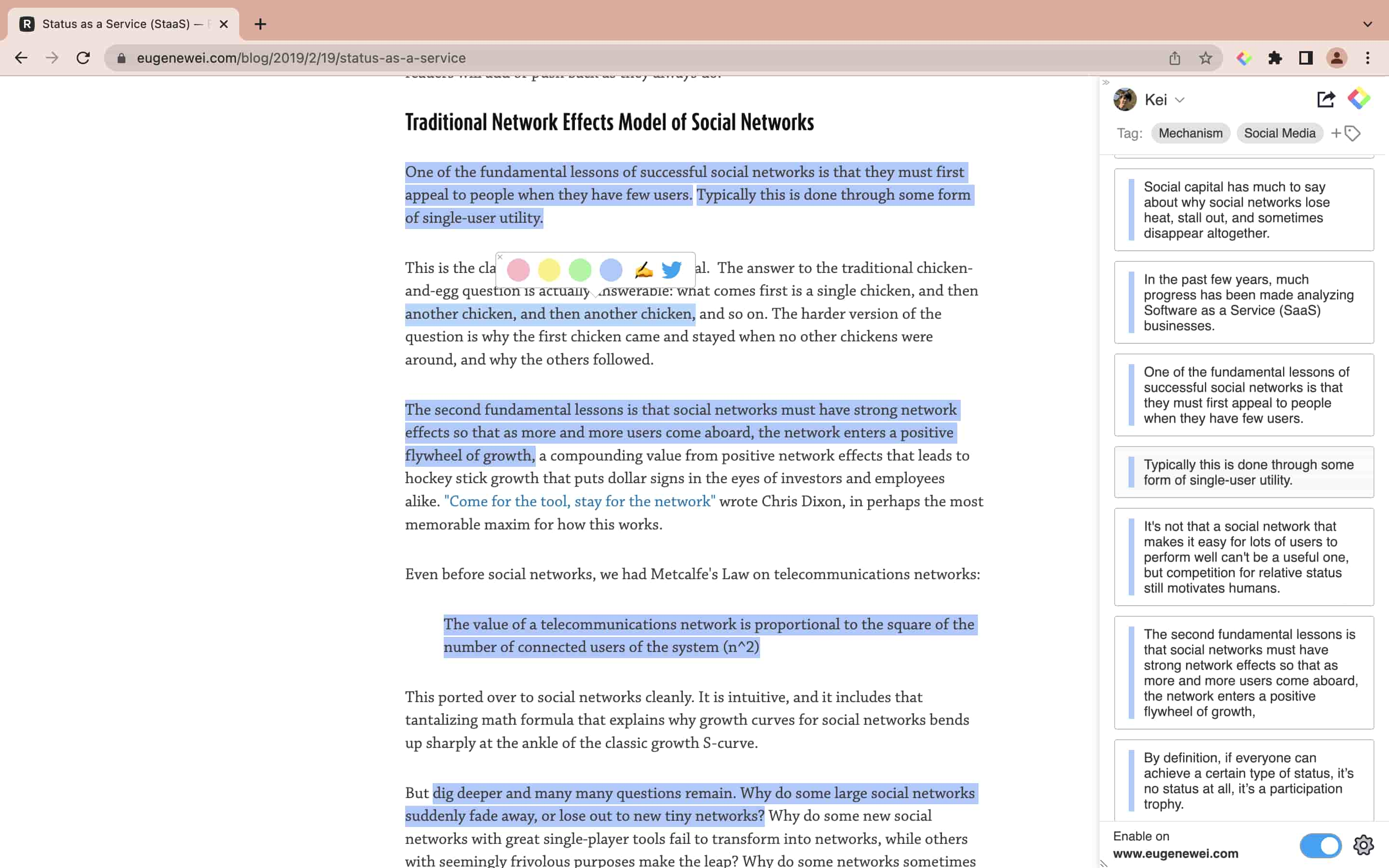
The same extension handles PDFs. Open a PDF in your browser and Glasp can show it in its own PDF highlighter viewer, where highlighting works exactly the same way. Scanned PDFs with no selectable text are the exception. If PDFs are most of your reading, our guide to the best PDF highlighters compares the dedicated tools.
Step 3: Come Back, Search, and Export
Return to the page later and your highlights are still there. Every highlighted page also lands in your Glasp library, where you can search across everything you've ever marked. When you want to take your highlights somewhere else:
- Download them as TXT, Markdown, HTML, CSV, or JSON, one page at a time or all at once.
- Sync them to Notion automatically, pull them into Obsidian with the official Glasp plugin, or send them to Readwise, Roam Research, Zotero, Tana, or Workflowy.
- Study them as flashcards by downloading an Anki deck.

Glasp also brings old highlights back to you. A Highlight Review email resurfaces past highlights on a schedule you choose (every day, twice a week, or once a week), and you can chat with your highlights to ask questions that get answered from what you've saved. Imported Kindle highlights and YouTube video summaries sit in the same library, so books, videos, and web pages end up in one place.
Step 4: Share Pages and See What Others Highlighted
Each page you highlight gets its own shareable page on your profile. Instead of sending a bare link with "good read!", you can send exactly the passages that mattered and the notes that explain why. The extension can also copy a link to a single highlight, post a highlighted passage to X or Bluesky, or share the page's link on Facebook or LinkedIn.
Because Glasp is a social highlighter, you can see what other readers highlighted on the same article, and the community feed shows what people are reading and highlighting across the web. Highlights are public by default; keeping individual highlights private requires a paid plan (Pro or Unlimited).
How to Highlight Web Pages on iPhone, iPad, and Android
Mobile is where most highlighting advice goes stale, because the rules are different on each platform.
iPhone and iPad
Safari on iOS runs extensions that come bundled inside App Store apps. The Glasp app for iPhone and iPad includes one. Install the app, allow the Glasp extension in Safari, and you can select text on any page and tap a color, just as you would on a desktop. You can add notes and tags and share what you highlight, and a panel shows the page's highlights, an AI summary, a chat about the page, and what the community highlighted there.
Without an extension, Safari's Quick Note and Markup are the built-in options (see the Safari section above). Chrome on iPhone can also create a link to a highlight: select text, then tap Create link.
Android
Chrome for Android doesn't run extensions at all. Google's help page says extensions only work on computers, even if you request the desktop site. You have three workarounds:
- Firefox for Android has accepted, since December 2023, any add-on whose developer marks it Android-compatible, so check whether your highlighter's add-on is offered for Android.
- Edge for Android began offering a small, curated set of extensions in 2025.
- An app with its own reader. In the Glasp app for Android, share a link from any app to Glasp, tap Open in Reader or Save & Highlight, and the page opens in a built-in reader where you can highlight and take notes. Everything lands in the same library as your desktop highlights.
For a quick share without saving anything, Chrome for Android can still create a link to a highlight: select the text and tap Share.
Original-Page Highlighters vs. Read-Later Apps in 2026
Tools that highlight web content take one of two approaches.
Approach 1: Highlight the Original Page
A browser extension marks up the live page you're reading. Your highlights stay attached to the real URL, so they reappear when you return, and anyone you share with sees the same source. Glasp, Web Highlights, Liner, the Readwise Highlighter extension, and Raindrop.io's extension all work this way, as do Hypothesis (once you switch it on for the page) and Weava (for your active folder). For a head-to-head comparison, see our guide to the best online highlighters.
Approach 2: Highlight a Saved Copy
Read-later apps fetch the article, strip ads and navigation, and store a clean copy. You highlight their copy, not the original. This category has shrunk sharply since this guide was first published. Omnivore's hosted app shut down in November 2024 when its team joined ElevenLabs, and Mozilla shut down Pocket on July 8, 2025.
The survivors charge for full highlighting. Instapaper's free plan caps notes at five a month, Matter keeps unlimited highlighting for Premium, Feedly reserves highlights for its paid plans, and Readwise Reader is paid-only.
| Feature | Original page (extensions) | Saved copy (read-later apps) |
|---|---|---|
| Setup | Install an extension once | Save each article to the app |
| Where highlights show | On the live page, every visit | Only inside the app |
| Content freshness | Always the current page | A snapshot from the day you saved it |
| Sharing | Easy, and links point to the real source | Usually private or limited |
| Offline reading | Needs a connection | Usually available offline |
| Ads and clutter | You see the page as published | Stripped out |
| Cost of highlighting | Free tiers are common (Glasp, Hypothesis, Web Highlights) | Unlimited highlighting is usually paid |
| Main risk | A highlight can fail to reappear if the page is heavily rewritten | The copy goes stale, and apps can shut down (Pocket, Omnivore) |
Choose original-page highlighting if you read a lot on the web, want your highlights in context when you come back, and like sharing what you read. We recommend it for most people.
Choose a read-later app if you mostly read offline, want a distraction-free view, or need a copy that survives if the page disappears. Some people use both: Readwise, for example, pairs its Reader app with an extension that highlights the original page.
Does Highlighting Web Pages Actually Help You Learn?
Yes for remembering what you read, provided you highlight sparingly. It does far less for deep understanding, and that gap explains most of highlighting's bad press.
The bad press usually traces back to a 2013 review by John Dunlosky and four colleagues, which graded ten study techniques and rated highlighting "low utility." Their reasoning was specific: as students typically use it, highlighting does little to boost test performance, and it may even hurt on tasks that require making inferences. Only two techniques, practice testing and distributed practice, earned "high utility." The same review pointed out that in the few studies where students were trained to highlight, with feedback that stopped them from marking too much, performance improved.
More recent evidence is kinder to careful highlighters:
- A 2022 meta-analysis by Ponce, Mayer, and Méndez pooled 85 effect sizes from 36 published articles. Highlighting while reading improved memory for the text (effect size 0.36) but not comprehension (0.20). College students benefited (0.39), while K-12 students didn't (0.24). Text that an instructor had already highlighted helped both memory and comprehension (0.44 each).
- Yue, Storm, Kornell, and Bjork (2015) found an overall benefit of highlighting, largest when students reread the text in a single sitting.
- Joshi and Vogel (2024) capped one group of readers at 150 highlighted words, about 10% of a roughly 1,500-word story. A day later, on a short open-book quiz, the capped group scored 14.3 out of 20, ahead of unlimited highlighters (12.1) and readers who didn't highlight at all (10.5).
Reading on a screen adds its own wrinkles. In a study of 371 students in grades 5 to 8, more highlighting on paper went with lower comprehension, while more highlighting on screen went with higher comprehension (Goodwin et al., 2020). The authors' explanation was that paper highlights more often landed on unimportant text. A 2024 study of 170 university students reading on screen found that highlighting wasn't effective in itself; what mattered was the quality of what readers chose to mark (Mason et al., 2024).
Reading alongside other people may help too. In one introductory physics course, students who discussed their readings on Perusall, a social annotation platform, scored significantly higher on exams than students in two earlier semesters who had used a simpler annotation tool (Miller et al., 2018). The comparison wasn't randomized, so treat it as a promising signal rather than proof.
Finally, highlighting gives you something to review, and review is what makes it stick. In Hermann Ebbinghaus's 1885 experiments on himself, the effort he saved when relearning a list of nonsense syllables fell to about a third after one day and a quarter after six days. Coming back to your highlights a few times, spread out over days, turns them into distributed practice, one of the two techniques the Dunlosky review rated most useful. For the full research story, see our deep dive on the science of highlighting.
Best Practices for Effective Web Highlighting
The research points to a handful of habits that separate useful highlighting from colorful busywork.
Set a Budget Before You Start
No study backs a magic percentage, but limits seem to help. The 150-word cap in the Joshi and Vogel study worked out to about 10% of the text, and in a 1975 study by Rickards and August, students limited to underlining one sentence per paragraph later recalled more of a science text than students who didn't underline at all. A practical rule: read the whole paragraph first, then highlight the one sentence that carries it.
The old warning that over-highlighting "decreases test performance" rests on thinner evidence than its reputation. In Fowler and Barker's 1974 experiment, students who highlighted more scored somewhat lower a week later, but with only 19 highlighters the correlation (r = -0.29) wasn't statistically significant. The practical point survives anyway: when everything is marked, nothing stands out.
Add Your Own Notes
A highlight shows what caught your eye. A note records what you thought about it. Weeks later, a bare highlighted sentence can feel meaningless, while one with a note like "This contradicts what I read about X" is still useful. Glasp lets you attach a note to any highlight, so your thinking stays next to the source. For techniques beyond highlighting, see our complete guide to annotation.
Use a Color-Coding System
Assigning each color a meaning adds a quick sorting decision while you read, and it makes your highlights scannable at a glance later. With Glasp's four colors, a simple system looks like this:
| Color | Meaning |
|---|---|
| Pink (default) | Core argument or main idea |
| Yellow | Supporting evidence or data |
| Green | Examples or ideas to try |
| Blue | Questions, doubts, or things to look up |
Keep the system small and stick with it. Four colors you use consistently beat eight colors you have to remember.
Review on a Schedule
Highlighting is only half the job. The other half is coming back. Skim your recent highlights once a week, or let Glasp's Highlight Review email bring them to you. Before rereading a highlight, try to recall the point it makes and why you marked it. That turns review into retrieval practice, which works far better than passive rereading.
Organize by Topic, Not by Source
Most people file highlights by the article they came from. It's more useful to group them by the topic or project they serve. When you export highlights into Notion or Obsidian, collect them under themes rather than source URLs, and your highlights start to work like a knowledge base that supports your thinking and writing.
Frequently Asked Questions
How do I highlight text on a website in Chrome?
Chrome can't save highlights by itself. To keep them, install a highlighter extension such as Glasp from the Chrome Web Store, select text, and click a color; your highlights reappear whenever you revisit the page. To send one passage to someone, select it, right-click, and choose Copy link to highlight.
Can you highlight a web page without installing anything?
Partly. Every major browser can create a link that highlights a passage for whoever opens it, and Safari on a Mac can keep highlights through Quick Note. For saved, searchable highlights in Chrome, Edge, or Firefox, you need an extension or a bookmarklet; Hypothesis offers a bookmarklet for Firefox and Safari. Its Via proxy, which once let people annotate pages with nothing installed, has been limited to partner sites since February 2026.
How do I permanently highlight text on a web page?
Use a tool that stores your highlights: an original-page extension such as Glasp, or a read-later app that saves a copy. With Glasp, highlights belong to your account, so they reappear on the page in any browser where the extension is installed and you're signed in. If a page is heavily rewritten and a highlight can't be placed again, the text is still saved in your library.
How do I highlight text on a web page on my iPhone?
Install the Glasp app, allow its Safari extension, then select text in Safari and tap a color. Without an app, Quick Note can save a passage, Markup can highlight a PDF copy of the page, and Chrome for iPhone can create a link to a highlight (select text, then tap Create link).
Can I highlight PDFs in my browser?
Yes. Chrome, Edge, and Firefox all have built-in PDF highlighting, though your marks only survive in the file you download. Glasp's extension opens PDFs in its own viewer and saves PDF highlights to your library next to your web highlights.
Can I export my highlights to Notion or Obsidian?
With Glasp, yes. Notion syncs automatically, Obsidian imports through the official Glasp plugin, and you can also send highlights to Readwise, Roam Research, Zotero, Tana, or Workflowy, or download them as TXT, Markdown, HTML, CSV, or JSON files. Exporting is free.
Can other people see my highlights?
It depends on the tool. Glasp is a social highlighter, so highlights are public by default, which is what lets readers learn from each other. Private highlights require a paid plan (Pro or Unlimited), and some things stay private automatically on every plan, including uploaded PDFs, Kindle imports, and pages like email or AI chats. Hypothesis offers public, group, and private layers, while read-later apps keep highlights to yourself.
Does highlighting actually help me learn, or is it just busywork?
It helps you remember a text when you do it selectively, and it does little for deeper comprehension on its own. A 2022 meta-analysis of 36 published articles found a memory benefit but no comprehension benefit, and in a 2024 experiment, readers limited to about 10% of a text outscored unlimited highlighters. Pair sparing highlights with notes and spaced review.
Conclusion: Highlight Less, Keep More
Browsers have gotten good at pointing to a passage. Chrome, Edge, Safari, and now Firefox can all hand someone a link that scrolls straight to the sentence you meant. What most of them still can't do is remember what you highlighted, which is the part that turns reading into knowledge you can use later.
Remembering is a highlighter's job. Install one in the browser you already use, set yourself a budget of about one sentence per paragraph, add a note when something sparks a thought, and come back to your highlights on a schedule. Start with Glasp's web highlighter on your desktop, add the Glasp mobile app for your phone, and browse the community feed to see what other readers found worth keeping.