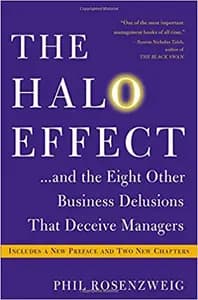
The Halo Effect...: . . . and the Eight Other Business Delusions That Deceive Managers
by Phil Rosenzweig
Recommended byMichael Mauboussin
About This Book
"The Halo Effect: ... and the Eight Other Business Delusions That Deceive Managers" by Phil Rosenzweig is a provocative and insightful examination of common business myths and misconceptions that often mislead managers in their decision-making.
Rosenzweig challenges the widely accepted notion of the 'Halo Effect,' which suggests that a company's overall performance can be attributed to the excellence of its leadership or strategy. Using real-life examples and extensive research, he demonstrates how this belief can lead to flawed assessments, unrealistic expectations, and ultimately, business failure.
Through a series of captivating case studies, Rosenzweig uncovers several other common business delusions that managers frequently fall prey to. He reveals the danger of confirmation bias, where decision-makers selectively interpret evidence to support their preconceived beliefs, and warns against the allure of simplistic cause-and-effect explanations for complex organizational outcomes.
In addition, Rosenzweig exposes the limitations of relying solely on benchmarking and best practices, demonstrating how they can stifle innovation and hinder long-term success. He discredits the notion that success always equals competence, emphasizing the role of luck and opportunity in achieving favorable outcomes.
The author also explores the dangers of basing decisions solely on financial metrics, highlighting the importance of considering a broader range of factors to gain a comprehensive understanding of performance.
"The Halo Effect: ... and the Eight Other Business Delusions That Deceive Managers" challenges conventional wisdom and offers a fresh perspective on the complexities of business success and failure. Drawing on research from a variety of fields, Rosenzweig provides valuable insights and practical advice for managers to navigate the treacherous terrain of decision-making, ultimately allowing them to make more informed and effective choices for their organizations.
Rosenzweig challenges the widely accepted notion of the 'Halo Effect,' which suggests that a company's overall performance can be attributed to the excellence of its leadership or strategy. Using real-life examples and extensive research, he demonstrates how this belief can lead to flawed assessments, unrealistic expectations, and ultimately, business failure.
Through a series of captivating case studies, Rosenzweig uncovers several other common business delusions that managers frequently fall prey to. He reveals the danger of confirmation bias, where decision-makers selectively interpret evidence to support their preconceived beliefs, and warns against the allure of simplistic cause-and-effect explanations for complex organizational outcomes.
In addition, Rosenzweig exposes the limitations of relying solely on benchmarking and best practices, demonstrating how they can stifle innovation and hinder long-term success. He discredits the notion that success always equals competence, emphasizing the role of luck and opportunity in achieving favorable outcomes.
The author also explores the dangers of basing decisions solely on financial metrics, highlighting the importance of considering a broader range of factors to gain a comprehensive understanding of performance.
"The Halo Effect: ... and the Eight Other Business Delusions That Deceive Managers" challenges conventional wisdom and offers a fresh perspective on the complexities of business success and failure. Drawing on research from a variety of fields, Rosenzweig provides valuable insights and practical advice for managers to navigate the treacherous terrain of decision-making, ultimately allowing them to make more informed and effective choices for their organizations.
What People Are Saying
“It’s a short book that will change the way you think”
Revisit Your Highlights, Deepen Your Understanding
Import your Kindle highlights to review, organize, and share the ideas that matter most to you.
Get the free browser extension
Share This Book
More Books in Business
View More
High Output Management
Andrew Grove

Principles
Ray Dalio

Shoe Dog
Phil Knight

Originals
Adam Grant

Rework
Jason Fried

The Ride of a Lifetime
Bob Iger
7 Powers
Hamilton Helmer
Good To Great
Jim Collins

Hopping Over The Rabbit Hole
Anthony Scaramucci
Only the Paranoid Survive
Andy Grove
The Outsiders
William Thorndike
Creativity, Inc.
Ed Catmull
Crossing the Chasm
Geoffrey Moore
Bad Blood
John Carreyrou
Loonshots
Safi Bahcall
Measure What Matters
John Doerr

Range
David Epstein

The Great CEO Within
Matt Mochary
The Power of Habit
Charles Duhigg
The Third Wave
Steve Case
Built To Last
Jim Collins
Getting to Yes
Roger Fisher

Lean In
Sheryl Sandberg

Made to Stick
Chip Heath
Negotiating The Impossible
Deepak Malhotra
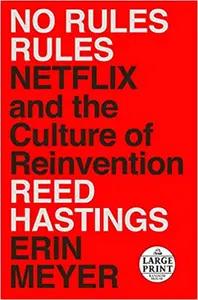
No Rules Rules
Reed Hastings

Sam Walton
Sam Walton

Steve Jobs
Walter Isaacson
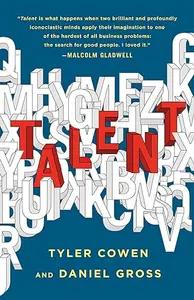
Talent
Tyler Cowen & Daniel Gross

The Fish That Ate The Whale
Rich Cohen
Popular Books Recommended by Great Minds 📚
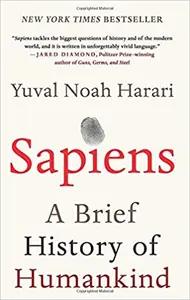
Sapiens
Yuval Noah Harari
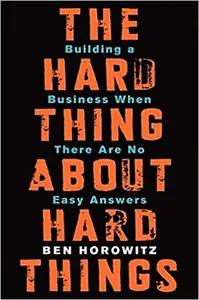
The Hard Thing About Hard Things
Ben Horowitz
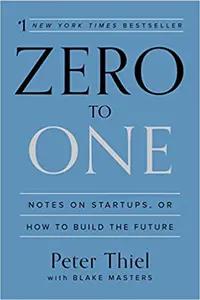
Zero to One
Peter Thiel
High Output Management
Andrew Grove
Principles
Ray Dalio
Shoe Dog
Phil Knight

Snow Crash
Neal Stephenson

Meditations
Marcus Aurelius
Originals
Adam Grant

Poor Charlie's Almanack
Charlie Munger
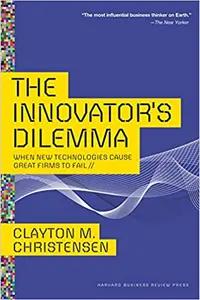
The Innovators Dilemma
Clayton Christensen
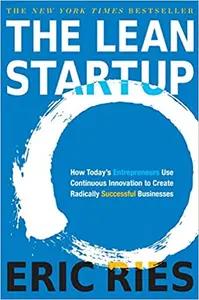
The Lean Startup
Eric Reis
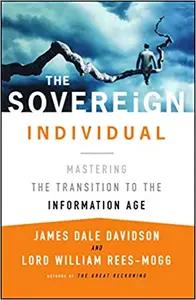
The Sovereign Individual
James Dale Davidson & William Rees-Mogg
High Growth Handbook
Elad Gil
Influence
Robert Cialdini
Principles for Dealing With The Changing World Order
Ray Dalio
Rework
Jason Fried
Surely You're Joking Mr. Feynman
Richard Feynman
The Ride of a Lifetime
Bob Iger
The Three Body Problem
Cixin Liu
Thinking, Fast and Slow
Daniel Kahneman
7 Powers
Hamilton Helmer

Antifragile
Nassim Nicholas Taleb
Atlas Shrugged
Ayn Rand
Blitzscaling
Reid Hoffman

Dune
Frank Herbert

Foundation
Isaac Asimov
Good To Great
Jim Collins
Hopping Over The Rabbit Hole
Anthony Scaramucci

Man's Search for Meaning
Viktor Frankl