Integration By Parts Formula Derivation
TL;DR
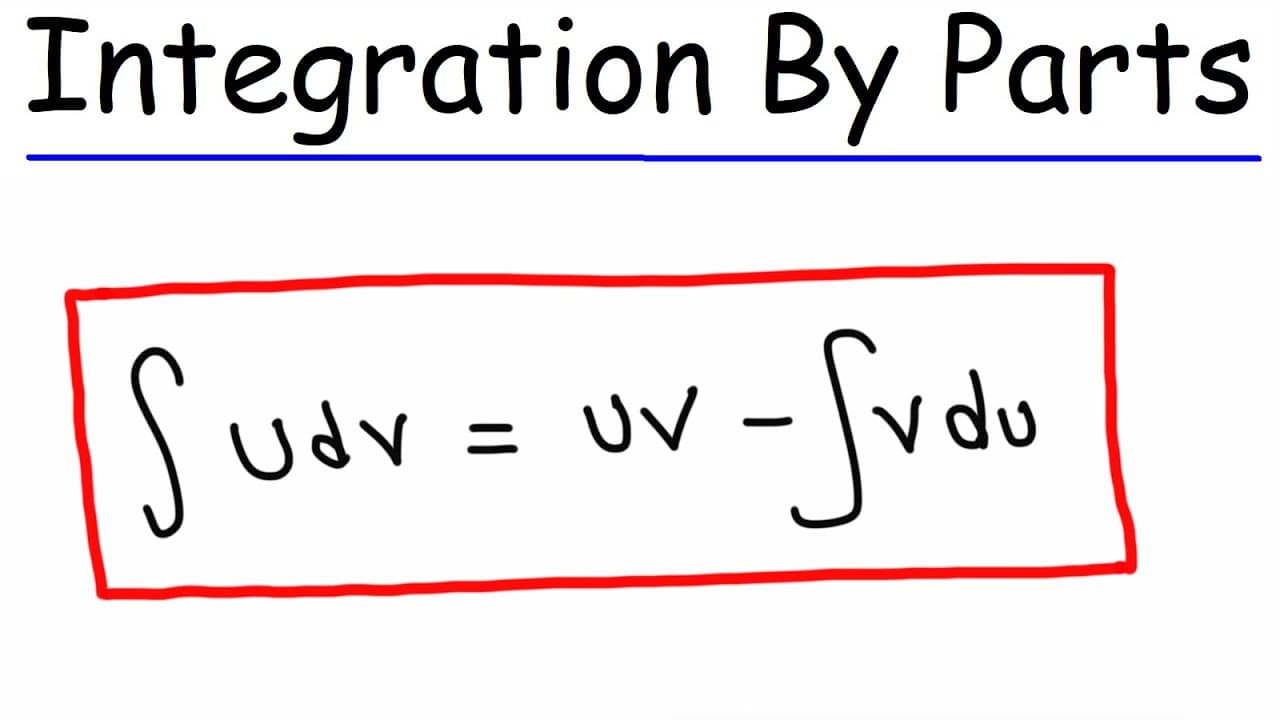
The integration by parts formula is derived by reversing the product rule, and it states that the integral of U times DV equals U times V minus the integral of V times DU.
Transcript
let's talk about the integration by parts formula how can we derive that formula the integration by parts formula is basically the reverse of the product rule so let's start with that let's say we have two functions f and g which are both functions of x and we're going to take the derivative of those two functions which are multiplied to each other... Read More
Key Insights
- 🥳 The integration by parts formula is derived from the product rule for differentiation.
- 🇻🇮 By introducing the variables U and V, the formula becomes more concise and easier to use.
- ❓ The formula enables the integration of products of functions that cannot be integrated directly.
- 😑 Rearranging the equation allows for solving for the desired expression.
- ❓ The formula is useful for solving a variety of integration problems.
- 🇻🇮 It is essential to correctly identify which function to assign as U and V in the formula.
- ❓ The formula can be used for both definite and indefinite integrals.
Install to Summarize YouTube Videos and Get Transcripts
Explore YouTube Video Summarizer or Get YouTube Transcript Extractor
Questions & Answers
Q: What is the integration by parts formula?
The integration by parts formula states that the integral of U times DV is equal to U times V minus the integral of V times DU. It is used to integrate products of functions.
Q: How is the integration by parts formula derived?
The integration by parts formula is derived by reversing the product rule for differentiation. The derivative terms are replaced with integration symbols, and the equation is rearranged to solve for the desired expression.
Q: What are the variables U and V in the integration by parts formula?
The introduction of the variables U and V in the integration by parts formula allows for an easier representation. U represents one of the functions being integrated, while V represents the other function.
Q: How is the integration by parts formula useful in integration?
The integration by parts formula allows for the integration of products of functions that cannot be integrated using other techniques. It helps simplify the integration process by breaking down complex integrals.
Summary & Key Takeaways
-
The integration by parts formula is derived from the product rule by taking the derivative of two functions multiplied to each other.
-
The derivative terms are then replaced with integration symbols, and the equation is rearranged to solve for the desired expression.
-
Introducing the variables U and V allows for an easier representation of the formula, where the integral of U times DV equals U times V minus the integral of V times DU.
Read in Other Languages (beta)
Share This Summary 📚
Summarize YouTube Videos and Get Video Transcripts with 1-Click
Try YouTube Summary with ChatGPT & Claude or YouTube Transcript Generator
Explore More Summaries from The Organic Chemistry Tutor 📚




Summarize YouTube Videos and Get Video Transcripts with 1-Click
Try YouTube Summary with ChatGPT & Claude or YouTube Transcript Generator