How to Identify Fractions Greater Than One
TL;DR
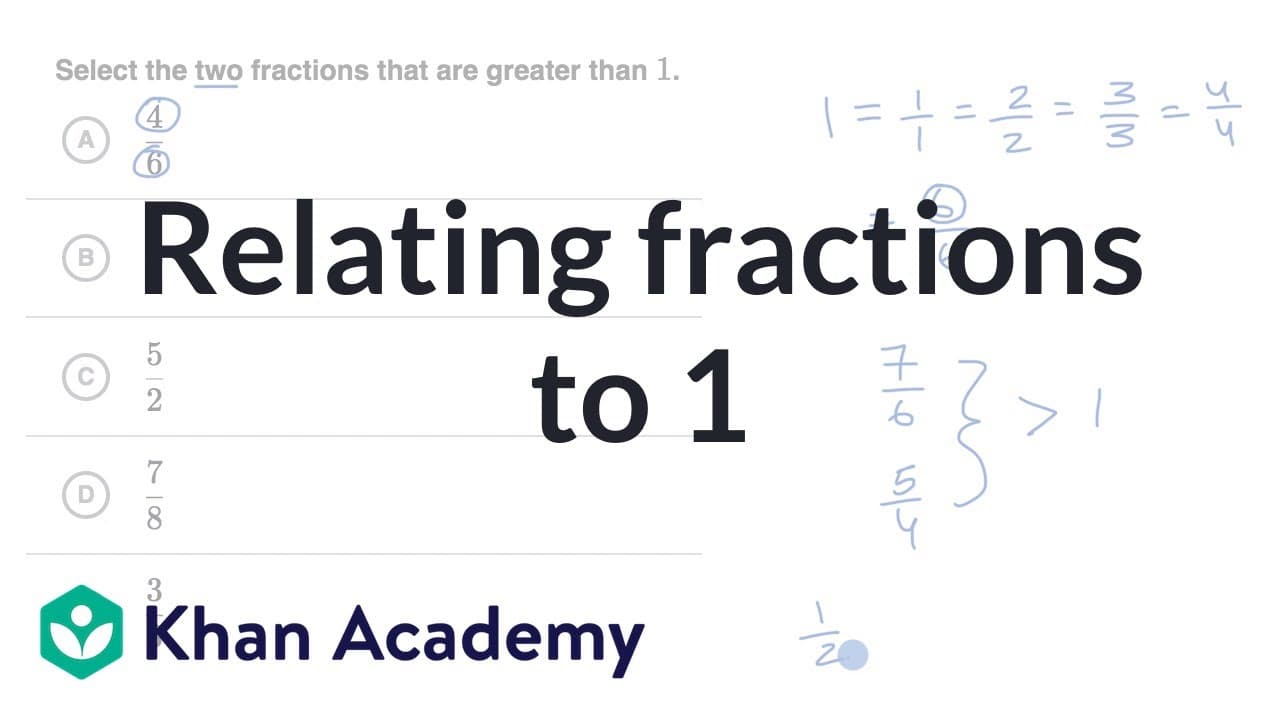
To determine if a fraction is greater than one, check if the numerator is larger than the denominator. For example, fractions like 7/6 and 5/4 are greater than one, while 4/6 is not. Remember, when the numerator equals the denominator, the fraction equals one.
Transcript
- [Instructor] We are told, "Select the two fractions "that are greater than one." So pause this video and see if you can figure out which two of these fractions are greater than one. All right, now let's work on this together. And so, the main realization here, the main thing to pay attention to is how the numerator relates to the denominator. Whe... Read More
Key Insights
- 🌥️ When the numerator of a fraction is larger than the denominator, the fraction is greater than one.
- 🛩️ Fractions with numerators smaller than denominators are less than one.
- 🟰 Fractions that represent the same value as one whole have equal numerators and denominators.
Install to Summarize YouTube Videos and Get Transcripts
Explore YouTube Video Summarizer or Get YouTube Transcript Extractor
Questions & Answers
Q: How can we identify fractions that are greater than one?
To identify fractions that are greater than one, compare the numerator and denominator. If the numerator is larger than the denominator, the fraction is greater than one.
Q: What does it mean if a fraction is less than one?
If a fraction is less than one, it means that the numerator is smaller than the denominator. In other words, the fraction represents a value smaller than one whole.
Q: How do we determine if a fraction is greater than one using examples?
By examining examples, we can see that if the numerator is larger than the denominator, the fraction is greater than one. For example, 9/4 and 5/2 are both greater than one because the numerators (9 and 5) are larger than the denominators (4 and 2).
Q: Can fractions with equal numerator and denominator be greater than one?
No, fractions with equal numerator and denominator represent one whole. In such cases, the fraction is not greater or less than one.
Summary & Key Takeaways
-
Fractions greater than one have numerators that are larger than the denominators.
-
Fractions less than one have numerators that are smaller than the denominators.
-
Comparing the numerator and denominator can help determine if a fraction is greater than one.
Read in Other Languages (beta)
Share This Summary 📚
Summarize YouTube Videos and Get Video Transcripts with 1-Click
Try YouTube Summary with ChatGPT & Claude or YouTube Transcript Generator
Explore More Summaries from Khan Academy 📚




Summarize YouTube Videos and Get Video Transcripts with 1-Click
Try YouTube Summary with ChatGPT & Claude or YouTube Transcript Generator