How Is a Sewage Pump Station Constructed Using Cranes?
TL;DR
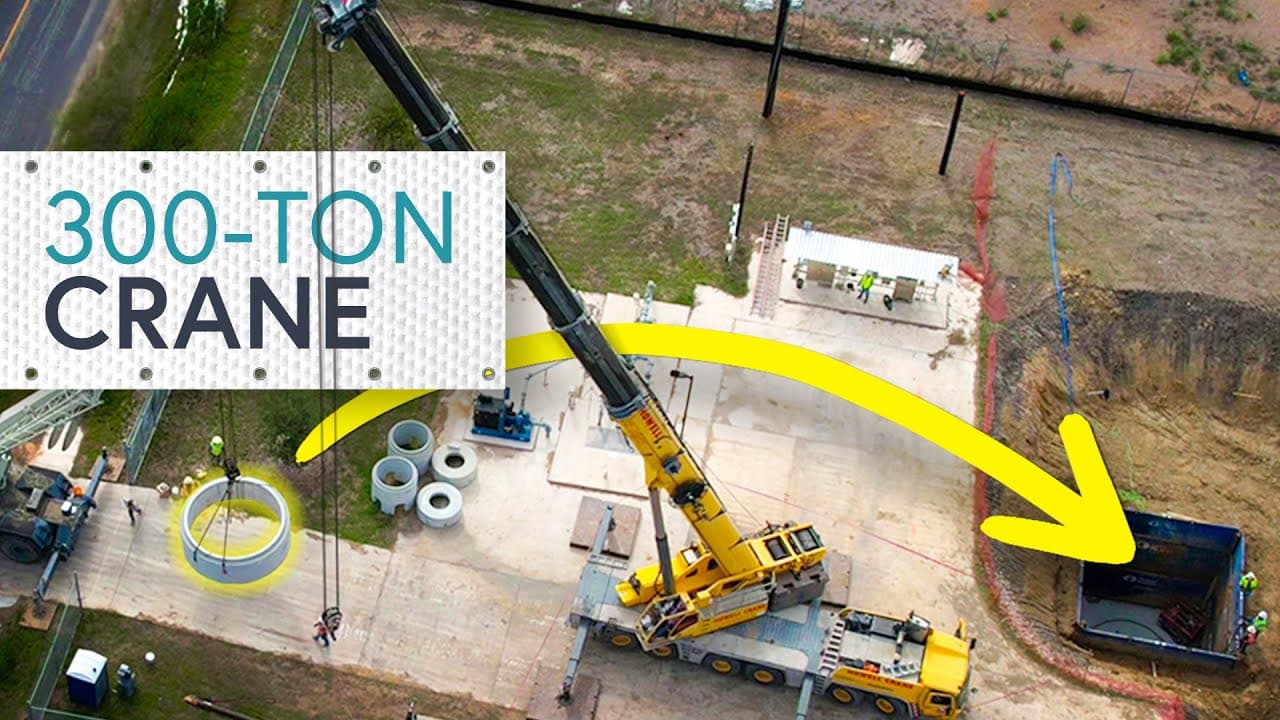
A sewage pump station is constructed using large cranes to lift and stack heavy concrete segments called wet well rings, sealed with gaskets to prevent leaks. Safety is prioritized through careful coordination among site workers during crane operations. Backfilling involves using flowable fill for stability, which allows for future access to the excavation as needed.
Transcript
I’ve partnered up with the San Antonio River Authority to walk you through the construction of a major sewage lift station project. And, it’s crane day! Check out that all-wheel steering. At the end of the previous episode, this 300-ton mobile crane had just finished getting set up on site with its outriggers and more than 100 tons of counterwei... Read More
Key Insights
- The construction of a sewage lift station involves using large cranes to lift heavy concrete segments, ensuring they are watertight with gaskets and lubricants.
- Safety is a priority on site, with multiple personnel ensuring smooth operations and preventing accidents during crane operations.
- The wet well construction starts with a concrete base, followed by stacking precast concrete segments sealed with gaskets to prevent leaks.
- Backfilling the wet well requires careful coordination, using flowable fill instead of soil to ensure stability and ease future trenching for pipe installation.
- The shoring system used to support the excavation is gradually removed as the backfill progresses, ensuring the excavation remains stable.
- Flowable fill is preferred for its self-compacting properties, making it ideal for tight and irregular spaces in the excavation.
- A leak test is conducted on the wet well to ensure it is watertight before backfilling, involving filling it with water and checking for leaks.
- The project highlights the complexities and precision required in heavy construction, showcasing the importance of planning and teamwork.
Install to Summarize YouTube Videos and Get Transcripts
Explore YouTube Video Summarizer or Get YouTube Transcript Extractor
Questions & Answers
Q: What is the main focus of the construction project?
The main focus of the construction project is the building of a major sewage lift station. This involves assembling a wet well using precast concrete segments, ensuring they are watertight, and coordinating crane operations to lift and position these heavy components accurately.
Q: How is safety ensured during crane operations?
Safety during crane operations is ensured by having multiple personnel on site to oversee the process. Spotters, signal persons, and radio communication are used to guide the crane's movements safely, preventing accidents and ensuring the heavy loads are lifted and positioned accurately without causing damage or injury.
Q: Why is flowable fill used for backfilling?
Flowable fill is used for backfilling because it is self-compacting and ideal for tight, irregular spaces where conventional soil compaction would be difficult. It provides stability, prevents future settling, and facilitates future trenching for pipe installations, making it a cost-effective and efficient choice for the project.
Q: What is the purpose of the leak test conducted on the wet well?
The leak test on the wet well is conducted to ensure it is watertight before backfilling. The test involves filling the wet well with water and observing it over several days to check for leaks. This step is crucial to confirm that the gaskets and seals are effective in preventing any potential leakage.
Q: How are the concrete segments sealed to prevent leaks?
Concrete segments are sealed to prevent leaks by installing compressible gasket material between mating surfaces and applying lubricant to rubber gaskets. This ensures a tight seal between segments, preventing water ingress and maintaining the integrity of the wet well, which is critical for holding raw sewage without leakage.
Q: What challenges are faced during the removal of the shoring system?
The removal of the shoring system is challenging due to the increased pressure on the panels from ground settling. The process requires careful coordination and the use of hydraulic pullers and excavators to loosen and lift the panels without causing damage, ensuring the excavation remains stable as backfilling progresses.
Q: Why is crane day significant in the construction process?
Crane day is significant because it involves the critical task of lifting and positioning heavy concrete segments for the wet well. This requires precise coordination, safety measures, and the use of large cranes and additional equipment to ensure the segments are installed correctly and safely, marking a major milestone in the project.
Q: What is the role of the signal person during crane operations?
The signal person plays a crucial role during crane operations by acting as the eyes and ears for the crane operator. They use a combination of radio communication and hand signals to guide the crane's movements, ensuring the heavy loads are lifted and positioned accurately and safely, preventing accidents and ensuring smooth operations.
Summary & Key Takeaways
-
The episode focuses on the construction of a sewage lift station, detailing the use of cranes to lift heavy concrete segments for the wet well. Safety measures and precise coordination are emphasized to ensure smooth operations.
-
The construction process involves sealing concrete segments with gaskets to prevent leaks and using flowable fill for backfilling. The shoring system is carefully removed as the backfill progresses, ensuring excavation stability.
-
A leak test is conducted to certify the wet well's watertightness before backfilling. The episode highlights the intricacies of heavy construction and the importance of planning and teamwork in such projects.
Read in Other Languages (beta)
Share This Summary 📚
Summarize YouTube Videos and Get Video Transcripts with 1-Click
Try YouTube Summary with ChatGPT & Claude or YouTube Transcript Generator
Explore More Summaries from Practical Engineering 📚


Summarize YouTube Videos and Get Video Transcripts with 1-Click
Try YouTube Summary with ChatGPT & Claude or YouTube Transcript Generator