How to Compare Railcar and Road Car Pulling Ease
TL;DR
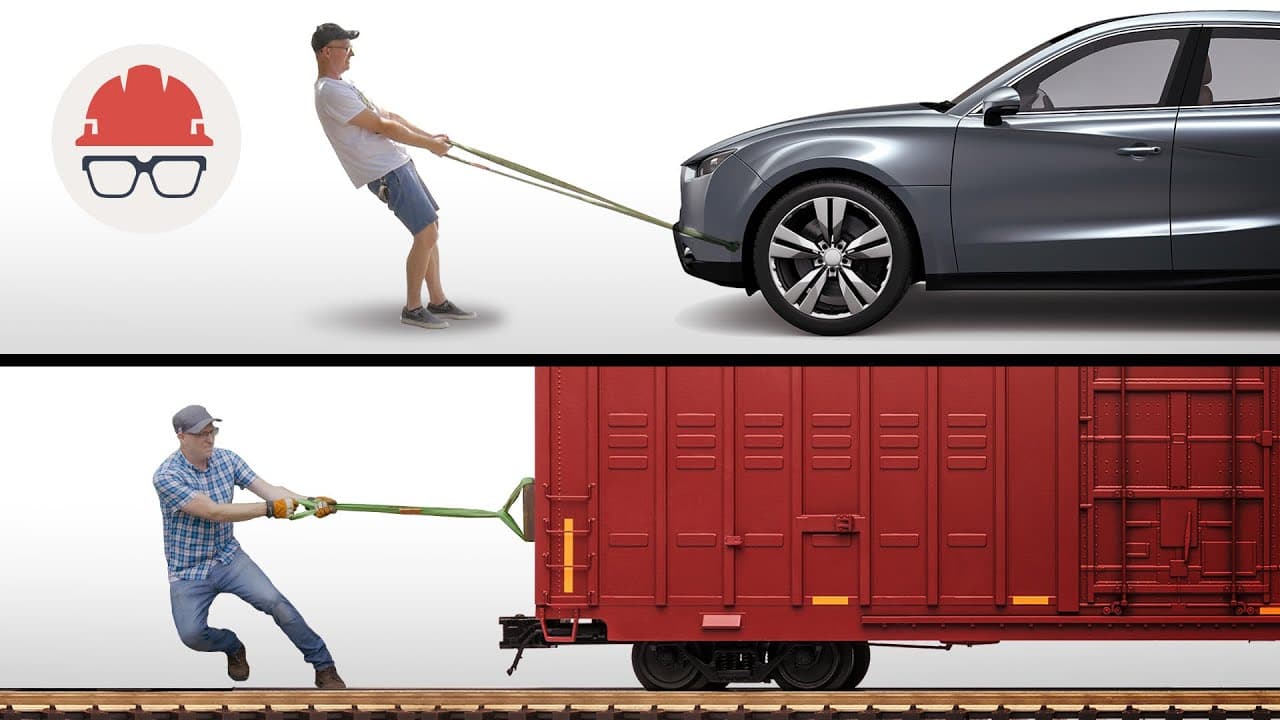
Railcars, due to their design and low rolling resistance, are easier to pull than road cars when moving heavy loads over long distances. The video explores the factors affecting this, including the energy efficiency of rail systems and how factors like grades, curves, and resistance impact the energy needed to move trains.
Transcript
Imagine the room you’re in right now was filled to the top with gravel. (I promise I’m headed somewhere with this.) I don’t know the size of the room you’re in, but if it’s anywhere near an average-sized bedroom, that’s roughly 70 tons of material. Fill every room in an average-sized apartment, and now we’re up to 400 tons. Fill up an average-s... Read More
Key Insights
- Railcars are more energy-efficient for moving heavy loads compared to road cars due to lower rolling resistance.
- Grades and curves significantly impact the energy required to move trains, with gentle grades reducing energy loss.
- Curves add drag to trains, increasing the tractive effort needed to pull them around bends.
- Railroad routes often prioritize gentle slopes over direct paths to minimize energy waste and braking needs.
- Rolling resistance in railcars is significantly lower than in road vehicles, allowing fewer locomotives to move larger loads.
- The Davis Formula is used to estimate train resistance, accounting for mechanical, velocity-dependent, and air resistance factors.
- Steel wheels on steel rails offer low friction, making rail transport energy-efficient for large loads.
- Infrastructure like bridges and tunnels can optimize railroad routes, balancing cost and efficiency.
Install to Summarize YouTube Videos and Get Transcripts
Explore YouTube Video Summarizer or Get YouTube Transcript Extractor
Questions & Answers
Q: How does rolling resistance affect railcars compared to road cars?
Rolling resistance in railcars is much lower than in road cars due to the steel wheels on steel rails, which provide minimal friction. This allows railcars to move heavier loads with less energy compared to road vehicles, which have higher rolling resistance due to rubber tires deforming on the road surface.
Q: Why are gentle grades important in railroad engineering?
Gentle grades are crucial in railroad engineering because they minimize the energy required to move trains uphill. Steeper grades require more tractive effort and energy, which increases fuel consumption. Gentle slopes allow trains to maintain speed without excessive braking or acceleration, improving energy efficiency and reducing costs.
Q: What role do curves play in train energy efficiency?
Curves in train tracks add drag, increasing the tractive effort needed to pull trains around bends. This additional resistance requires more energy, impacting fuel efficiency. Railroads aim to minimize curves or design them with gentle radii to reduce drag and maintain energy-efficient operations.
Q: How does the Davis Formula estimate train resistance?
The Davis Formula estimates train resistance by considering three main factors: mechanical resistance, velocity-dependent resistance, and air resistance. Mechanical resistance relates to friction in bearings and wheel-track deformation. Velocity-dependent resistance increases with speed due to ride quality issues. Air resistance affects the train's front, back, and sides, increasing with the square of velocity.
Q: Why are steel wheels on steel rails advantageous for trains?
Steel wheels on steel rails offer low friction, reducing rolling resistance significantly compared to rubber tires on road vehicles. This low resistance allows trains to move heavier loads with less energy, making rail transport more energy-efficient and cost-effective for long-distance freight movement.
Q: What are the benefits of using infrastructure like bridges and tunnels in railroads?
Bridges and tunnels help optimize railroad routes by allowing trains to bypass difficult terrain, such as mountains or gorges. This can reduce the need for steep grades and sharp curves, improving energy efficiency and reducing operational costs. Such infrastructure balances construction costs with long-term savings in energy and maintenance.
Q: How do railroads minimize energy waste on steep terrains?
Railroads minimize energy waste on steep terrains by avoiding direct routes over mountains and opting for paths with gentle grades. This reduces the need for excessive braking on descents and high tractive effort on ascents, conserving energy and enhancing fuel efficiency. Distributed power systems can also help manage in-train forces on steep grades.
Q: Why are rail systems more cost-effective for large loads over long distances?
Rail systems are more cost-effective for large loads over long distances due to their lower rolling resistance and energy efficiency. Steel wheels on steel rails reduce friction, allowing fewer locomotives to move heavier loads with less fuel compared to trucks. Railroads also benefit from economies of scale, making them ideal for bulk freight transport.
Summary & Key Takeaways
-
Railcars, with their low rolling resistance, are more efficient than road cars for transporting heavy loads over long distances. This video examines energy use in railroads, highlighting how grades, curves, and resistance impact train movement. Rail systems prioritize gentle slopes and minimal curves to reduce energy waste and improve efficiency.
-
The Davis Formula helps estimate train resistance by considering mechanical, velocity-dependent, and air resistance factors. Railcars benefit from steel wheels on steel rails, enabling fewer locomotives to move larger loads with less energy compared to trucks. Infrastructure like bridges and tunnels can further optimize routes.
-
Railroads use gentle grades and curves to minimize energy use, avoiding steep terrains that require more energy for braking and acceleration. By understanding the factors affecting energy efficiency, rail transport remains a cost-effective option for moving large loads overland compared to road transport.
Read in Other Languages (beta)
Share This Summary 📚
Summarize YouTube Videos and Get Video Transcripts with 1-Click
Try YouTube Summary with ChatGPT & Claude or YouTube Transcript Generator
Explore More Summaries from Practical Engineering 📚




Summarize YouTube Videos and Get Video Transcripts with 1-Click
Try YouTube Summary with ChatGPT & Claude or YouTube Transcript Generator