London dispersion forces | Intermolecular forces and properties | AP Chemistry | Khan Academy
TL;DR
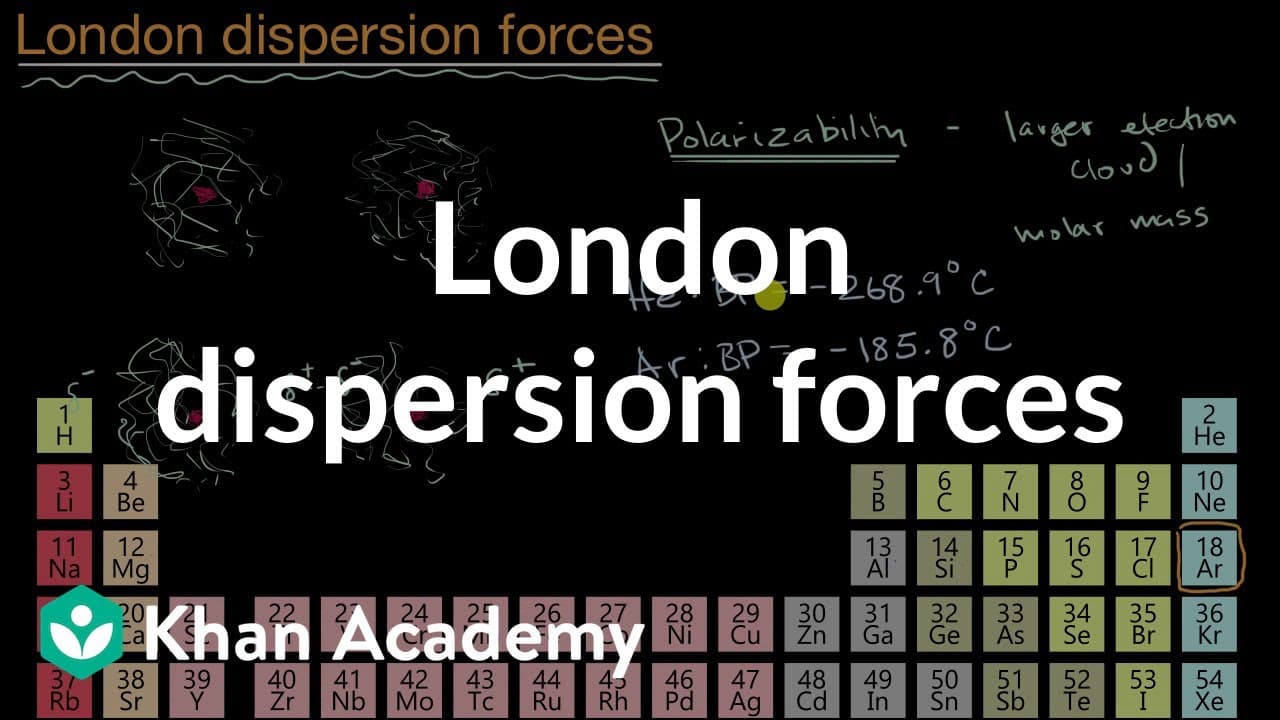
London dispersion forces, also known as induced dipole forces, explain the attraction between neutral atoms or molecules due to temporary imbalances of electrons and the resulting dipole interactions.
Transcript
- [Instructor] What we're going to do in this video is start talking about forces that exist between even neutral atoms, or neutral molecules. The first of these intermolecular forces we will talk about are London dispersion forces. So it sounds very fancy but it's actually a pretty interesting and almost intuitive phenomenon. So we are used to thi... Read More
Key Insights
- 😐 London dispersion forces are intermolecular attractions that occur between neutral atoms or molecules.
- 🫀 These forces result from temporary imbalances of electrons and the induction of dipoles in neighboring atoms or molecules.
- 😶🌫️ The strength of London dispersion forces depends on the polarizability of the atom or molecule, which is determined by the size of its electron cloud.
- 🌥️ Molecules with larger electron clouds and more surface area have higher polarizability and stronger London dispersion forces.
- 😥 The boiling points of substances can be influenced by the strength of their London dispersion forces.
- 🌤️ Noble gases with larger electron clouds, such as Argon, have higher London dispersion forces and higher boiling points compared to gases like Helium with smaller electron clouds.
- 💪 The shape of a molecule can also affect the strength of its London dispersion forces, with molecules that have larger surface areas experiencing stronger attractions.
Install to Summarize YouTube Videos and Get Transcripts
Explore YouTube Video Summarizer or Get YouTube Transcript Extractor
Summary & Key Takeaways
-
London dispersion forces are intermolecular forces that occur between neutral atoms or molecules.
-
These forces result from temporary imbalances of electrons, leading to the creation of dipoles.
-
The strength of London dispersion forces depends on the polarizability of the atom or molecule, which is determined by the size of its electron cloud.
Read in Other Languages (beta)
Share This Summary 📚
Summarize YouTube Videos and Get Video Transcripts with 1-Click
Try YouTube Summary with ChatGPT & Claude or YouTube Transcript Generator
Explore More Summaries from Khan Academy 📚



Summarize YouTube Videos and Get Video Transcripts with 1-Click
Try YouTube Summary with ChatGPT & Claude or YouTube Transcript Generator