Products
Features
YouTube Video Summarizer
Summarize YouTube videos
Web & PDF Highlighter
Highlight web pages & PDFs
Chat with PDF
Ask any PDF questions with AI
Ask AI Clone
Chat with your highlights & memories
Audio Transcriber
Transcribe audio files to text
Glasp Reader
Read and highlight articles
Kindle Highlight Export
Export your Kindle highlights
Idea Hatch
Hatch ideas from your highlights
Integrations
Obsidian Plugin
Notion Integration
Pocket Integration
Instapaper Integration
Medium Integration
Readwise Integration
Snipd Integration
Hypothesis Integration
Apps & Extensions
Chrome Extension
Safari Extension
Edge Add-ons
Firefox Add-ons
iOS App
Android App
Discover
Discover
Ideas
Discover new ideas and insights
Articles
Curated articles and insights
Books
Book recommendations by great minds
Posts
Essays and notes from readers
Quotes
Inspiring quotes collection
Videos
Curated videos and summaries
Explore Glasp
Glasp Newsletter
Weekly insights and updates
Glasp Talk
Interview series with great minds
Glasp Blog
Latest news and articles
Glasp Use Cases
Learn how others use Glasp
Build & Support
Glasp API
Access Glasp's API for developers
MCP Connector
Connect Glasp to Claude & ChatGPT
Community
Glasp Reddit Community
Students
Student discount and benefits
FAQs
Frequently Asked Questions
AboutPricing
DashboardLog inSign up

Fluid Mosaic Model of the Plasma Membrane - Phospholipid Bilayer
October 15, 2019
by
The Organic Chemistry Tutor
YouTube video player
Fluid Mosaic Model of the Plasma Membrane - Phospholipid Bilayer

TL;DR

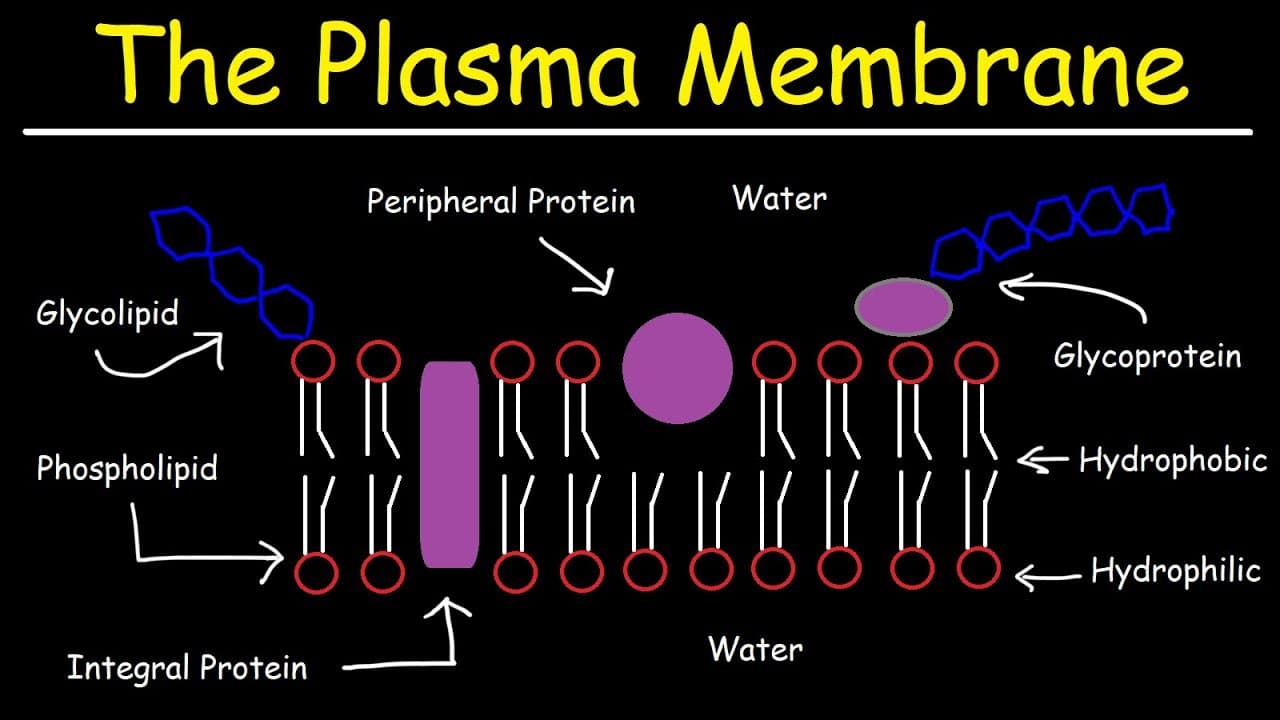
The plasma membrane is composed of phospholipids arranged in a bilayer, with a polar head attracted to water and nonpolar tails repelling water. It also contains integral, peripheral, and surface proteins, as well as carbohydrates, glycoproteins, glycolipids, and cholesterol.

Transcript

in this video we're going to talk about the plasma membrane the plasma membrane of cells is made up of something called phospholipids and here is a typical structure of a phospholipid the phospholipid is made up of three subunits it has a phosphate group a glycerol molecule and two fatty acid tails the head of the phospholipid is the phosphate grou... Read More

Key Insights

  • 💁 The plasma membrane is composed of phospholipids, which form a bilayer structure.
  • ❓ Integral, peripheral, and surface proteins are embedded in the plasma membrane.
  • ❓ Carbohydrates can be attached to proteins (glycoproteins) or lipids (glycolipids) on the plasma membrane.
  • 🆘 Cholesterol helps regulate the fluidity of the plasma membrane.
  • 💦 Phospholipids have a polar head attracted to water and nonpolar tails repelling water.
  • 🥶 The fluid mosaic model describes the free movement of phospholipids and proteins in the plasma membrane.
  • 👥 The phosphate group, glycerol molecule, and fatty acid chains make up a phospholipid.

Install to Summarize YouTube Videos and Get Transcripts

Explore YouTube Video Summarizer or Get YouTube Transcript Extractor

Summary & Key Takeaways

  • The plasma membrane is made up of phospholipids, which form a bilayer structure with polar heads attracting water and nonpolar tails repelling water.

  • Integral, peripheral, and surface proteins are embedded in the plasma membrane, while carbohydrates are attached to proteins (glycoproteins) or lipids (glycolipids).

  • Cholesterol helps maintain the fluidity of the membrane by acting as a spacer, preventing it from becoming too rigid or too fluid.


Read in Other Languages (beta)

English

Share This Summary 📚

Summarize YouTube Videos and Get Video Transcripts with 1-Click

Download browser extensions on:

Try YouTube Summary with ChatGPT & Claude or YouTube Transcript Generator

Explore More Summaries from The Organic Chemistry Tutor 📚

How to Access a Comprehensive Trigonometry Course on Udemy thumbnail
How to Access a Comprehensive Trigonometry Course on Udemy
The Organic Chemistry Tutor
Central Limit Theorem - Sampling Distribution of Sample Means - Stats & Probability thumbnail
Central Limit Theorem - Sampling Distribution of Sample Means - Stats & Probability
The Organic Chemistry Tutor
Converting Hours to Minutes and Minutes to Hours thumbnail
Converting Hours to Minutes and Minutes to Hours
The Organic Chemistry Tutor
How to Find the Inverse of a Function Simply thumbnail
How to Find the Inverse of a Function Simply
The Organic Chemistry Tutor
How to Convert Alcohols into Alkyl Halides thumbnail
How to Convert Alcohols into Alkyl Halides
The Organic Chemistry Tutor
Reflections Over The X-Axis, Y-Axis, and The Origin thumbnail
Reflections Over The X-Axis, Y-Axis, and The Origin
The Organic Chemistry Tutor

Summarize YouTube Videos and Get Video Transcripts with 1-Click

Download browser extensions on:

Try YouTube Summary with ChatGPT & Claude or YouTube Transcript Generator

Apps & Extensions

  • Chrome Extension
  • Safari Extension
  • Edge Add-ons
  • Firefox Add-ons
  • iOS App
  • Android App

Key Features

  • YouTube Video Summarizer
  • Web & PDF Summarizer
  • Web & PDF Highlighter
  • Chat with PDF
  • Ask AI Clone
  • Audio Transcriber
  • Glasp Reader
  • Kindle Highlight Export
  • Idea Hatch

Integrations

  • Obsidian Plugin
  • Notion Integration
  • Pocket Integration
  • Instapaper Integration
  • Medium Integration
  • Readwise Integration
  • Snipd Integration
  • Hypothesis Integration

More Features

  • APIs
  • MCP Connector
  • Blog & Post
  • Embed Links
  • Image Highlight
  • Personality Test
  • Quote Shots

Company

  • About us
  • Blog
  • Community
  • FAQs
  • Job Board
  • Newsletter
  • Pricing
Terms

•

Privacy

•

Guidelines

© 2026 Glasp Inc. All rights reserved.