How Can Paralyzed Individuals Control Robots with Their Mind?
TL;DR
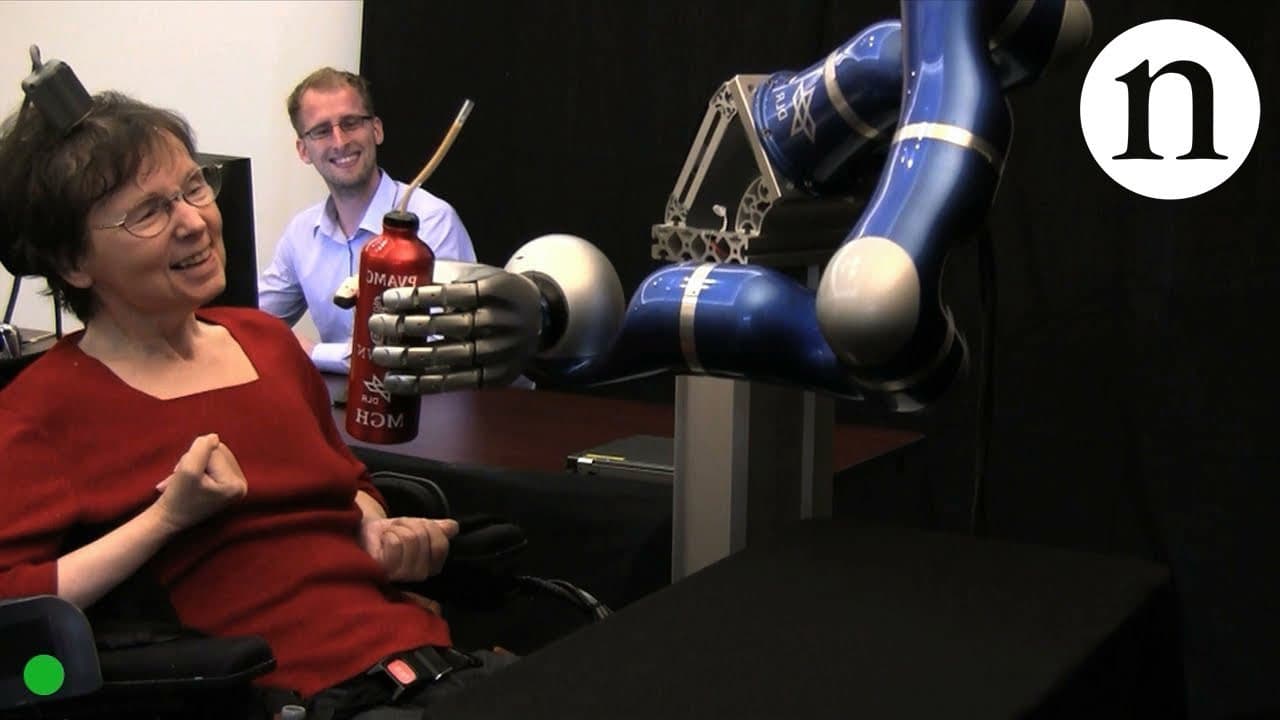
Paralyzed individuals can control robotic arms through a brain-machine interface that translates neural signals into movements. This technology, demonstrated by Kathy Hutchinson, bypasses damaged nervous systems by using a sensor implanted in the motor cortex. The goal is to enhance robotic functionality for more complex tasks and eventually create a wireless version for easier use.
Transcript
you're watching the most advanced brain machine interface in action Kathy Hutchinson is paralyzed and unable to speak but just by thinking she's able to control the movements of this robotic arm and drink her morning coffee she's part of a pioneering study run by researchers at Brown University in the US people who are paralyzed have their brain di... Read More
Key Insights
- 👻 The brain-machine interface represents a breakthrough in neuroscience, allowing paralyzed patients to regain some independence.
- 😒 Kathy Hutchinson's successful use of the technology emphasizes real-world applications and the impact of assistive technologies on daily life.
- 🙈 The technology's inception in animal trials, like those with monkeys, paved the way for its application in human subjects, highlighting a critical development pathway in biomedical research.
- 🦺 Safety and sensitivity in robotic movements remain a significant focus, as researchers are dedicated to ensuring these devices respond appropriately to their environments.
- 😤 A major goal of the research team is to minimize the invasiveness of the brain-machine interface, with future iterations aiming for a non-invasive wireless option.
- 🧑🏭 The emotional resilience and psychological benefits for patients using such technology are factors researchers are keen to explore further.
- ❓ The collaboration between robotics experts and neuroscientists exemplifies the interdisciplinary approach necessary to develop advanced healthcare technologies.
Install to Summarize YouTube Videos and Get Transcripts
Explore YouTube Video Summarizer or Get YouTube Transcript Extractor
Questions & Answers
Q: How does the brain-machine interface help individuals with paralysis?
The brain-machine interface allows individuals with paralysis to bypass damaged nerves by converting brain signals directly into mechanical movements, enabling them to perform tasks such as controlling a robotic arm to drink, type, or interact with their environment independently.
Q: What components make up the brain-machine interface?
The brain-machine interface consists of a sensor array implanted in the motor cortex, a decoder that interprets brain activity, and an assistive technology component, which can be a computer cursor or a robotic arm, thus providing a functional output to the user's thoughts.
Q: What advancements are researchers seeking in the robotic arm technology?
Researchers aim to enhance the robotic arm's functionality to react more naturally, navigate its environment, and perform complex tasks like brushing teeth. They also aspire to create a wireless version of the device for improved user comfort and mobility.
Q: What was the emotional impact of Kathy Hutchinson using the robotic arm?
Kathy's ability to drink coffee independently using the robotic arm after nearly 15 years profoundly affected both her and the researchers. It was described as a "magic moment" that showcased the potential of technology to restore agency and normalcy in paralyzed individuals' lives.
Summary & Key Takeaways
-
A pioneering study at Brown University showcases a brain-machine interface enabling paralyzed individuals, like Kathy Hutchinson, to control robotic arms through neural signals, allowing tasks such as drinking coffee independently.
-
The brain gate system functions by bypassing damaged nervous systems, utilizing a sensor implanted in the motor cortex to detect brain signals, which are then translated into movements by robotic devices.
-
Researchers face challenges in advancing robotic arm functionality to mimic natural human movement, aiming for smoother, more intuitive control and the potential for wireless operation in the future.
Read in Other Languages (beta)
Share This Summary 📚
Summarize YouTube Videos and Get Video Transcripts with 1-Click
Try YouTube Summary with ChatGPT & Claude or YouTube Transcript Generator
Explore More Summaries from nature video 📚



Summarize YouTube Videos and Get Video Transcripts with 1-Click
Try YouTube Summary with ChatGPT & Claude or YouTube Transcript Generator