The Hidden Engineering of Floating Bridges
TL;DR
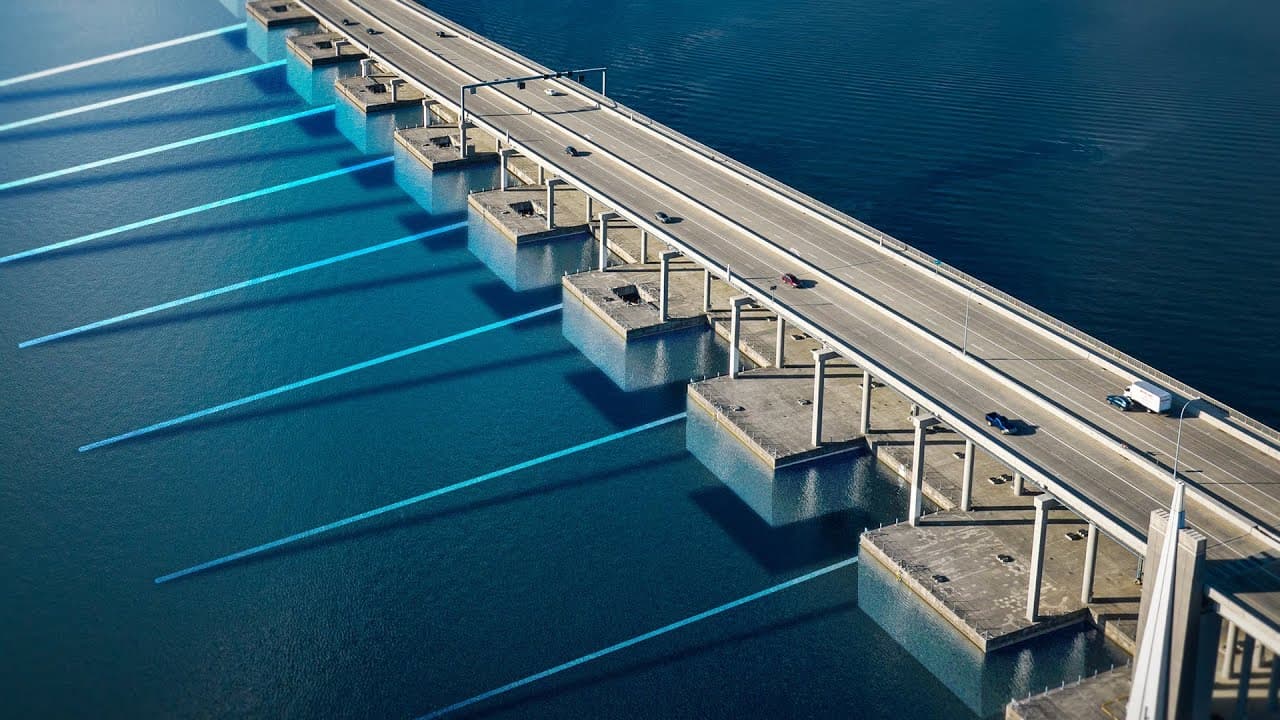
Explore the engineering behind Washington's innovative floating bridges.
Transcript
In the early 1900s, Seattle was a growing city hemmed in by geography. To the west was Puget Sound, a vital link to the Pacific Ocean. To the east, Lake Washington stood between the city and the farmland and logging towns of the Cascades. As the population grew, pressure mounted for a reliable east–west transportation route. But Lake Washington... Read More
Key Insights
- Floating bridges provide a unique solution for crossing deep or unstable bodies of water, using pontoons to support the structure on the water's surface.
- Homer Hadley's 1921 concept of floating bridges revolutionized transportation in Seattle, leading to the construction of the Lacey V. Murrow Bridge in 1940.
- Floating bridges face challenges such as accommodating maritime traffic, requiring innovative solutions like retractable spans or hydraulic lifts.
- Anchoring systems are crucial for floating bridges, using cables and anchors to stabilize the structure against waves and weather conditions.
- Concrete pontoons, despite their weight, are designed to float by being hollow and using specialized concrete mixes to prevent leaks and cracking.
- Floating bridges in Washington have experienced failures due to design oversights and weather, highlighting the importance of meticulous engineering and maintenance.
- Innovations continue with floating infrastructure, such as testing light rail transit on floating bridges, requiring solutions for track alignment and electrical safety.
- Future possibilities include floating tunnels, which could reduce costs and environmental impact by suspending tunnels in the water column.
Install to Summarize YouTube Videos and Get Transcripts
Explore YouTube Video Summarizer or Get YouTube Transcript Extractor
Questions & Answers
Q: What inspired the concept of floating bridges in Seattle?
The concept of floating bridges in Seattle was inspired by the geographical challenges of the area. Seattle was hemmed in by Puget Sound to the west and Lake Washington to the east, making traditional bridge construction difficult and costly due to deep waters and soft lakebed conditions. Engineer Homer Hadley proposed the idea of a floating bridge in 1921 as a solution to these challenges, allowing for a reliable east-west transportation route without the need for massive underwater supports.
Q: What are the main engineering challenges faced by floating bridges?
Floating bridges face several engineering challenges, including accommodating maritime traffic, maintaining stability in various weather conditions, and ensuring structural integrity over time. They must be designed to allow boats to pass, often requiring movable spans or hydraulic lifts. Stability is managed through anchoring systems that secure the bridge against waves and wind. Additionally, the pontoons must be leak-proof and durable, requiring specialized concrete mixes and construction techniques to prevent cracking and water ingress.
Q: How do floating bridges accommodate maritime traffic?
Floating bridges accommodate maritime traffic through various design solutions. Some bridges, like the Evergreen Point Floating Bridge, use elevated approach spans to allow ships to pass underneath. Others, like the Hood Canal Bridge, incorporate movable spans that can be raised or retracted to create a navigable channel. These mechanisms ensure that the bridge does not obstruct maritime routes while still providing a stable roadway for vehicles.
Q: What are the risks associated with floating bridges in extreme weather?
In extreme weather, floating bridges face risks such as waves crashing onto the roadway, obscuring visibility, and creating hazards for drivers. High winds can cause the bridge to flex and shift, potentially unnerving drivers. To mitigate these risks, floating bridges are often closed when wind speeds exceed certain thresholds. Despite being structurally sound, the bridges can become part of the storm, necessitating temporary closures to ensure safety.
Q: How are concrete pontoons designed to float?
Concrete pontoons are designed to float by being hollow and using specialized concrete mixes that enhance water resistance and reduce shrinkage. The pontoons are subdivided into sealed chambers with watertight doors to prevent leaks. Leak detection systems and pumps are also installed to manage any water ingress. The design ensures that the pontoons can support the weight of the bridge deck and traffic while remaining buoyant.
Q: What lessons were learned from past failures of floating bridges in Washington?
Past failures of floating bridges in Washington, such as the sinking of the Hood Canal Bridge and the Lacey V. Murrow Bridge, highlighted the importance of careful design and maintenance. These incidents were caused by design oversights, such as open hatches allowing water ingress and inadequate handling of stormwater during rehabilitation work. The lessons learned emphasize the need for meticulous engineering, regular inspections, and contingency plans to prevent similar failures in the future.
Q: What future innovations are being explored for floating infrastructure?
Future innovations for floating infrastructure include the development of floating tunnels, which could offer cost-effective and environmentally friendly alternatives to traditional tunnels. These tunnels would be suspended in the water column, potentially reducing excavation costs and environmental impacts. Additionally, the integration of light rail transit on floating bridges is being tested, requiring innovative solutions for track alignment and electrical safety to accommodate the unique movements of floating structures.
Q: How does the video highlight the importance of media literacy in engineering stories?
The video highlights the importance of media literacy by discussing how news coverage can influence public perception of engineering stories. It uses the example of the Key Bridge investigation to show how different media outlets frame the same story in various ways, potentially leading to biased interpretations. The video promotes tools like Ground News to help viewers access diverse perspectives and understand potential biases in reporting, emphasizing the need for critical thinking when consuming news.
Summary & Key Takeaways
-
The video explores the history and engineering of floating bridges, focusing on Washington State, where four of the world's five longest floating bridges are located. It highlights the challenges and innovations in designing these structures, from accommodating maritime traffic to ensuring stability and safety in extreme weather conditions.
-
Homer Hadley's pioneering idea of a floating bridge led to the construction of the Lacey V. Murrow Bridge in 1940, marking a significant advancement in civil engineering. Floating bridges offer solutions for crossing deep waters without extensive underwater construction, but they also present unique challenges, such as maintaining structural integrity and accommodating maritime traffic.
-
Washington State's floating bridges have seen both successes and failures, with notable incidents like the sinking of the Hood Canal Bridge and the Lacey V. Murrow Bridge due to design and operational oversights. The video also discusses future innovations, such as floating tunnels, which could further revolutionize infrastructure design in suitable environments.
Read in Other Languages (beta)
Share This Summary 📚
Summarize YouTube Videos and Get Video Transcripts with 1-Click
Try YouTube Summary with ChatGPT & Claude or YouTube Transcript Generator
Explore More Summaries from Practical Engineering 📚

Summarize YouTube Videos and Get Video Transcripts with 1-Click
Try YouTube Summary with ChatGPT & Claude or YouTube Transcript Generator