Why the Tacoma Narrows Bridge Collapsed
TL;DR
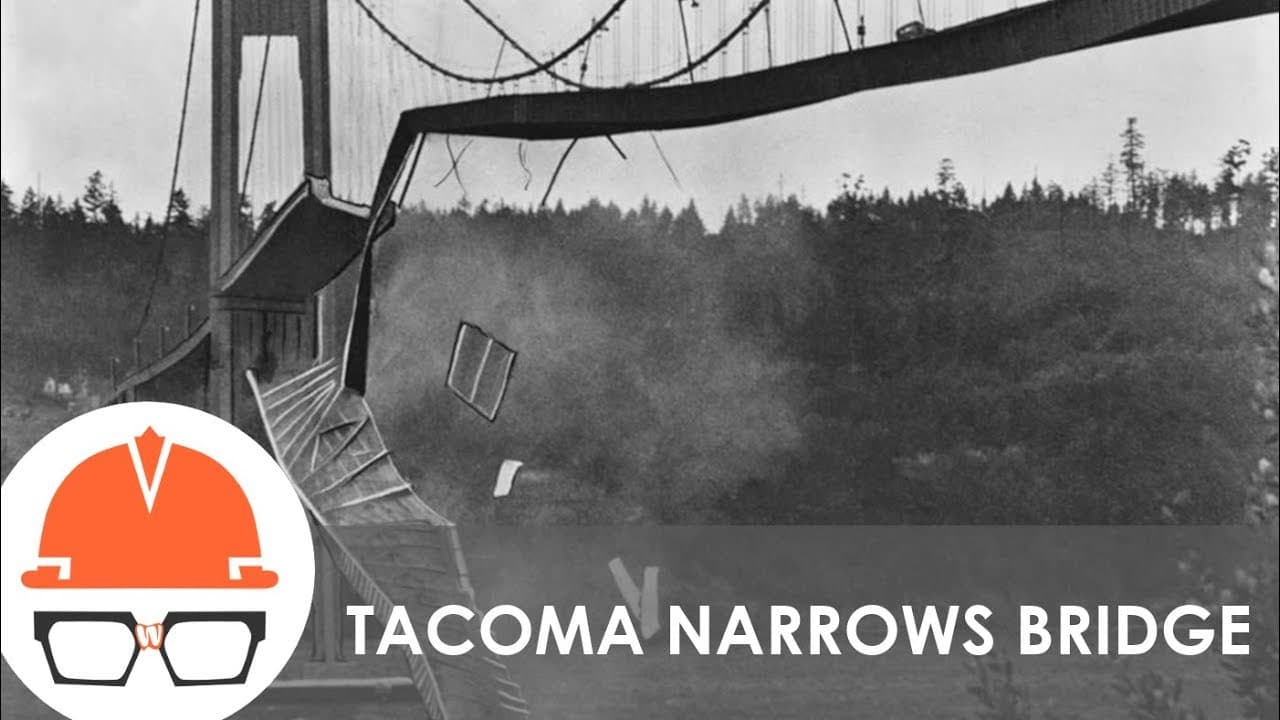
The Tacoma Narrows Bridge collapsed due to aeroelastic flutter.
Transcript
One of the most fundamental jobs of an engineer is to compare loading conditions to strengths. If the loads exceed the strengths, you know you’ve got a problem. Buildings and other structures face a huge variety of loads, including floods, snow, rain, ice, earthquakes, and crowds of people. One of the most interesting forces faced by civil structur... Read More
Key Insights
- The Tacoma Narrows Bridge collapse is a classic engineering failure case study, highlighting the importance of considering wind loads in design.
- Suspension bridges are efficient for spanning long distances but can be susceptible to wind-induced forces due to their slender design.
- The bridge's collapse was primarily due to aeroelastic flutter, a self-induced oscillation caused by the bridge's aerodynamic shape.
- Vortex shedding, a phenomenon where alternating low-pressure zones form behind an object, contributed to the bridge's oscillations.
- Resonance occurs when a periodic force aligns with a structure's natural frequency, leading to increased oscillation amplitudes.
- Modern bridges incorporate design features such as gaps in the deck or aerodynamic shapes to mitigate wind-induced vibrations.
- The failure of the Tacoma Narrows Bridge serves as a reminder of the unforeseen challenges that can arise with innovative designs.
- Understanding past engineering failures is crucial for improving current design practices and preventing similar incidents.
Install to Summarize YouTube Videos and Get Transcripts
Explore YouTube Video Summarizer or Get YouTube Transcript Extractor
Questions & Answers
Q: What was the main cause of the Tacoma Narrows Bridge collapse?
The main cause of the Tacoma Narrows Bridge collapse was aeroelastic flutter. This phenomenon occurs when the aerodynamic shape of a structure leads to self-induced oscillations. In the case of the bridge, the large steel plates on either side created vortices that amplified twisting motions, ultimately causing the bridge to fail.
Q: How did vortex shedding contribute to the bridge's oscillations?
Vortex shedding contributed to the bridge's oscillations by creating alternating zones of low pressure behind the structure. When these zones occurred at a frequency near the bridge's natural frequency, they caused resonance, leading to increased oscillation amplitudes. However, this was not the primary cause of the bridge's collapse.
Q: What design features are used in modern bridges to prevent similar failures?
Modern bridges incorporate several design features to prevent failures similar to the Tacoma Narrows Bridge. These include adding gaps in the deck to equalize pressure on either side and making the bridge deck more aerodynamic to avoid creating vortices. These measures help reduce wind-induced vibrations and ensure greater structural stability.
Q: Why is the Tacoma Narrows Bridge collapse a significant case study in engineering?
The Tacoma Narrows Bridge collapse is a significant case study in engineering because it highlights the importance of considering wind loads in bridge design. It serves as a cautionary tale of how unforeseen challenges can arise with innovative designs, emphasizing the need for thorough analysis and understanding of all potential loading conditions.
Q: What is the difference between resonance and aeroelastic flutter?
Resonance occurs when a periodic force aligns with a structure's natural frequency, leading to increased oscillation amplitudes over time. Aeroelastic flutter, on the other hand, is a self-induced oscillation caused by the aerodynamic shape of a structure. It involves the interaction of aerodynamic forces with the structure's motion, leading to instability and potential failure.
Q: How did the bridge's design contribute to its collapse?
The bridge's design, with its slender and graceful appearance, made it susceptible to wind-induced forces. The use of narrow plate girders instead of trusses reduced the bridge's rigidity and stiffness, allowing for greater flexibility. This design choice, while economical, contributed to the bridge's instability under wind loads, ultimately leading to its collapse.
Q: What lessons can be learned from the Tacoma Narrows Bridge failure?
The Tacoma Narrows Bridge failure teaches several important lessons, including the need to consider all potential loading conditions, especially wind loads, in structural design. It also emphasizes the importance of learning from past engineering failures to improve current design practices and prevent similar incidents in the future.
Q: How does the case of the Tacoma Narrows Bridge relate to innovation in engineering?
The case of the Tacoma Narrows Bridge highlights the challenges of innovation in engineering. Pushing the envelope with new designs can lead to unforeseen challenges and failures. It serves as a reminder that innovation requires vigilance and a thorough understanding of all potential risks and loading conditions to ensure safety and stability.
Summary & Key Takeaways
-
The Tacoma Narrows Bridge collapse is a significant engineering failure case that highlights the importance of considering wind loads, especially in suspension bridges. The bridge's slender design made it susceptible to aeroelastic flutter, leading to its dramatic collapse.
-
Aeroelastic flutter, a self-induced oscillation caused by the bridge's aerodynamic shape, was the primary cause of the Tacoma Narrows Bridge collapse. Vortex shedding also contributed to the oscillations, but it was not the main reason for failure.
-
The failure of the Tacoma Narrows Bridge underscores the importance of learning from past engineering mistakes. Modern bridges incorporate design features to mitigate wind-induced vibrations, ensuring greater stability and safety.
Read in Other Languages (beta)
Share This Summary 📚
Summarize YouTube Videos and Get Video Transcripts with 1-Click
Try YouTube Summary with ChatGPT & Claude or YouTube Transcript Generator
Explore More Summaries from Practical Engineering 📚



Summarize YouTube Videos and Get Video Transcripts with 1-Click
Try YouTube Summary with ChatGPT & Claude or YouTube Transcript Generator