Rocket Propulsion Physics & Mass Flow Rate - Newton's 3rd Law of Motion
TL;DR
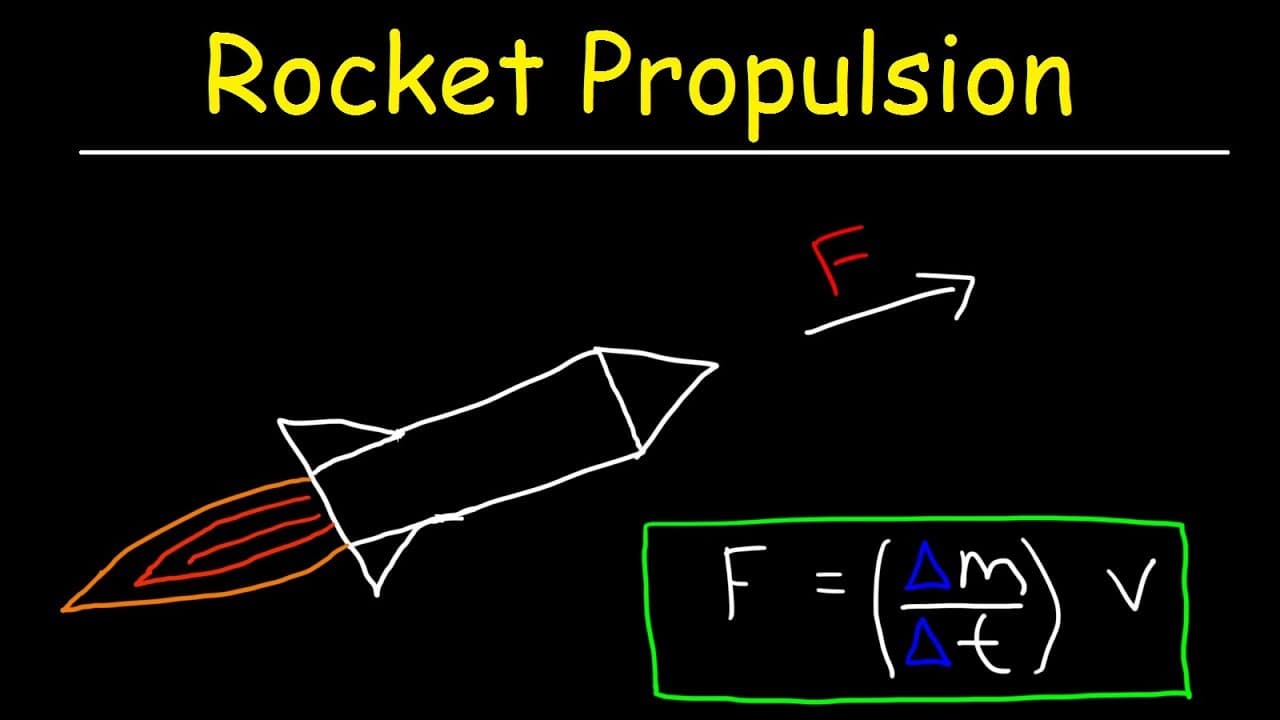
Rocket propulsion is based on Newton's third law of motion, where for every action force, there is an equal and opposite reaction force. To calculate the thrust force exerted by a fluid, such as a liquid or gas, you can use the equation: Force = Mass flow rate x Velocity.
Transcript
in this video we're going to talk about rocket propulsion and we're going to solve a physics problem related to it but before we get into that let's talk about newton's third law of motion for every action force there is an equal but opposite reaction force to illustrate it imagine if you're ice skating and you're holding a ball what's gonna happen... Read More
Key Insights
- 👮 Newton's third law of motion is crucial in understanding rocket propulsion.
- 🫢 Rocket propulsion involves shooting out gas particles in the opposite direction to achieve forward or upward movement.
- ☺️ The force exerted by a fluid on an object can be calculated using the equation: Force = Mass flow rate x Velocity.
Install to Summarize YouTube Videos and Get Transcripts
Explore YouTube Video Summarizer or Get YouTube Transcript Extractor
Questions & Answers
Q: How does Newton's third law of motion apply to rocket propulsion?
Newton's third law states that for every action force, there is an equal but opposite reaction force. In rocket propulsion, throwing matter in one direction creates a reaction force that propels the rocket in the opposite direction.
Q: How does a rocket accelerate upward in space?
A rocket accelerates upward in space by shooting out gas particles underneath it. The force exerted by the gas particles in one direction causes the rocket to accelerate in the opposite upward direction.
Q: How can we calculate the force exerted by a fluid on an object?
The force exerted by a fluid, such as water or gas, can be calculated using the equation: Force = Mass flow rate x Velocity. The mass flow rate is the change in mass divided by the change in time, and the velocity is the speed of the fluid.
Q: What is the force required for a rocket to propel forward?
The force required for a rocket to propel forward is equal to the force exerted by the fluid, but in the opposite direction. This force can be calculated using the equation: Force = Mass flow rate x Velocity.
Summary & Key Takeaways
-
Newton's third law of motion states that for every action force, there is an equal but opposite reaction force. This applies to rocket propulsion, where throwing matter in one direction propels the rocket in the opposite direction.
-
Rocket propulsion is achieved by shooting out gas particles beneath the rocket, causing it to accelerate upward. It can also move in the x direction by shooting gas particles to the side.
-
To calculate the force exerted by a fluid, such as water or gas, on an object, you can use the equation: Force = Mass flow rate x Velocity.
Read in Other Languages (beta)
Share This Summary 📚
Summarize YouTube Videos and Get Video Transcripts with 1-Click
Try YouTube Summary with ChatGPT & Claude or YouTube Transcript Generator
Explore More Summaries from The Organic Chemistry Tutor 📚


Summarize YouTube Videos and Get Video Transcripts with 1-Click
Try YouTube Summary with ChatGPT & Claude or YouTube Transcript Generator