Design Your Own Space Elevator
TL;DR
Explores the engineering challenges of building a space elevator.
Transcript
If you’re into science, technology, and/or space, chances are you’ve heard of the space elevator. And if you’re paying any attention at all, you’ve seen just about every famous advocate of space or science parrot out pretty much the same facts for the last 10 years. Just last week as I was writing this, the illustrious whooshing-animation YouTube c... Read More
Key Insights
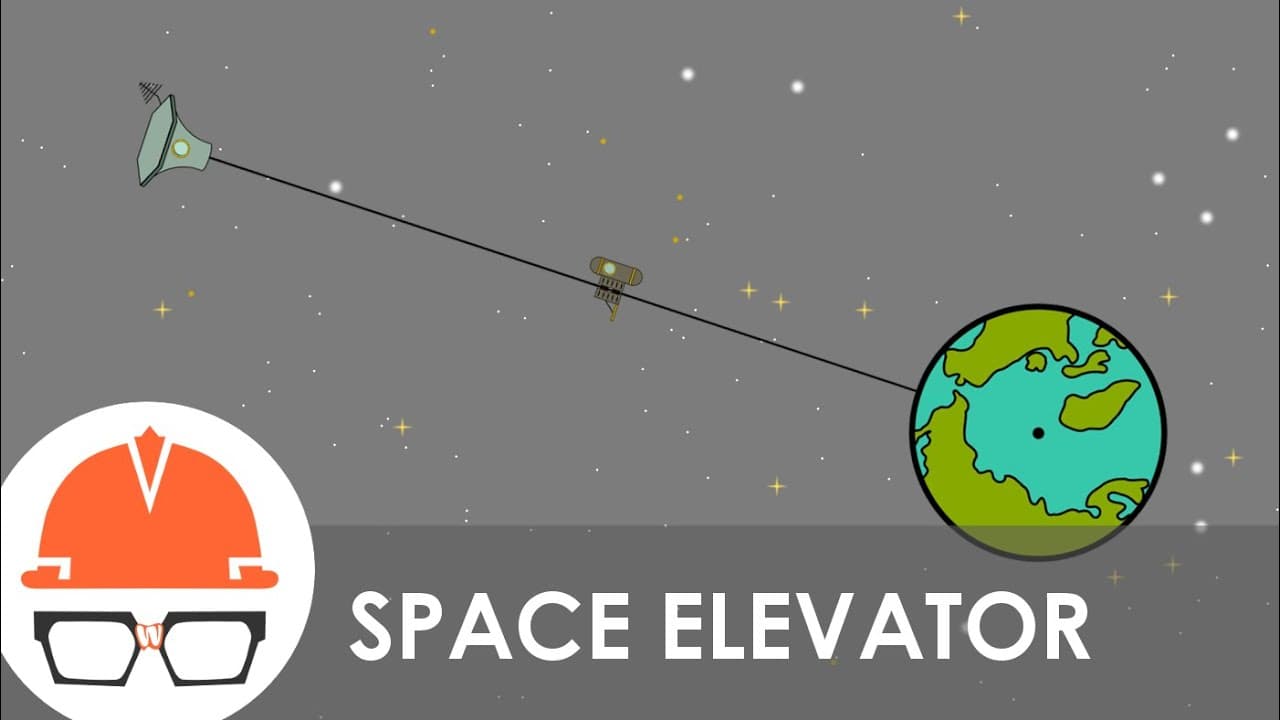
- The space elevator concept involves a tether between a geostationary satellite and Earth's equator, aiming to simplify space access.
- Building a space elevator could potentially reduce payload costs to orbit by 95%, but significant engineering challenges remain.
- A rotating reference frame is used to simplify the analysis of the space elevator, considering it as a static structure.
- The tether needs a high tensile strength material, with current estimates suggesting carbon nanotubes as a potential solution.
- Powering the climber is a major challenge, with solar power deemed unfeasible and laser power offering limited efficiency.
- The counterweight mass and tether strength are fundamental to the elevator's design, requiring innovative engineering solutions.
- Adaptive optics could enhance laser power transmission efficiency by compensating for atmospheric distortion.
- The space elevator's completion could revolutionize space access, but its construction is unprecedented in size and complexity.
Install to Summarize YouTube Videos and Get Transcripts
Explore YouTube Video Summarizer or Get YouTube Transcript Extractor
Questions & Answers
Q: What is the main purpose of a space elevator?
The main purpose of a space elevator is to reduce the complexity and cost of accessing space. By providing a more routine and less risky method of transport compared to rockets, it aims to make space travel more accessible. The elevator would use a tethered cable to transport cargo and possibly humans to space, potentially reducing payload costs by up to 95%.
Q: What are the primary engineering challenges in building a space elevator?
Building a space elevator involves several significant engineering challenges. These include finding a material strong enough for the tether, such as carbon nanotubes, managing the power supply for the climber, and dealing with the mass of the counterweight. Each of these elements requires innovative engineering solutions to address the unprecedented scale and complexity involved in constructing such a structure.
Q: Why is solar power considered impractical for powering the climber?
Solar power is deemed impractical for powering the space elevator's climber due to its inefficiency over the long journey to geostationary orbit. The video explains that even under ideal conditions, solar panels would take an estimated week to power the climber, excluding the weight of the structure, motors, or payload. This makes solar power an unrealistic option for the energy-intensive climb.
Q: How could laser power be used to power the space elevator's climber?
Laser power could potentially be used to power the space elevator's climber by beaming energy from Earth. However, this method is also challenging due to atmospheric distortion, which reduces efficiency. Adaptive optics, similar to noise-cancelling technology for mirrors, could improve the focus and efficiency of the laser beam, making it a more viable option than solar power, though still demanding significant energy resources.
Q: What role does the counterweight play in a space elevator?
The counterweight in a space elevator serves to balance the forces acting on the tether, enabling it to remain taut and stable. It helps counteract the gravitational pull and centrifugal forces experienced by the tether. Proposals have suggested using a captured asteroid as a counterweight to provide the necessary mass and stability, highlighting the engineering complexity of this component.
Q: What material is currently considered most promising for the space elevator tether?
Carbon nanotubes are currently considered the most promising material for the space elevator tether due to their incredible tensile strength and low density. The video highlights that current estimates suggest carbon nanotube tethers could have a taper ratio between 2 and 20, a significant improvement over traditional materials like steel or Kevlar, making them a potential candidate for this ambitious project.
Q: What is the significance of the Clarke Belt in the space elevator concept?
The Clarke Belt, located approximately 26,000 miles from Earth's center, is significant for the space elevator as it marks the point where geostationary satellites can remain stationary relative to the Earth's surface. This is crucial for the space elevator's design, as the tether would extend from this belt to an anchor point on the equator, allowing the climber to travel along a stable path to space.
Q: How does the video describe the potential impact of a successful space elevator?
The video suggests that a successful space elevator could revolutionize space exploration by making access to space more routine and affordable. It would enable more frequent and cost-effective transportation of cargo and potentially humans, opening up new possibilities for space research, industry, and travel. However, achieving this requires overcoming significant engineering challenges and constructing an unprecedentedly large and complex structure.
Summary & Key Takeaways
-
The video discusses the concept of a space elevator, a structure that could drastically reduce the cost and complexity of accessing space. It highlights the engineering challenges, such as tether strength, power transmission, and counterweight mass, that need to be overcome to make this concept a reality.
-
The space elevator's tether would need to be made from an incredibly strong material, with carbon nanotubes being a potential candidate. The video explains the forces acting on the satellite and climber, emphasizing the complexity of balancing these forces to maintain a static structure.
-
Powering the climber presents a significant challenge, with solar power being impractical due to inefficiency. The video explores the use of laser power, which requires advanced adaptive optics to improve efficiency. The potential impact of a successful space elevator on space exploration is also discussed.
Read in Other Languages (beta)
Share This Summary 📚
Summarize YouTube Videos and Get Video Transcripts with 1-Click
Try YouTube Summary with ChatGPT & Claude or YouTube Transcript Generator
Explore More Summaries from Practical Engineering 📚



Summarize YouTube Videos and Get Video Transcripts with 1-Click
Try YouTube Summary with ChatGPT & Claude or YouTube Transcript Generator