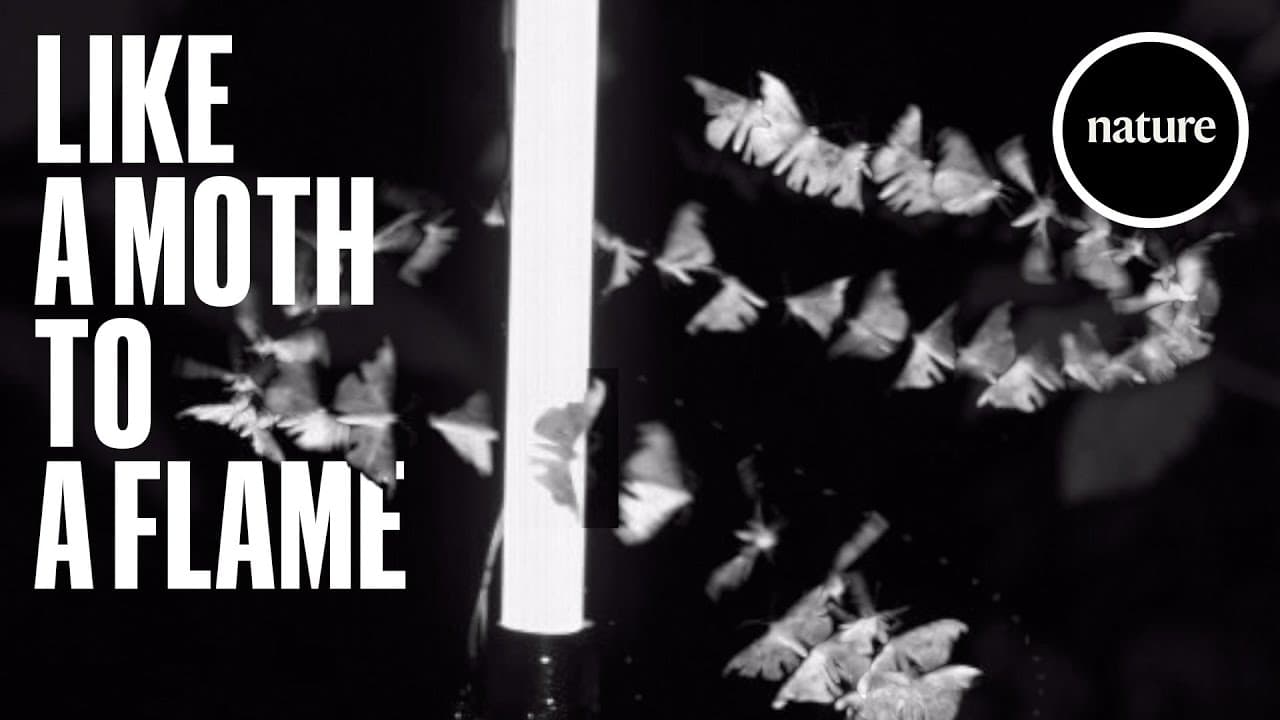
‘Like a moth to a flame’ — this strange insect behaviour is finally explained
TL;DR
Insects are drawn to artificial lights due to a navigation reflex, not attraction.
Transcript
VOICE OVER: If you’ve turned on a light outside at night, you’ve probably seen this. SAMUEL FABIAN: As soon as humans started lighting fires or creating light at night, they noticed that seemingly suicidally insects would dive into them or kind of emerge out the night and cluster around these light sources, and we wondered why. VO: Previous... Read More
Key Insights
- 🙂 Insects display a common response to artificial light, leading to erratic circling behavior rather than direct attraction.
- 🙂 The dorsal light response is a well-documented mechanism in insects that assists in navigation while flying.
- 👻 Technology advancements in filming allow researchers to gather detailed data on insect movement in low-light conditions.
- 🙂 The phenomenon of insects flying toward light may have broader ecological implications, impacting their roles in ecosystems.
- 🙂 Observations indicate that not all night-flying insect species respond to light the same way, revealing complexities in their behavior.
- 🥵 Challenging traditional assumptions, the study found that insects are not drawn to heat as a primary attraction method.
- 🙂 The ongoing decline in insect populations worldwide emphasizes the need for research into their interactions with artificial light.
Install to Summarize YouTube Videos and Get Transcripts
Explore YouTube Video Summarizer or Get YouTube Transcript Extractor
Questions & Answers
Q: Why do insects fly around artificial lights?
Insects fly around artificial lights due to a navigational reflex known as the dorsal light response. This reflex causes them to tilt their backs towards the brightest light source, misdirecting their flight and keeping them in a looping pattern rather than moving towards the light itself.
Q: How did researchers study insect behavior around lights?
Researchers used high-speed cameras and reflective markers to capture the precise movement and orientation of flying insects near light sources. This advanced technology enabled them to observe insect behavior in real-time under various lighting conditions, leading to important discoveries regarding their flight patterns.
Q: What implications does this research have on insect populations?
The study's findings suggest that artificial light contributes significantly to declining insect populations by entrapment. By understanding the mechanics of the insects' navigation near lights, strategies can be developed to create lighting designs that mitigate this issue, ultimately supporting insect conservation.
Q: What are other factors, besides light, affecting insect behavior?
While the study mainly focused on light's influence, researchers acknowledge that factors such as heat and ecological context also play a role in insect behavior. Future research aims to explore how these factors interact with light and affect various insect activities like foraging and migration.
Summary & Key Takeaways
-
Researchers discovered that flying insects, including moths and dragonflies, exhibit a dorsal light response, causing them to circle near light rather than fly directly toward it.
-
Advanced camera technology allowed scientists to observe and analyze insect movements at night, revealing that insects maintain their backs toward light sources in a navigational strategy.
-
Understanding this behavior could help address the global decline in insect populations by creating lighting conditions that minimize harmful trapping effects.
Read in Other Languages (beta)
Share This Summary 📚
Summarize YouTube Videos and Get Video Transcripts with 1-Click
Try YouTube Summary with ChatGPT & Claude or YouTube Transcript Generator
Explore More Summaries from nature video 📚




Summarize YouTube Videos and Get Video Transcripts with 1-Click
Try YouTube Summary with ChatGPT & Claude or YouTube Transcript Generator