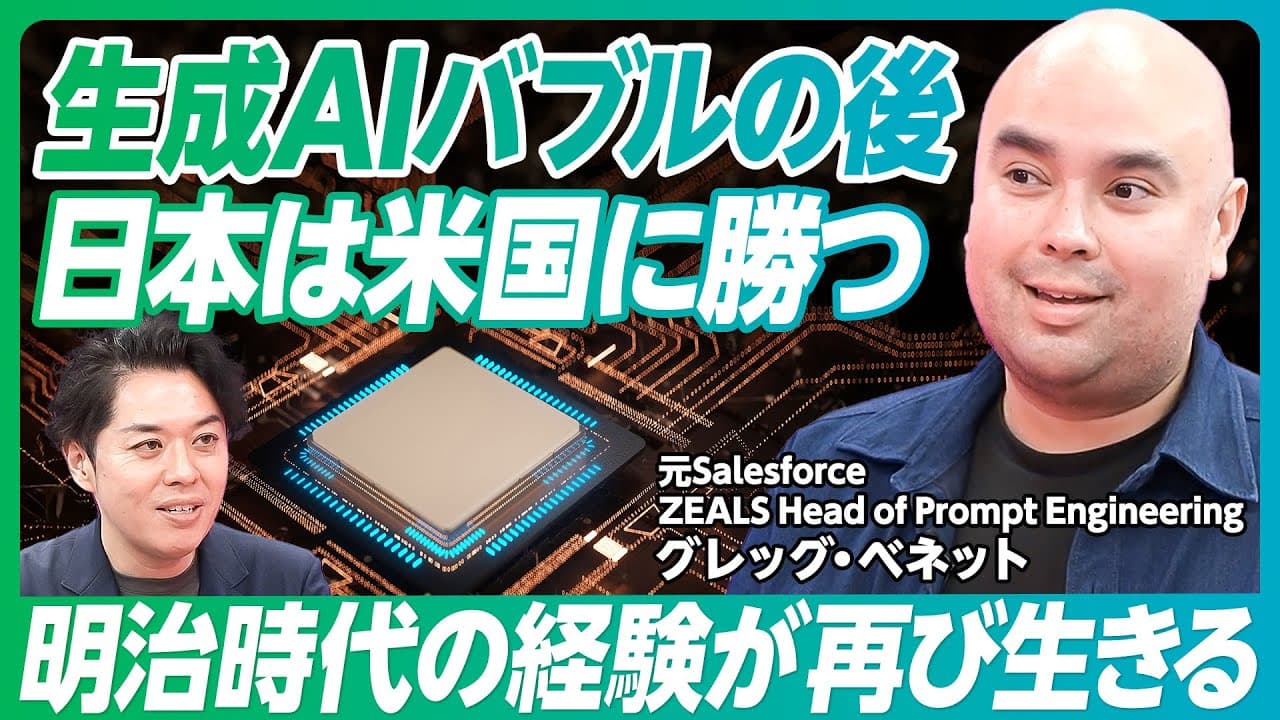
【日本は世界的な生成AI競争に勝てるのか】「優れた成果を上げる準備ができている」/日本文化がAI競争に有利な理由/元Salesforceエンジニア グレッグ・ベネット【PIVOT GLOBAL】
TL;DR
Japan's cultural approach gives it an edge in AI development.
Transcript
do you think Japan can win in this AI competition that's actually where I think Japan is uniquely prepared to be able to excel in this space I think the way that sort of maybe from a Japanese cultural standpoint Japan is looking at generative AI it's more around here are the problems that we have to solve and how can we not just solve a problem but... Read More
Key Insights
- Japan's cultural focus on societal benefit rather than competition gives it a unique advantage in AI development compared to the US.
- The Japanese approach to generative AI emphasizes solving specific societal problems, contrasting with the US focus on creating advanced models.
- Japan's cultural practice of adopting and perfecting foreign concepts, like whiskey and pastries, extends to AI, potentially enhancing its application.
- The Japanese concept of 'omotenashi' or hospitality can influence AI development, focusing on user comfort and experience rather than technological showmanship.
- There is a cultural difference in perception: Japan values societal harmony, while the US emphasizes individualism, impacting AI development approaches.
- Prompt engineering in Japan involves adapting Western AI models to fit Japanese cultural contexts, like 'omotenashi'.
- The idea of 'omotenashi' in AI is about creating comfortable user experiences, not about making AI human-like.
- Language learning can provide insights into cultural values, as seen in the relationship between Japanese language structure and societal norms.
Install to Summarize YouTube Videos and Get Transcripts
Explore YouTube Video Summarizer or Get YouTube Transcript Extractor
Questions & Answers
Q: What is Japan's unique advantage in the AI competition?
Japan's unique advantage in the AI competition lies in its cultural approach, which emphasizes practical applications and societal benefit over technological competition. This perspective allows Japan to focus on solving specific societal issues using AI, rather than merely developing advanced models for competitive purposes.
Q: How does the Japanese concept of 'omotenashi' relate to AI?
The Japanese concept of 'omotenashi', or hospitality, relates to AI by focusing on creating comfortable and user-friendly experiences. This approach prioritizes the user's comfort and needs, contrasting with the Western focus on technological prowess. In AI, 'omotenashi' involves adapting AI models to anticipate and meet user needs subtly and respectfully.
Q: How does Japan's approach to AI differ from that of the US?
Japan's approach to AI differs from that of the US in its focus on practical applications for societal benefit rather than technological competition. While the US emphasizes developing advanced models and achieving artificial general intelligence, Japan prioritizes using AI to address specific societal challenges, reflecting its cultural values of harmony and collective well-being.
Q: What role does language play in understanding cultural values in AI development?
Language plays a crucial role in understanding cultural values in AI development, as it reflects societal norms and perspectives. For example, the Japanese language's structure and use of honorifics highlight societal values of respect and harmony. Understanding these linguistic nuances helps in adapting AI models to align with cultural expectations, ensuring they are user-friendly and contextually appropriate.
Q: Why is prompt engineering important in adapting AI models for Japan?
Prompt engineering is important in adapting AI models for Japan because it involves translating cultural concepts into instructions that AI can understand. Given that many AI models are developed in the West, prompt engineering ensures these models can operate effectively within the Japanese cultural context, incorporating values like 'omotenashi' to enhance user experience and relevance.
Q: What challenges does Japan face in implementing AI with 'omotenashi'?
Japan faces challenges in implementing AI with 'omotenashi' due to the need to codify cultural nuances into AI models developed in the West. This requires detailed prompt engineering to ensure AI systems understand and replicate the subtle aspects of Japanese hospitality, such as anticipating user needs and providing comfort without being intrusive.
Q: How does the focus on societal benefit influence Japan's AI strategy?
The focus on societal benefit influences Japan's AI strategy by directing efforts towards solving real-world problems and improving quality of life. This approach contrasts with the competitive, model-centric focus seen in other countries, allowing Japan to develop AI applications that are directly relevant and beneficial to its society, thereby enhancing their practical impact.
Q: What insights does Greg Bennett offer on Japan's potential in AI?
Greg Bennett offers insights on Japan's potential in AI by highlighting its cultural strengths, such as the ability to adopt and perfect foreign technologies and the emphasis on societal benefit. He sees Japan's approach as more aligned with practical applications, leveraging cultural concepts like 'omotenashi' to create AI solutions that enhance user experience and societal well-being.
Summary & Key Takeaways
-
Japan's approach to AI development is culturally driven, focusing on practical applications for societal benefit rather than competing for technological supremacy. This cultural perspective provides a unique edge in the global AI race.
-
Greg Bennett discusses how Japan's cultural practices, such as 'omotenashi', influence its approach to AI. This focus on user comfort and societal improvement contrasts with the competitive, individualistic approach seen in the US.
-
Prompt engineering in Japan involves translating cultural concepts like 'omotenashi' into AI models, ensuring they align with Japanese societal norms. This cultural adaptation is seen as a potential advantage in developing more user-friendly AI applications.
Read in Other Languages (beta)
Share This Summary 📚
Summarize YouTube Videos and Get Video Transcripts with 1-Click
Try YouTube Summary with ChatGPT & Claude or YouTube Transcript Generator
Explore More Summaries from PIVOT 公式チャンネル 📚





Summarize YouTube Videos and Get Video Transcripts with 1-Click
Try YouTube Summary with ChatGPT & Claude or YouTube Transcript Generator