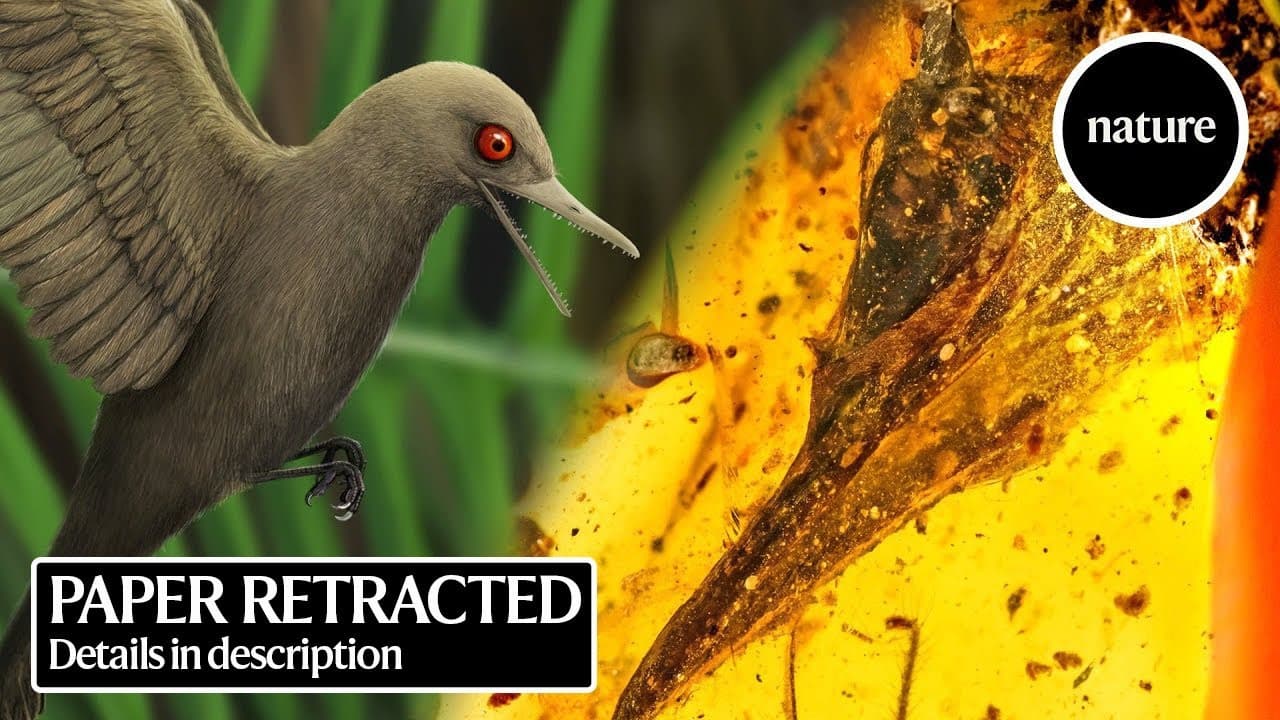
RETRACTED: The bird in amber: A tiny skull from the age of dinosaurs
TL;DR
A remarkable bird skull preserved in amber reveals insights into prehistoric ecosystems.
Transcript
when I first saw this specimen I was completely blown away you can see this beautiful little tiny bird skull preserved within this piece of amber so I was going around showing it to everyone like look at this it's so cool to a paleontologist it's weird we've never seen anything like it I definitely like couldn't keep a lid on this one when we think... Read More
Key Insights
- 💀 The discovery of the bird skull has introduced a new perspective on the diversity of life during the Mesozoic era, particularly regarding small avian species.
- 💀 The size and morphology of the skull suggest that it was uniquely adapted for a predatory lifestyle, providing insights into how these tiny predators operated.
- 👻 The amber preservation allows scientists to study organisms that lived contemporaneously with dinosaurs and other larger fauna, revealing the complexity of ancient ecosystems.
- 👨🔬 Ongoing research aims to uncover the biochemical details of preserved soft tissues, which may change our understanding of color and behavior in ancient birds.
- 🌥️ This specimen illustrates the importance of amber as a window into prehistoric biodiversity, offering clues to evolution that might not be apparent through larger fossils alone.
- 💁 The study of such specimens is in its infancy, indicating a wealth of undiscovered information that may redefine aspects of paleontological science.
- 🦕 The presence of this specimen alongside well-known dinosaurs highlights the intricate interdependencies of life that existed in ancient ecosystems during the Cretaceous period.
Install to Summarize YouTube Videos and Get Transcripts
Explore YouTube Video Summarizer or Get YouTube Transcript Extractor
Questions & Answers
Q: What makes this bird skull find unique in paleontology?
The uniqueness of this bird skull lies in its exceptionally small size and the preservation of soft tissues within amber, providing a rare glimpse into ancient avian life. Unlike larger fossils usually studied in paleontology, this specimen offers insights into tiny organisms that have traditionally been missed, shining a light on previously unknown ecological niches.
Q: How does the preserved structure of the skull suggest the bird's predatory lifestyle?
The skull's fused structure, large eyes, and a mouth filled with over a hundred teeth indicate that, despite its small size, the bird was likely a predator. The large eyes suggest it was adapted for spotting prey, although its side-facing orientation implies it lacked binocular vision, which is typically associated with predatory birds.
Q: Why is amber indispensable for studying tiny ancient organisms?
Amber plays a crucial role in preserving small ancient organisms because it creates a perfect medium that captures fine details, which would otherwise be lost. While other preservation methods exist, they often miss small fauna. The sticky nature of amber traps these organisms quickly, allowing researchers to study them with remarkable clarity.
Q: What future research is anticipated regarding the preserved specimen?
Researchers plan to develop advanced techniques over the next decade to explore the biochemistry of preserved soft tissues in the amber, aiming to identify color in feathers and other biological traits. This could significantly enhance our understanding of the specimen and the ecological roles of similar tiny organisms.
Summary & Key Takeaways
-
A tiny bird skull, smaller than a bee hummingbird, was discovered in amber, showcasing well-preserved soft tissues and over a hundred teeth.
-
This specimen, dating back 100 million years, coexisted with dinosaurs and flying reptiles, highlighting a diverse cretaceous fauna that is often overlooked.
-
Ongoing studies are expected to yield further insights into the biochemistry of preserved soft tissues, potentially revealing details such as feather color and more about ancient ecosystems.
Read in Other Languages (beta)
Share This Summary 📚
Summarize YouTube Videos and Get Video Transcripts with 1-Click
Try YouTube Summary with ChatGPT & Claude or YouTube Transcript Generator
Explore More Summaries from nature video 📚

Summarize YouTube Videos and Get Video Transcripts with 1-Click
Try YouTube Summary with ChatGPT & Claude or YouTube Transcript Generator