How flying snakes glide: Swimming through the air
TL;DR
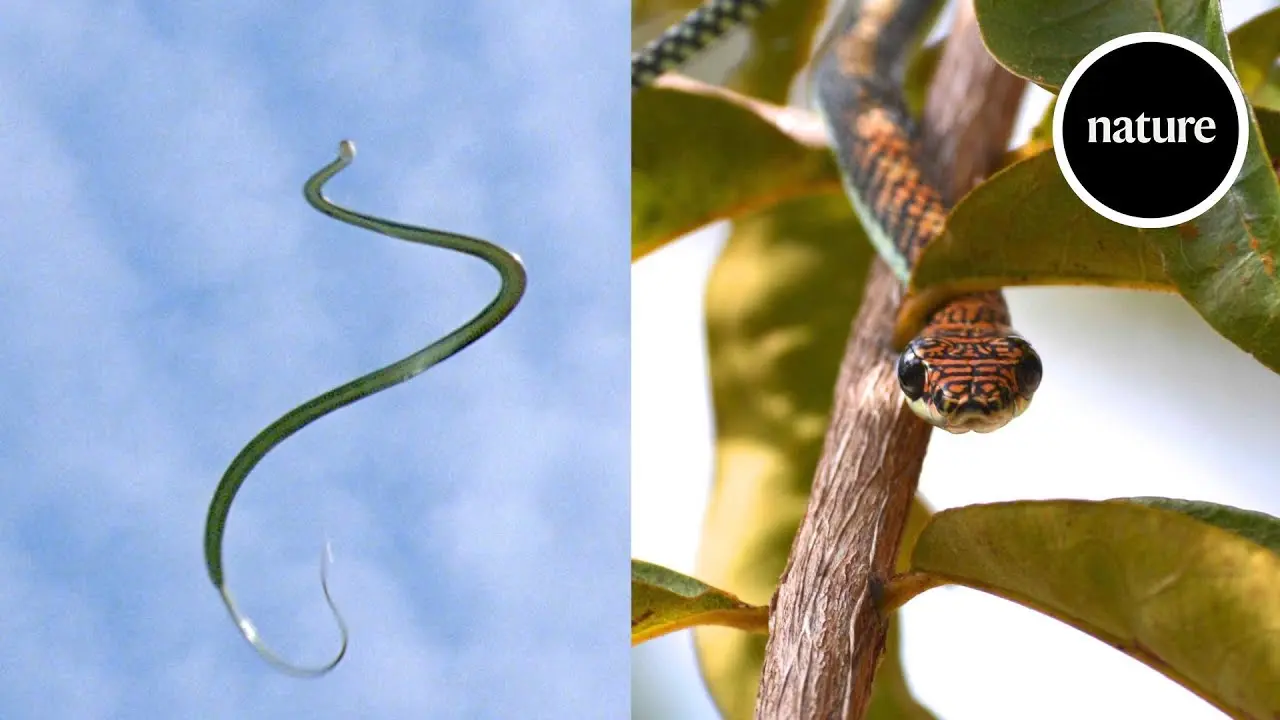
Flying snakes use undulation to enhance stability during glides, aiding in predator evasion.
Transcript
this snake is about to do something surprising I have been studying flying snakes for over 20 years and the reason that I find them so interesting is that the snake is perhaps the least obvious animal that should be able to fly through the air it's thought that these snakes take to the air to avoid predators but Jake's sohe has a lot of questions a... Read More
Key Insights
- 🐍 Flying snakes are capable of gliding due to their ability to undulate through the air, an unusual trait among snakes.
- 👻 Undulation helps stabilize flying snakes during glides, allowing them to maneuver effectively and safely evade predators.
- ❓ Motion capture technology enables researchers to study animal movements in depth, providing insights into biomechanics and aerodynamics.
- 🪽 Traditional gliding animals often rely on fixed wings; however, flying snakes demonstrate a unique form of movement that incorporates undulation.
- 🤖 Insights from snake undulation research could influence the engineering of robots designed for complex terrain navigation.
- 🐍 The study clarifies that undulation is not merely a characteristic of being a snake but a critical mechanism for successful gliding.
- 🤞 Researchers hope the findings can inspire future innovations in robotics, potentially improving mobility in various environments.
Install to Summarize YouTube Videos and Get Transcripts
Explore YouTube Video Summarizer or Get YouTube Transcript Extractor
Questions & Answers
Q: What unique adaptation do flying snakes have compared to other gliding animals?
Flying snakes uniquely employ undulation, a motion that enhances their gliding stability and allows them to maintain an upright position while airborne. Unlike other gliding animals that rely more on wings or flaps, flying snakes utilize this remarkable movement to prevent tumbling and ensure a successful glide.
Q: How do researchers study the gliding mechanics of flying snakes?
Researchers use a motion capture system, similar to those used in film production, to track the movements of snakes. By placing markers on a snake's body, they can capture its undulation and overall flight dynamics in three-dimensional space, enabling a comprehensive analysis of their gliding behavior.
Q: Why is the undulation of flying snakes considered critical for their gliding?
Undulation is essential for flying snakes as it increases stability during glides. Without this motion, a snake is likely to tumble and lose control while descending. The study showed that the act of undulating minimizes lateral instability and helps maintain an upright posture, making gliding much safer and more effective.
Q: What implications does the research on flying snakes have for robotics?
The insights gained from studying the aerial undulation of flying snakes present potential applications in robotics. Researchers believe that understanding this unique gliding mechanism could inspire new designs in robots, allowing them to maneuver effectively in challenging environments such as rough terrains, sand, or even water.
Q: What experimental setup did researchers use to encourage flying snakes to glide?
The research team set up an indoor environment mimicking the snakes' natural habitat, which included a high platform for jumping and a fake tree as a target for gliding. This controlled space, equipped with foam flooring for safety, allowed the snakes to exhibit their gliding behavior in a way that the researchers could observe and measure.
Q: How did the researchers ensure accurate measurement of the snakes’ movements during the study?
To obtain precise measurements, researchers covered the snake’s body with reflective tape that interfaced with motion capture cameras. This technology tracked the snake’s movements in real-time, allowing the team to create detailed 3D models to analyze the undulating motion and its effect on gliding stability.
Summary & Key Takeaways
-
Flying snakes, particularly the paradise tree snake, utilize undulation while gliding, moving with a swimming-like motion that enhances stability during aerial maneuvers.
-
Researchers conducted experiments using motion capture technology to analyze the undulation patterns of these snakes, revealing that this motion prevents tumbling and facilitates gliding.
-
The findings suggest that the mechanisms behind snake gliding could inspire robotic designs, enabling machines to navigate diverse terrains similarly to how flying snakes maneuver through the air.
Read in Other Languages (beta)
Share This Summary 📚
Summarize YouTube Videos and Get Video Transcripts with 1-Click
Try YouTube Summary with ChatGPT & Claude or YouTube Transcript Generator
Explore More Summaries from nature video 📚



Summarize YouTube Videos and Get Video Transcripts with 1-Click
Try YouTube Summary with ChatGPT & Claude or YouTube Transcript Generator