What is a Tuned Mass Damper?
TL;DR
Tuned mass dampers reduce skyscraper sway from wind and earthquakes.
Transcript
In many of the world's tallest skyscrapers there's a secret device protecting not only the building, but also the people inside from strong motion due to wind and earthquakes. Did you know you can tune a skyscraper just like a guitar? Hey I'm Grady today on Practical Engineering we're comparing theory to the real world for tuned mass dampers. *dubs... Read More
Key Insights
- Tuned mass dampers (TMDs) are devices used in skyscrapers to reduce vibrations caused by wind and earthquakes, enhancing comfort and safety for occupants.
- An oscillator, like a skyscraper, experiences a restoring force when displaced from its equilibrium position, similar to a marble in a bowl or a guitar string.
- Wind and earthquakes can excite a building's resonant frequency, causing oscillations that, while not structurally damaging, can be uncomfortable for occupants.
- The Taipei 101 tower in Taiwan made its TMD public, turning it into a tourist attraction and highlighting this engineering marvel.
- A TMD works by absorbing kinetic energy from a building's swaying motion, reducing the amplitude of vibrations and improving occupant comfort.
- The effectiveness of a TMD can be evaluated through scale model tests, which are a standard part of the design phase for major buildings.
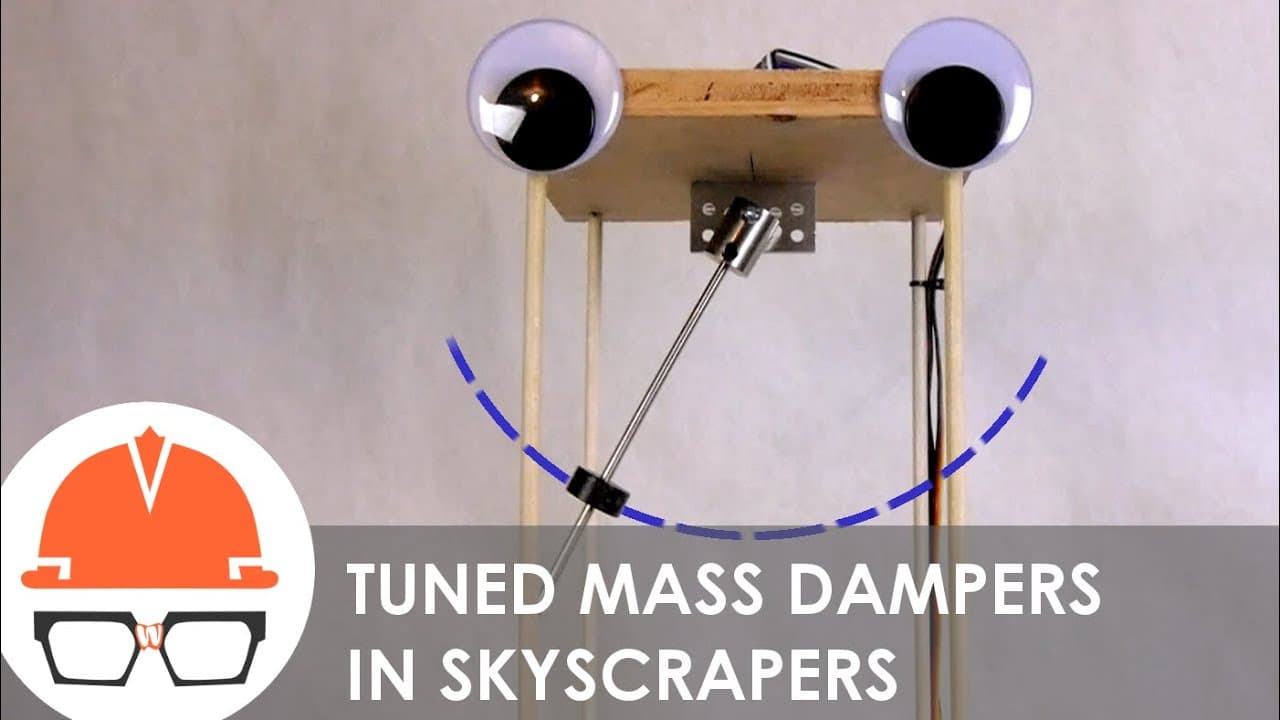
- A pendulum-style TMD can be tuned to a building's resonant frequency by adjusting the pendulum's length, similar to tuning a metronome.
- The damping ratio is a measure of how quickly an oscillating system returns to equilibrium, with TMDs significantly increasing this ratio in buildings.
Install to Summarize YouTube Videos and Get Transcripts
Explore YouTube Video Summarizer or Get YouTube Transcript Extractor
Questions & Answers
Q: What is a tuned mass damper and how does it work?
A tuned mass damper (TMD) is a device used in skyscrapers to reduce vibrations caused by wind and earthquakes. It works by absorbing kinetic energy from the building's swaying motion, thus reducing the amplitude of vibrations. This is achieved by tuning the TMD to the building's resonant frequency, allowing it to counteract oscillations effectively.
Q: How does a skyscraper act as an oscillator?
A skyscraper acts as an oscillator because, like a marble in a bowl or a guitar string, it experiences a restoring force when displaced from its equilibrium position. This force causes the building to oscillate around its equilibrium point, especially when excited by external factors like wind or earthquakes, which can match the building's resonant frequency.
Q: What role did Taipei 101 play in popularizing tuned mass dampers?
Taipei 101 played a significant role in popularizing tuned mass dampers by making its massive spherical TMD a public attraction. Unlike traditional TMDs, which are hidden from view, Taipei 101's designers chose to showcase it, drawing attention to this engineering marvel and educating the public about its importance in reducing building sway.
Q: How are tuned mass dampers evaluated for effectiveness?
Tuned mass dampers are evaluated for effectiveness through scale model tests, which simulate real-world conditions. These tests involve constructing models that replicate a building's oscillatory behavior and testing the TMD's ability to reduce vibrations. The tests help engineers assess the TMD's performance and make necessary adjustments to optimize its damping capabilities.
Q: What is the significance of the damping ratio in oscillatory systems?
The damping ratio is a measure of how quickly an oscillating system returns to equilibrium after being displaced. It is significant because it indicates the system's ability to dissipate energy and reduce oscillations. A higher damping ratio means quicker stabilization, which is crucial for structures like skyscrapers to minimize sway and enhance occupant comfort.
Q: How does a pendulum-style tuned mass damper function?
A pendulum-style tuned mass damper functions by using a pendulum to absorb and dissipate kinetic energy from a building's movement. The pendulum's frequency is tuned to match the building's resonant frequency, allowing it to counteract oscillations effectively. Adjustments to the pendulum's length can fine-tune its frequency, similar to tuning a metronome.
Q: Why is it important to reduce building sway in skyscrapers?
Reducing building sway in skyscrapers is important because excessive movement can cause discomfort and anxiety for occupants, even if the structure itself remains safe. People expect buildings to be stable, so noticeable sway can be unsettling. Additionally, reducing sway helps protect sensitive equipment and furnishings within the building.
Q: What are some challenges in designing tuned mass dampers?
Designing tuned mass dampers involves challenges such as accurately tuning the TMD to the building's resonant frequency, ensuring it can effectively dissipate energy, and integrating it into the building's structure without compromising aesthetics or functionality. Engineers must also consider factors like cost, maintenance, and potential impacts on the building's overall design.
Summary & Key Takeaways
-
Tuned mass dampers (TMDs) are critical engineering devices installed in skyscrapers to reduce vibrations caused by wind and earthquakes. These devices work by absorbing kinetic energy from the building's movement, thereby reducing the amplitude of oscillations and improving comfort for occupants.
-
The concept of oscillators is central to understanding TMDs. Like a marble in a bowl or a guitar string, a skyscraper can act as an oscillator, experiencing a restoring force when displaced from equilibrium. This principle is used to tune TMDs to a building's resonant frequency.
-
The Taipei 101 tower in Taiwan popularized TMDs by making its massive spherical damper a public attraction. TMDs are evaluated through scale model tests, which simulate real-world conditions to assess their effectiveness in minimizing building sway and enhancing structural stability.
Read in Other Languages (beta)
Share This Summary 📚
Summarize YouTube Videos and Get Video Transcripts with 1-Click
Try YouTube Summary with ChatGPT & Claude or YouTube Transcript Generator
Explore More Summaries from Practical Engineering 📚





Summarize YouTube Videos and Get Video Transcripts with 1-Click
Try YouTube Summary with ChatGPT & Claude or YouTube Transcript Generator