How Can a Mobile Robot Chemist Transform Research?
TL;DR
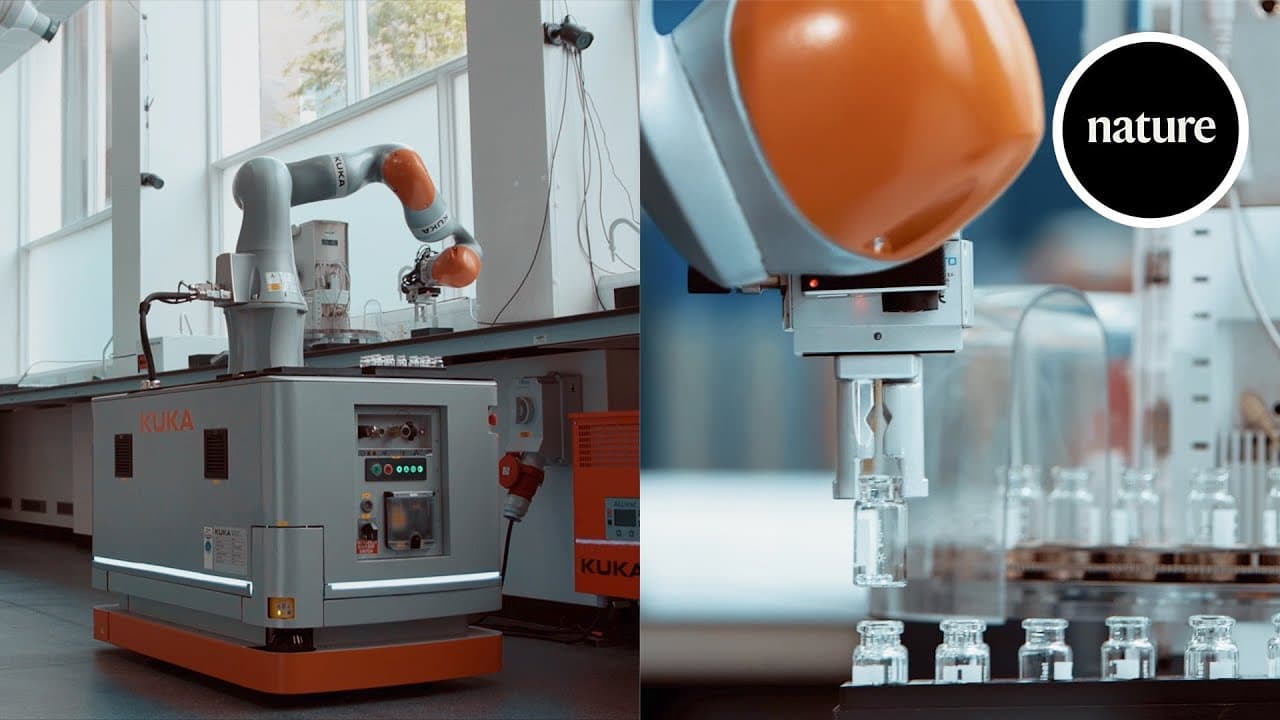
A mobile robot chemist revolutionises research by autonomously conducting experiments, optimising processes, and facilitating safe lab operations. Equipped with advanced AI and navigation technology, it enhances productivity while allowing human researchers to focus on critical problem-solving.
Transcript
meet the robot chemist a mobile autonomous worker that has been designed to offer a helping hand around the lab we started the project around three years ago and we'd never worked with mobile robots before we've worked with automation but the first few months were that were spend really just learning how to drive the thing around the lab reliably w... Read More
Key Insights
- 🤖 The mobile robot chemist represents an advancement in lab automation, designed specifically for chemical research.
- 👻 It autonomously conducts various experimental tasks, allowing human researchers to focus on higher-level problem-solving and hypothesis generation.
- 🤖 Advanced AI algorithms enable the robot to optimize its workflow, balancing thorough exploration of experiments with efficient exploitation of known results.
- 👻 The integration of lidar technology enhances navigation capabilities, allowing the robot to function safely in a crowded lab environment.
- 👨🔬 Its ability to operate continuously without fatigue significantly improves research efficiency compared to human-operated experiments.
- 🤖 Force feedback calibration contributes to the robot's delicate handling of lab equipment, increasing its versatility and precision in executing tasks.
- 🤖 The robot assists in research while maintaining social distancing, showcasing a potential for future lab management amidst similar challenges.
Install to Summarize YouTube Videos and Get Transcripts
Explore YouTube Video Summarizer or Get YouTube Transcript Extractor
Questions & Answers
Q: What are the main functions performed by the mobile robot chemist in the lab?
The mobile robot chemist undertakes various tasks, including weighing solid catalysts, dispensing liquids, shining lights onto samples, and measuring outputs such as nitrogen and hydrogen emissions. By performing these functions, it automates critical steps within the research process, aiding scientists in their studies without requiring constant human oversight.
Q: How does the robot use AI to optimize its experiments?
The robot employs a Bayesian optimization algorithm, which processes vast numbers of possible experimental combinations—estimated at 98 million. This AI-driven decision-making ability allows the robot to navigate experimental variables intelligently, balancing exploration of new potential options while ensuring thorough exploitation of successful combinations to enhance research efficiency.
Q: In what ways does the robot maintain safety while navigating the lab?
The robot utilizes lidar technology to create a precise map of its environment, allowing it to detect obstacles such as misplaced stools. Additionally, it incorporates a force feedback calibration method to improve its interaction with delicate instruments. These features help ensure safe navigation while enabling the robot to operate among human colleagues without causing disruptions or accidents.
Q: How does the robot aid researchers during social distancing measures?
During the global pandemic, the robot's autonomous capabilities became particularly valuable for maintaining laboratory operations while adhering to social distancing protocols. This allows researchers to set up experiments that the robot can run independently for extended periods, thus minimizing the need for continuous human presence and enhancing productivity under challenging conditions.
Summary & Key Takeaways
-
The mobile robot chemist developed by the University of Liverpool assists researchers in producing hydrogen from water using innovative photo catalysts, thus enhancing lab productivity.
-
Utilizing advanced AI algorithms, the robot can make decisions about experimental processes by analyzing output data, balancing exploration and optimization effectively.
-
The robot's design includes features like lidar for navigation and a specialized gripper for handling delicate lab equipment, demonstrating its ability to integrate with existing lab systems.
Read in Other Languages (beta)
Share This Summary 📚
Summarize YouTube Videos and Get Video Transcripts with 1-Click
Try YouTube Summary with ChatGPT & Claude or YouTube Transcript Generator
Explore More Summaries from nature video 📚



Summarize YouTube Videos and Get Video Transcripts with 1-Click
Try YouTube Summary with ChatGPT & Claude or YouTube Transcript Generator