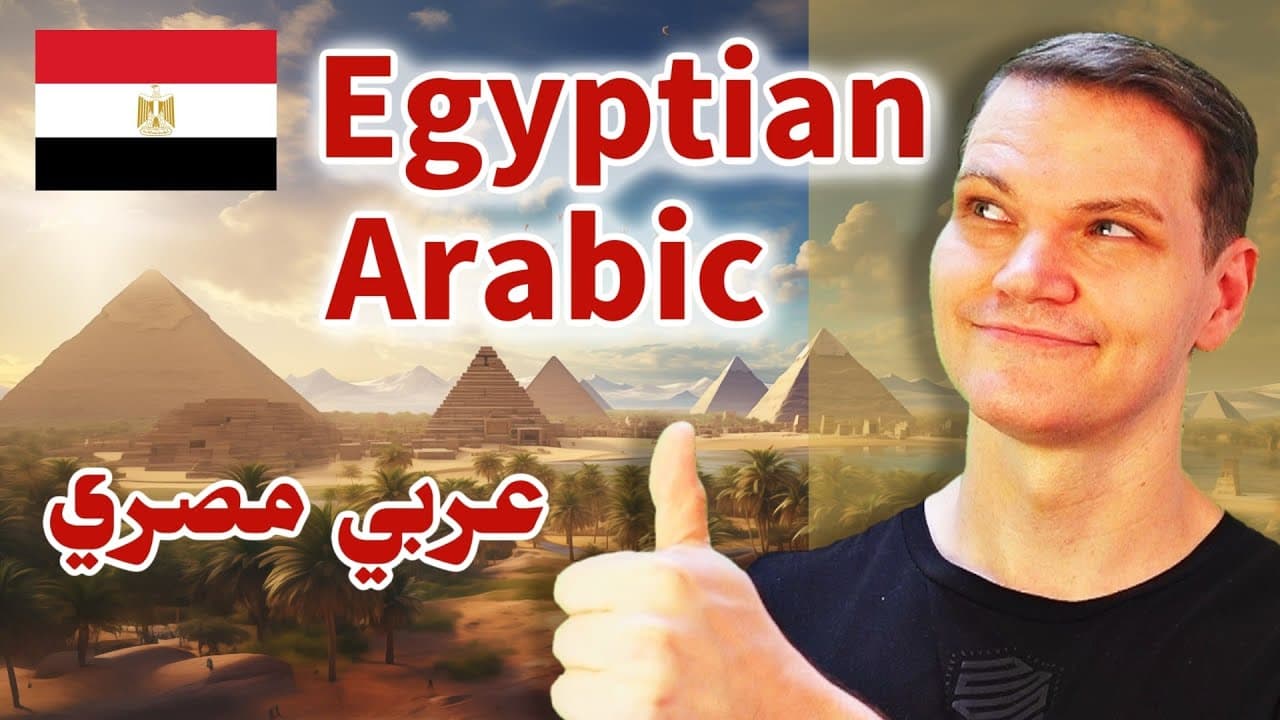
The Spoken Arabic of *EGYPT* and What Makes it DISTINCT
TL;DR
Egyptian Arabic is distinct and widely understood due to Egypt's media influence.
Transcript
of the many dialects of the Arabic language spoken across the Arab world the most widely understood is probably Egyptian Arabic in particular the variety spoken in Cairo why well Egypt is by far the most populous Arab country with 110 million people and Cairo is by far the largest Arab City with around 22 million people living in its metropolitan a... Read More
Key Insights
- Egyptian Arabic is the most widely understood dialect due to Egypt's large population and historical media influence.
- The dialect has been influenced by languages like Coptic, Turkish, French, Italian, and Greek, contributing to its uniqueness.
- Pronunciation differences include the consonant 'J' as 'G' and the replacement of certain sounds with a glottal stop.
- Egyptian Arabic has distinct vocabulary and expressions, often using words borrowed from other languages like French and Italian.
- The grammar of Egyptian Arabic differs from Modern Standard Arabic, with unique syntax and verb conjugation rules.
- Egyptian Arabic uses different question word placement and demonstrative adjective positioning compared to Standard Arabic.
- The dialect is known for its expressive slang and idioms, reflecting the culture and history of Egypt.
- Despite changes in media dominance, Egyptian Arabic remains a popular choice for Arabic learners due to its widespread understanding.
Install to Summarize YouTube Videos and Get Transcripts
Explore YouTube Video Summarizer or Get YouTube Transcript Extractor
Questions & Answers
Q: Why is Egyptian Arabic widely understood across the Arab world?
Egyptian Arabic is widely understood across the Arab world primarily due to Egypt's historical dominance in media and entertainment throughout the 20th century. Cairo, being the largest Arab city, was the hub for movie and music industries, which familiarized Arabic speakers with the dialect. Despite the rise of digital media, Egyptian Arabic remains influential and popular among learners.
Q: What are the main linguistic influences on Egyptian Arabic?
Egyptian Arabic has been influenced by several languages due to historical interactions. Coptic, the language of ancient Egyptians, influenced the dialect after the Arab conquest. Additionally, Turkish influence came from Ottoman rule, French from Napoleon's occupation and modernization, Italian from trade and migration, and Greek from administrative use. These influences have shaped its vocabulary and pronunciation.
Q: How does the pronunciation of Egyptian Arabic differ from Modern Standard Arabic?
In Egyptian Arabic, the consonant 'J' is pronounced as 'G', unlike in Modern Standard Arabic. The dialect also replaces certain sounds with a glottal stop, such as the letter 'Qaf'. Additionally, interdental fricatives like 'th' are often pronounced as 't' or 'd'. These pronunciation differences give Egyptian Arabic its distinct sound compared to other dialects.
Q: What are some unique vocabulary features of Egyptian Arabic?
Egyptian Arabic includes numerous unique vocabulary features, often borrowing words from other languages like French, Italian, and Turkish. For example, 'ascenseur' for elevator from French and 'guanti' for glove from Italian. The dialect also has its own expressions and idioms, such as 'kwayyis' for good and 'moot' as an intensifier, which are used more frequently or differently than in Modern Standard Arabic.
Q: How does the grammar of Egyptian Arabic differ from Modern Standard Arabic?
The grammar of Egyptian Arabic differs from Modern Standard Arabic in several ways. Question words in Egyptian Arabic often come at the end of the sentence, unlike in Standard Arabic. Demonstrative adjectives follow the noun they modify. The dialect also lacks dual verb forms and uses specific prefixes for present and future tense, which differ from Standard Arabic conjugation rules.
Q: What role does Egyptian Arabic play in the culture and media of the Arab world?
Egyptian Arabic has played a significant role in the culture and media of the Arab world due to Egypt's historical position as a media powerhouse. The dialect was popularized through Egyptian films, music, and television, making it widely recognized and understood. It remains influential, with Egyptian media continuing to be a significant part of Arab pop culture, contributing to the dialect's ongoing popularity.
Q: What are some common idioms or expressions in Egyptian Arabic?
Egyptian Arabic is rich with idioms and expressions that reflect its cultural nuances. For instance, 'khaliik tawiil' literally means 'stay heavy' but is used to mean 'be patient.' The word 'moot' is used as an intensifier, like 'moot tahaan' meaning 'a very difficult exam.' Such expressions showcase the dialect's expressiveness and connection to everyday life in Egypt.
Q: Why is Egyptian Arabic a popular choice for learners of Arabic?
Egyptian Arabic is a popular choice for learners due to its widespread understanding across the Arab world, thanks to Egypt's historical media influence. Its distinct and expressive nature, along with the availability of resources and media content, makes it accessible and appealing. Additionally, learning Egyptian Arabic allows learners to engage with a rich cultural heritage and communicate effectively in various Arab countries.
Summary & Key Takeaways
-
Egyptian Arabic, particularly the Cairo dialect, is the most widely understood Arabic dialect due to Egypt's historical dominance in media and entertainment. It features distinct pronunciation, vocabulary, and grammar influenced by languages like Coptic, Turkish, and French.
-
The dialect's pronunciation includes unique sounds such as 'J' pronounced as 'G' and the use of a glottal stop for certain consonants. Vocabulary includes many borrowed words, and grammar differs from Modern Standard Arabic in syntax and verb conjugation.
-
Egyptian Arabic is expressive and colorful, with unique slang and idioms that reflect Egyptian culture and history. Despite the rise of other media centers, it remains popular among Arabic learners for its broad comprehension across the Arab world.
Read in Other Languages (beta)
Share This Summary 📚
Summarize YouTube Videos and Get Video Transcripts with 1-Click
Try YouTube Summary with ChatGPT & Claude or YouTube Transcript Generator
Explore More Summaries from Langfocus 📚



Summarize YouTube Videos and Get Video Transcripts with 1-Click
Try YouTube Summary with ChatGPT & Claude or YouTube Transcript Generator