What Is the Turning Moment on a Crankshaft?
TL;DR
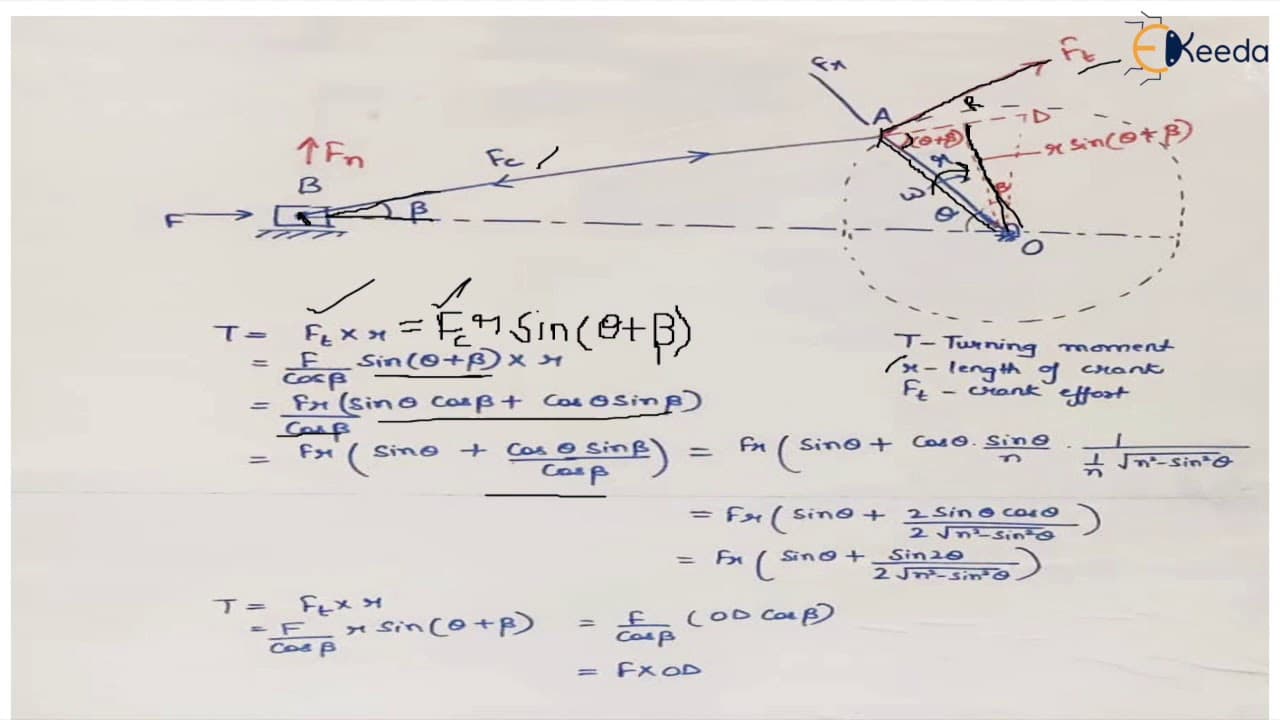
The turning moment on a crankshaft is generated by the crank effort, which is the net force applied at the crank pin. It can be calculated using the equation ft * r * sin(theta + beta) / (2 * sqrt(n^2 - sin^2(theta))), where ft is the tangential force, r is the crank length, and theta and beta are angles related to the crank and connecting rod.
Transcript
hello everyone in this video we'll discuss about turning moment on crankshaft so we have already done the engine force analysis and we have discussed about the crank effort where crank effort is the this crank effort is what it is the force the net force which is applied at the crank pin and it provides the required turning moment on the crankshaft... Read More
Key Insights
- 😴 The turning moment on a crankshaft is caused by the crank effort, which is the net force applied at the crank pin.
- 😴 The tangential force at the crank pin provides the turning moment and tries to rotate the crank about its fixed end.
- 💝 The value of the turning moment can be calculated using the equation ft * r * sin(theta + beta) / (2 * sqrt(n^2 - sin^2(theta))).
- 🔺 The exterior angle of the triangle is important in determining the perpendicular distance (or) for the turning moment.
Install to Summarize YouTube Videos and Get Transcripts
Explore YouTube Video Summarizer or Get YouTube Transcript Extractor
Questions & Answers
Q: What is the crank effort and how does it contribute to the turning moment on the crankshaft?
The crank effort is the net force applied at the crank pin, and it provides the required turning moment on the crankshaft. The tangential force at the crank pin, also known as the crank effort, is responsible for rotating the crank about its fixed end, thus generating the turning moment.
Q: How can the value of the turning moment on the crankshaft be calculated?
The value of the turning moment can be calculated using the equation ft * r * sin(theta + beta) / (2 * sqrt(n^2 - sin^2(theta))). This equation takes into account the tangential force (ft), the length of the crank (r), the angle the crank makes with the line of stroke (theta), and the angle the connecting rod makes with the line of stroke (beta).
Q: What is the significance of the exterior angle in determining the value of the perpendicular distance (or) for the turning moment?
The exterior angle of the triangle formed by extending point B to point R is used to calculate the perpendicular distance (or) for the turning moment. Its value is equal to the sum of the interior opposite angles (theta + beta), and this angle is crucial in accurately determining the value of the turning moment.
Q: Can the turning moment on the crankshaft be expressed in terms of the piston force?
Yes, the turning moment on the crankshaft can also be expressed in terms of the piston force. The perpendicular distance (OD) between the force and the axis of rotation is considered, and the equation ft * r is used to represent the turning moment in terms of the piston force.
Summary & Key Takeaways
-
The turning moment on a crankshaft is generated by the crank effort, which is the net force applied at the crank pin.
-
The tangential force at the crank pin, known as the crank effort, provides the turning moment to the crankshaft.
-
The value of the turning moment can be calculated using the equation ft * r * sin(theta + beta) / (2 * sqrt(n^2 - sin^2(theta))).
Read in Other Languages (beta)
Share This Summary 📚
Summarize YouTube Videos and Get Video Transcripts with 1-Click
Try YouTube Summary with ChatGPT & Claude or YouTube Transcript Generator
Explore More Summaries from Ekeeda 📚

Summarize YouTube Videos and Get Video Transcripts with 1-Click
Try YouTube Summary with ChatGPT & Claude or YouTube Transcript Generator