Why Are Short Arch Dams Rare in Engineering?
TL;DR
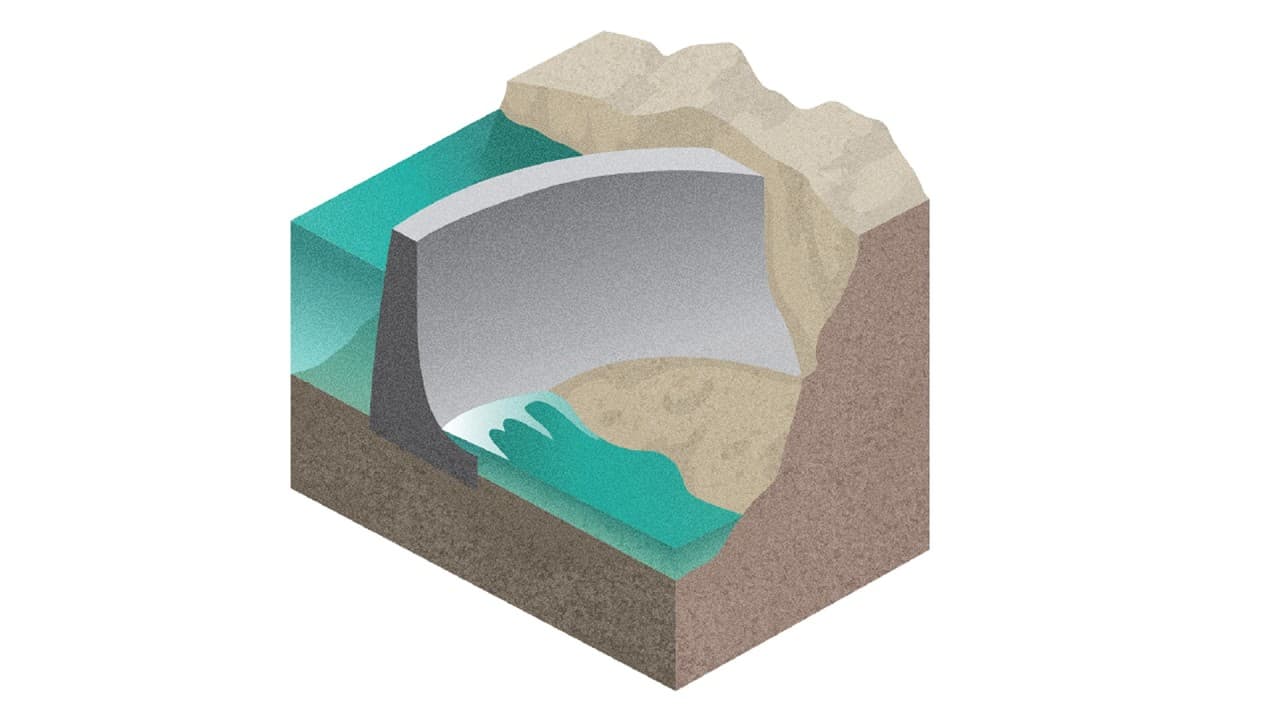
Short arch dams are rare due to specific engineering challenges and site requirements that limit their feasibility. These structures require strong abutments and are best suited for narrow, deep canyons. In contrast, gravity and embankment dams are more adaptable to various conditions, making them much more common.
Transcript
Flaming Gorge Dam rises from the Green River in northern Utah like a concrete wedge driven into the canyon, anchored against the sheer rock walls that flank it. It’s quintessential, in a way. It’s what we picture when we think about dams: a hulking, but also somehow graceful, wall of concrete stretching across a narrow rocky valley. But to dam ... Read More
Key Insights
- Arch dams are rare, comprising less than a tenth of a percent of all US dams, due to their specific site requirements.
- Gravity dams rely on friction and weight to resist water pressure, but their stability decreases with height due to increasing forces.
- Uplift forces, caused by water seepage, counteract the weight of gravity dams, complicating their design and construction.
- Arch dams efficiently use materials by transferring loads through compression, but require strong abutments and specific site conditions.
- The structural behavior of arch dams is complex and three-dimensional, making them suitable only for certain narrow and deep canyons.
- Multiple-arch and gravity-arch dams blend design principles to optimize material use and site conditions, as seen in Hoover Dam.
- Embankment and gravity dams are more adaptable to diverse site conditions, making them more common than arch dams.
- Independent creators on platforms like Nebula offer authentic and thoughtful content, with ad-free experiences and original series.
Install to Summarize YouTube Videos and Get Transcripts
Explore YouTube Video Summarizer or Get YouTube Transcript Extractor
Questions & Answers
Q: Why are arch dams rare?
Arch dams are rare because they require specific site conditions, such as strong abutments and narrow, deep canyons. Their construction is complex, involving three-dimensional structural behavior and significant engineering challenges. These specific requirements limit the number of suitable locations for their construction, making them less common than other types of dams.
Q: How do gravity dams resist water pressure?
Gravity dams resist water pressure primarily through friction and weight. The frictional resistance depends on the normal force, which is the weight of the dam, and the coefficient of friction between the dam and the ground. As the water pressure increases with depth, the dam must have sufficient weight to maintain stability and prevent sliding or overturning.
Q: What is the challenge of uplift forces in dam construction?
Uplift forces occur when water seeps beneath a dam, exerting upward pressure that counteracts the dam's weight. This is particularly problematic for gravity dams as it reduces their stability. Designing dams to manage uplift forces often involves incorporating drainage systems and cutoff walls to mitigate the effects of water seepage and maintain structural integrity.
Q: Why are arch dams more efficient in material use?
Arch dams are more efficient in material use because they transfer loads through compression, allowing for the use of simpler, cheaper, and longer-lasting materials like masonry and concrete. By utilizing the natural geology for support, arch dams reduce the need for massive structures, making them more material-efficient than gravity or embankment dams.
Q: In what conditions do arch dams make economic sense?
Arch dams make economic sense in narrow, deep canyons with strong, competent rock abutments. These conditions allow the dam to efficiently transfer loads through compression, reducing material costs. However, the complexity and expense of their design and construction are only justified when these specific site conditions are met, limiting their application.
Q: How do multiple-arch and gravity-arch dams optimize design?
Multiple-arch and gravity-arch dams optimize design by blending principles to balance material use and site conditions. Multiple-arch dams use a series of smaller arches supported by buttresses, dividing the span into manageable components. Gravity-arch dams, like Hoover Dam, combine mass and arch action to resist water loads, optimizing structural efficiency for specific sites.
Q: What is the significance of independent creators on platforms like Nebula?
Independent creators on platforms like Nebula offer authentic, thoughtful content that hasn't been diluted by studio executives. This allows for more compelling and genuine storytelling. Nebula provides an ad-free experience with original series, supporting creators in producing high-quality content that resonates with audiences seeking depth and creativity in their viewing experiences.
Q: What role does site geology play in dam design?
Site geology plays a crucial role in dam design, particularly for arch dams, which require strong abutments to withstand thrust forces. The natural rock or soil at a dam site must provide adequate support for the structure. Weak or unstable geology can limit the feasibility of certain dam designs, influencing the choice of dam type and construction methods.
Summary & Key Takeaways
-
Arch dams are rare due to their specific site requirements and engineering challenges. These dams efficiently use materials by transferring loads through compression, but require strong abutments and specific site conditions, making them suitable only for certain narrow and deep canyons.
-
Gravity dams rely on friction and weight to resist water pressure, but their stability decreases with height due to increasing forces. Uplift forces, caused by water seepage, counteract the weight of gravity dams, complicating their design and construction, leading to higher material and cost requirements.
-
Multiple-arch and gravity-arch dams blend design principles to optimize material use and site conditions. Platforms like Nebula offer authentic content from independent creators, providing ad-free experiences and original series, showcasing the value of independent production in delivering compelling and thoughtful videos.
Read in Other Languages (beta)
Share This Summary 📚
Summarize YouTube Videos and Get Video Transcripts with 1-Click
Try YouTube Summary with ChatGPT & Claude or YouTube Transcript Generator
Explore More Summaries from Practical Engineering 📚





Summarize YouTube Videos and Get Video Transcripts with 1-Click
Try YouTube Summary with ChatGPT & Claude or YouTube Transcript Generator