Arcade-Style Puzzle Box Mini Game
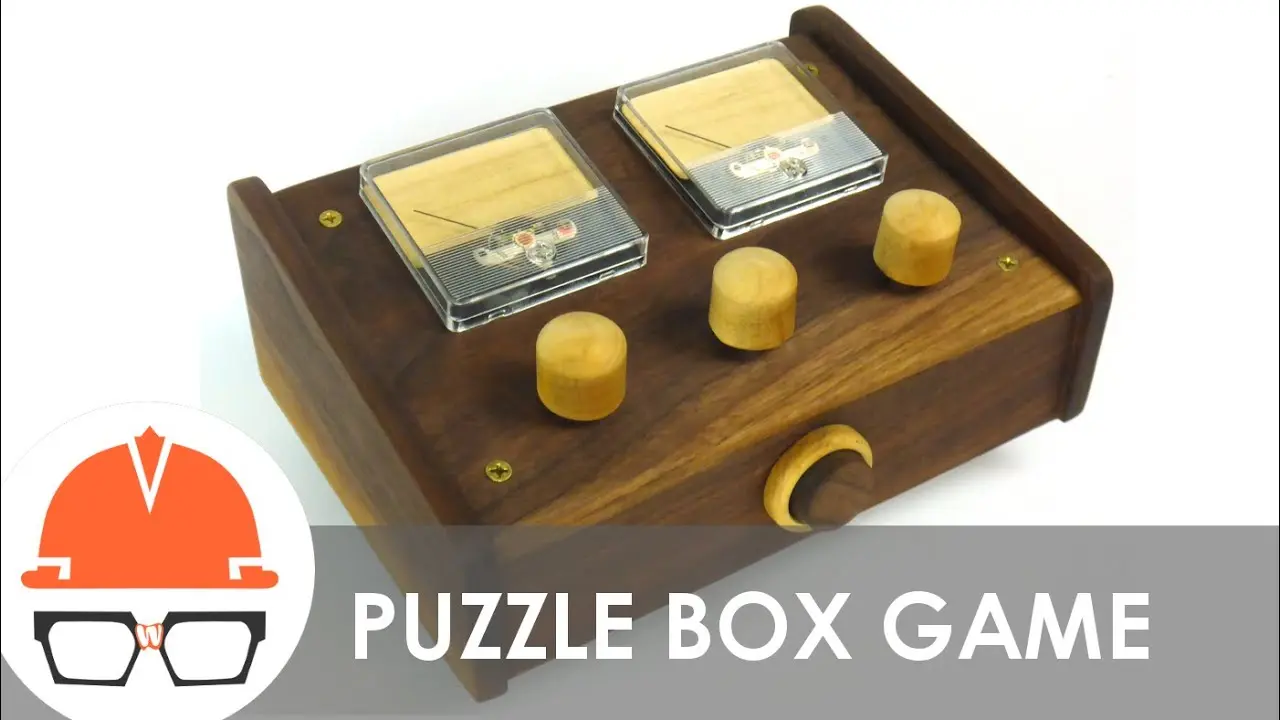
TL;DR
A DIY arcade-style puzzle box using Arduino and custom woodwork.
Transcript
as I've been learning more about circuits and microcontrollers I've been having lots of ideas about how to make my projects more interactive I don't know if this is a common sentiment but I have this deep seated desire to turn every knob and push every button and flip every switch that I see I think this is a lingering desire from when I was a kid ... Read More
Key Insights
- The project is inspired by childhood curiosity and the desire to interact with buttons and switches, leading to the creation of a handheld puzzle game.
- The design process involved using a wooden enclosure inspired by 1970s audio equipment, emphasizing aesthetics alongside functionality.
- The creator replaced plastic components with custom wooden parts, utilizing tools like a lathe to enhance the project's visual appeal.
- The electronics are driven by an Arduino microcontroller, with minimal circuitry, focusing on simplicity and functionality.
- Challenges in soldering were overcome by upgrading to a better soldering iron, highlighting the importance of quality tools in DIY projects.
- Programming the game mechanics was complex, involving unique relationships between knobs and meter needles, yet it was a rewarding learning experience.
- The game involves adjusting knobs to align needles with LEDs, presenting a mathematical challenge of finding intersections between three-dimensional planes.
- Future possibilities for the project include reprogramming the Arduino for different game mechanics, showcasing the versatility of the components used.
Install to Summarize YouTube Videos and Get Transcripts
Explore YouTube Video Summarizer or Get YouTube Transcript Extractor
Questions & Answers
Q: What inspired the creator to make the puzzle box?
The creator was inspired by a lingering childhood curiosity to interact with buttons and switches, which was often discouraged. This curiosity, combined with an interest in circuits and microcontrollers, led to the idea of creating a handheld puzzle game that mimics the allure of forbidden devices from childhood.
Q: How did the creator approach the design of the puzzle box?
The creator drew inspiration from 1970s audio equipment, opting for a wooden enclosure to enhance the aesthetic appeal. The design process involved using tools like a lathe to replace plastic components with custom wooden parts, ensuring the device was not only functional but also visually attractive.
Q: What challenges did the creator face during the project?
The creator faced challenges in soldering, initially struggling with a poor-quality soldering iron. Upgrading to a better tool significantly improved the experience. Additionally, programming the game mechanics proved complex, requiring thoughtful consideration to ensure the game functioned as intended.
Q: What are the main components of the puzzle box?
The puzzle box is powered by an Arduino microcontroller, with minimal circuitry involved. It includes components such as panel meters, potentiometers, LEDs, a button, and a vibration motor. The simplicity of the electronics contrasts with the intricate design of the wooden enclosure and components.
Q: How does the puzzle game work?
The game involves adjusting three knobs to align two meter needles with their respective LEDs. Each knob has a unique and random effect on the needles, requiring players to find the correct configuration. Success is indicated by a vibration motor buzz, and the puzzle resets with a new configuration.
Q: What is the mathematical analogy of the game?
The game presents a mathematical challenge of finding the intersection between two three-dimensional planes. This analogy was a pleasant surprise for the creator, who realized it during the programming phase. While not a selling point for everyone, it added an interesting dimension to the project.
Q: What future possibilities exist for the puzzle box?
The creator plans to explore different game mechanics by reprogramming the Arduino, taking advantage of the components' versatility. Suggestions for more engaging or challenging games are welcome, as the device's behavior can be altered without changing its physical structure.
Q: How can others get involved with the project?
The project is open-source, with the code available on GitHub for others to build or modify the puzzle box. The creator encourages feedback and suggestions for improvement, aiming to foster a community of DIY enthusiasts interested in electronics and woodworking.
Summary & Key Takeaways
-
This project involves creating an arcade-style puzzle box using an Arduino microcontroller and custom wooden components. Inspired by childhood curiosity, the creator aimed to design a game that looks like something forbidden to touch. The process included woodworking, electronics, and programming, resulting in a unique interactive device.
-
The puzzle game requires players to adjust knobs to align meter needles with LEDs, presenting a mathematical challenge. The creator faced challenges in soldering and programming but overcame them with better tools and determination. The project is open-source, allowing others to build or modify the game themselves.
-
Despite its simplicity, the game offers potential for further development with different mechanics. The creator emphasizes the aesthetic and functional aspects of the project, using wood to replace plastic components and ensuring the device is both a conversation piece and an interactive game.
Read in Other Languages (beta)
Share This Summary 📚
Summarize YouTube Videos and Get Video Transcripts with 1-Click
Try YouTube Summary with ChatGPT & Claude or YouTube Transcript Generator
Explore More Summaries from Practical Engineering 📚






Summarize YouTube Videos and Get Video Transcripts with 1-Click
Try YouTube Summary with ChatGPT & Claude or YouTube Transcript Generator