Student Video: Real and Reciprocal Space in 2D and 3D
TL;DR
Real and reciprocal space are essential concepts in crystallography, defining the structure and diffraction patterns of crystals in both two and three dimensions.
Transcript
STUDENT: Hello. Today we are going to talk about real and reciprocal space in two dimensions and three dimensions. Crystallography is a major topic within material science. A crystal is a highly ordered solid material made up of a lattice and a periodic arrangement of atoms. Atoms are located on every lattice site. Due to the periodic nature of the... Read More
Key Insights
- 🔮 Crystallography is fundamental to material science, studying the highly ordered structure of crystals.
- 🔺 Lattices in both two and three dimensions are defined by lattice vectors with specific lengths and angles.
- 👾 Reciprocal space, a non-physical space, is crucial for understanding diffraction phenomena in material science.
Install to Summarize YouTube Videos and Get Transcripts
Explore YouTube Video Summarizer or Get YouTube Transcript Extractor
Questions & Answers
Q: What is a crystal in material science?
In material science, a crystal is a highly ordered solid material with a lattice structure and a periodic arrangement of atoms, displaying translational symmetry.
Q: How are 2D lattices defined?
Two-dimensional lattices are defined by lattice vectors a and b, with different lengths and angles depending on the lattice type: oblique, rectangular, square, or hexagonal.
Q: What are the characteristics of three-dimensional lattices?
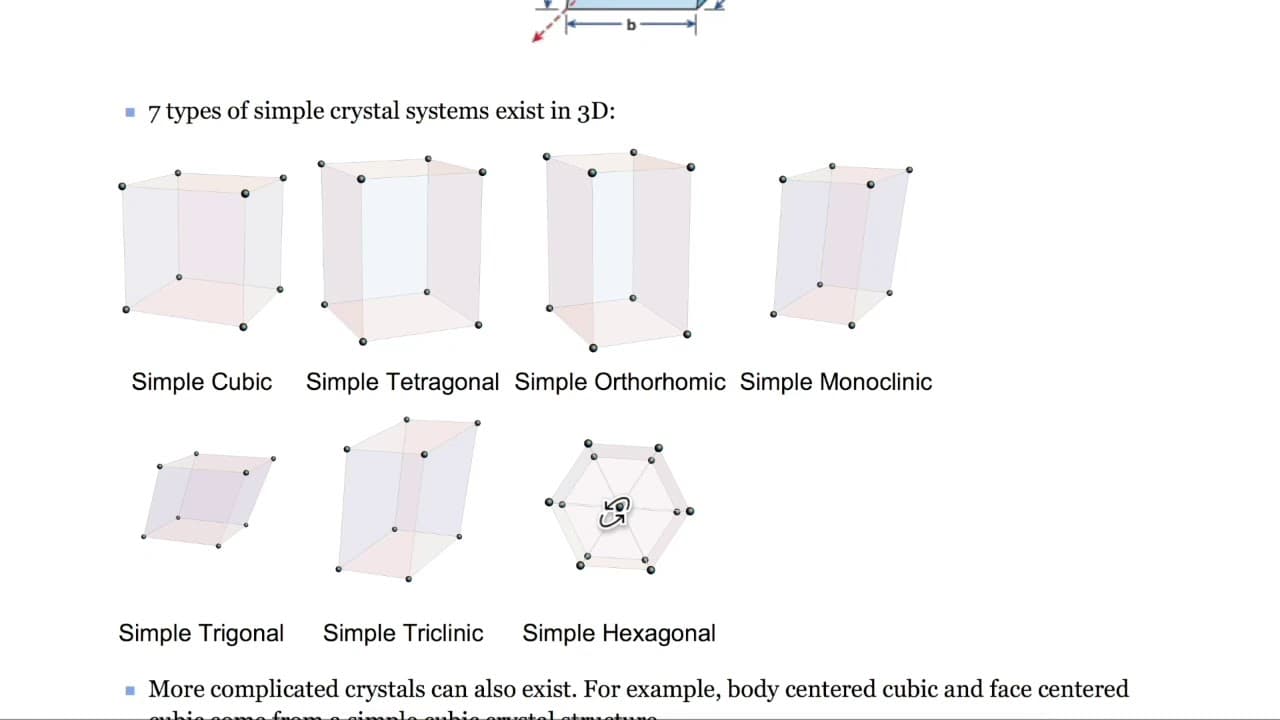
Three-dimensional lattices are defined by lattice vectors a, b, and c, with different angles (alpha, theta, gamma) and shapes, ranging from simple cubic to triclinic.
Q: What is reciprocal space?
Reciprocal space is a non-physical space used in material science to represent diffraction phenomena, related to real space through reciprocal lattice vectors.
Q: Why is reciprocal space important?
Reciprocal space plays a crucial role in understanding X-ray diffraction, as diffraction patterns in real space correspond to reciprocal lattice vectors in reciprocal space.
Q: How do unit cells in real and reciprocal space differ?
In two dimensions, as the real unit cell shrinks or expands, the reciprocal unit cell changes inversely. In three dimensions, the change in real unit cell size, shape, and angles reflects differently in reciprocal space.
Summary & Key Takeaways
-
Crystallography is a crucial topic in material science, involving the study of highly ordered solid materials with a lattice and periodic arrangement of atoms.
-
Two-dimensional lattices have lattice vectors a and b, with four general lattice types: oblique, rectangular, square, and hexagonal.
-
Three-dimensional lattices are defined by three lattice vectors a, b, and c, with different angles and seven simple crystal systems.
Read in Other Languages (beta)
Share This Summary 📚
Summarize YouTube Videos and Get Video Transcripts with 1-Click
Try YouTube Summary with ChatGPT & Claude or YouTube Transcript Generator
Explore More Summaries from MIT OpenCourseWare 📚



Summarize YouTube Videos and Get Video Transcripts with 1-Click
Try YouTube Summary with ChatGPT & Claude or YouTube Transcript Generator