How to Measure Flow with Magnets - (Magnetic Flow Meters)
TL;DR
Magnetic flow meters use Faraday's Law to measure fluid flow.
Transcript
practical engineering is brought to you in part by Audible and by viewers like you through patreon we all know that magnets are pretty much Voodoo invisible forces acting on the real world in unknown and unexpected ways but Engineers have developed a number of methods to harness that magic to perform useful and beneficial tasks including answer tha... Read More
Key Insights
- Magnetic flow meters utilize Faraday's Law of Induction to measure the flow of conductive fluids in pipes, by generating a voltage proportional to the fluid's velocity.
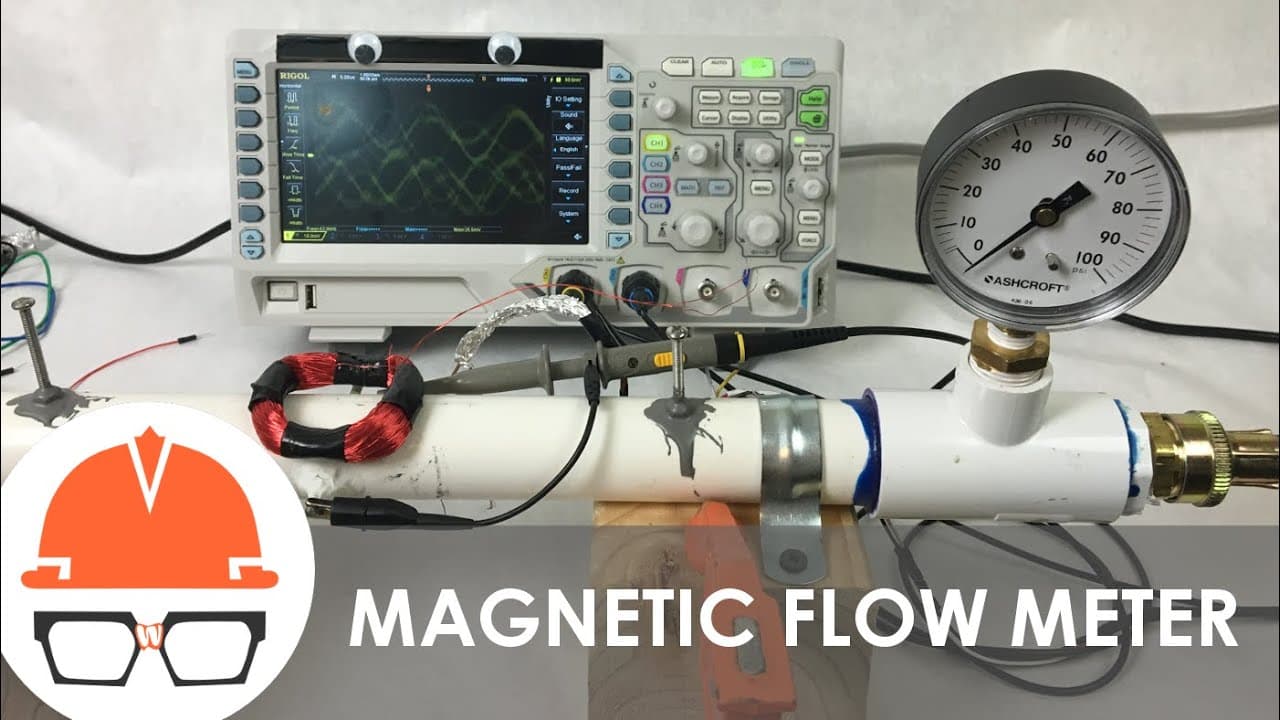
- The device relies on magnets to create a magnetic field and electrodes to detect the electromotive force generated as the fluid moves through the field.
- Challenges in real-world applications include electrical noise from electrolytic reactions, stray voltages, and capacitance, which can obscure the desired signal.
- Engineers overcome noise issues by varying the magnetic field's strength over time, allowing for the isolation of the signal related to fluid velocity.
- Permanent magnets are replaced with electromagnets in practical applications to facilitate the pulsed magnetic field necessary for accurate measurements.
- The calibration of a magnetic flow meter involves plotting induced voltage against flow rate, enabling straightforward calculation of flow using a proportionality constant.
- The video highlights the complexities and challenges of electrical engineering, particularly in designing and implementing devices like magnetic flow meters.
- Despite the unsuccessful prototype demonstration, the video underscores the importance of documenting both successes and failures in engineering projects.
Install to Summarize YouTube Videos and Get Transcripts
Explore YouTube Video Summarizer or Get YouTube Transcript Extractor
Questions & Answers
Q: What principle do magnetic flow meters rely on?
Magnetic flow meters rely on Faraday's Law of Induction, which states that moving a conductor through a magnetic field generates an electromotive force proportional to the velocity of the conductor. In the case of magnetic flow meters, the conductor is a conductive fluid moving through a pipe.
Q: How do engineers address the issue of electrical noise in magnetic flow meters?
Engineers address electrical noise by varying the magnetic field's strength over time, creating a pulsed magnetic field. This allows them to isolate the portion of the signal related to fluid velocity while ignoring noise from other sources like electrolytic reactions, stray voltages, and capacitance.
Q: Why are electromagnets used instead of permanent magnets in magnetic flow meters?
Electromagnets are used instead of permanent magnets because they allow for the creation of a pulsed magnetic field. This pulsing is necessary to isolate the flow-related signal from electrical noise, enabling more accurate measurements of the fluid's velocity and, consequently, the flow rate.
Q: What challenges did the video creator face in demonstrating the magnetic flow meter?
The creator faced challenges in achieving a reliable signal due to high levels of electrical noise, which obscured the desired signal. The crude setup in the garage workshop, combined with a weak pump and insufficiently strong electromagnets, made it difficult to capture a clean response from the electrodes.
Q: How is the flow rate calculated in a magnetic flow meter?
The flow rate is calculated by measuring the induced voltage between the electrodes and multiplying it by a calibration constant. This constant is determined by plotting the induced voltage against known flow rates, creating a linear relationship that simplifies the calculation of flow from the measured voltage.
Q: What are some potential sources of electrical noise in magnetic flow meters?
Potential sources of electrical noise include electrolytic reactions between the fluid and electrodes, stray voltages from other equipment along the pipe, and the capacitance of the liquid, which can create noise in the voltage signal between the electrodes, complicating accurate flow measurement.
Q: Why is documenting failures in engineering projects important?
Documenting failures is important because it provides valuable learning opportunities and insights into what went wrong, helping to refine future attempts. It also fosters a culture of transparency and continuous improvement, encouraging collaboration and feedback from others who may offer solutions or alternative approaches.
Q: What additional resources are provided in the video for further learning?
The video provides links to additional resources such as Wikipedia and a blog on electromagnetic flowmeter design, as well as the Arduino code used in the demonstration. These resources offer more detailed technical information and practical guidance for those interested in exploring the topic further.
Summary & Key Takeaways
-
Magnetic flow meters measure fluid flow by utilizing Faraday's Law of Induction. Magnets create a magnetic field, and electrodes detect voltage changes as conductive fluid moves through the field. This voltage is proportional to the fluid's velocity, allowing flow calculation.
-
Real-world challenges like electrical noise can interfere with signal clarity. Engineers address this by modulating the magnetic field's strength, isolating the flow-related signal from noise. Electromagnets are used instead of permanent magnets for this pulsed field approach.
-
Despite difficulties in achieving a functional prototype, the video emphasizes the learning process inherent in engineering. It showcases the value of documenting both successful and unsuccessful attempts and invites viewer feedback for further improvements.
Read in Other Languages (beta)
Share This Summary 📚
Summarize YouTube Videos and Get Video Transcripts with 1-Click
Try YouTube Summary with ChatGPT & Claude or YouTube Transcript Generator
Explore More Summaries from Practical Engineering 📚






Summarize YouTube Videos and Get Video Transcripts with 1-Click
Try YouTube Summary with ChatGPT & Claude or YouTube Transcript Generator