Generating Voltmeters - Measurement of High Voltages and High Current - High Voltage Engineering
TL;DR
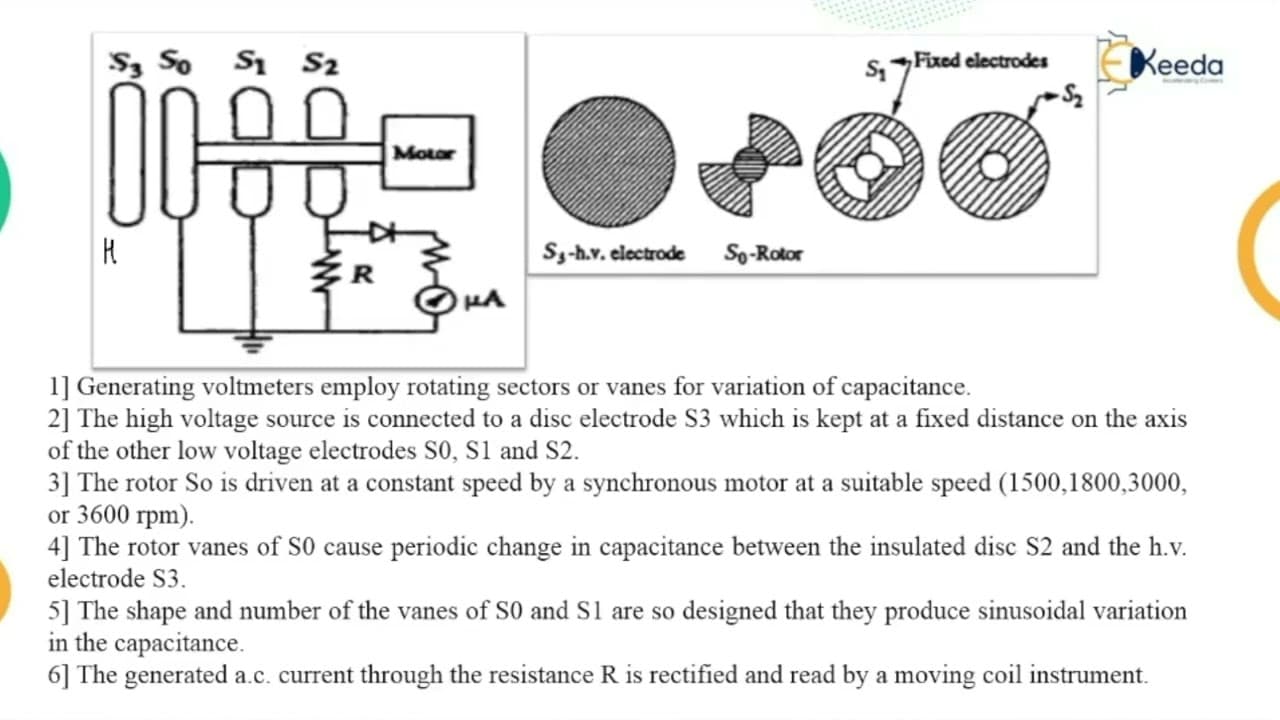
Generating voltmeters are used to measure high DC voltage by avoiding direct connection to the source, employing a variable capacitor and electrostatic voltage generator principle.
Transcript
hello friends now we are studying our third method of measurement of high dc voltage the name of the method is generating voltmeter it means there is need to have some generator which generates that high voltage high dc voltage which can be measured with the help of voltmeter so high voltage measuring devices employ the generating principle and tha... Read More
Key Insights
- ⚡ Generating voltmeters measure high DC voltage without direct connection to the source by employing a variable capacitor and electrostatic voltage generator principle.
- 🤒 The device is driven by a constant speed motor, and the generated current is rectified and measured by a moving coil meter.
- ⚡ The measurement process involves converting the generated AC voltage into DC using a diode.
- ⚖️ Advantages of generating voltmeters include no direct loading, linear scale, and the ability to extend the scale with resistance.
- 👷 Limitations include the need for regular calibration, careful construction, and the requirement of an auxiliary drive.
- 🧘 Disturbance in electrode position and mounting can invalidate the calibration.
- ⚡ Generating voltmeters are useful for measuring high DC voltage in electrostatic devices and accelerators.
Install to Summarize YouTube Videos and Get Transcripts
Explore YouTube Video Summarizer or Get YouTube Transcript Extractor
Questions & Answers
Q: How does a generating voltmeter avoid direct connection to the high voltage source?
A generating voltmeter uses a variable capacitor and electrostatic voltage generator principle to generate current proportional to the voltage, allowing measurement without direct connection to the source.
Q: What is the principle behind the operation of a generating voltmeter?
A charge is stored in a capacitor, and when the capacitance varies with time, the current through the capacitor can be calculated using the equation i = dv/dt. By differentiating the capacitance equation, the current can be expressed as i = im * cos(ωt), where im is the maximum value of current.
Q: What device is used to rectify the generated alternating current for measurement?
A diode is used to convert the generated alternating current into direct current for measurement of the DC voltage by the voltmeter.
Q: What are the advantages and limitations of using a generating voltmeter?
Advantages include no direct loading on the meter, linear scale, and the ability to extend the scale with additional resistance. Limitations include the need for regular calibration, careful construction, requirement of an auxiliary drive, and invalid calibration due to disturbance in electrode position and mounting.
Summary & Key Takeaways
-
The generating voltmeter is a method used to measure high DC voltage without direct connection to the source.
-
It employs a variable capacitor as an electrostatic voltage generator to generate current proportional to the applied voltage.
-
The device is driven by a constant speed motor and the generated current is rectified and measured by a moving coil meter.
Read in Other Languages (beta)
Share This Summary 📚
Summarize YouTube Videos and Get Video Transcripts with 1-Click
Try YouTube Summary with ChatGPT & Claude or YouTube Transcript Generator
Explore More Summaries from Ekeeda 📚

Summarize YouTube Videos and Get Video Transcripts with 1-Click
Try YouTube Summary with ChatGPT & Claude or YouTube Transcript Generator