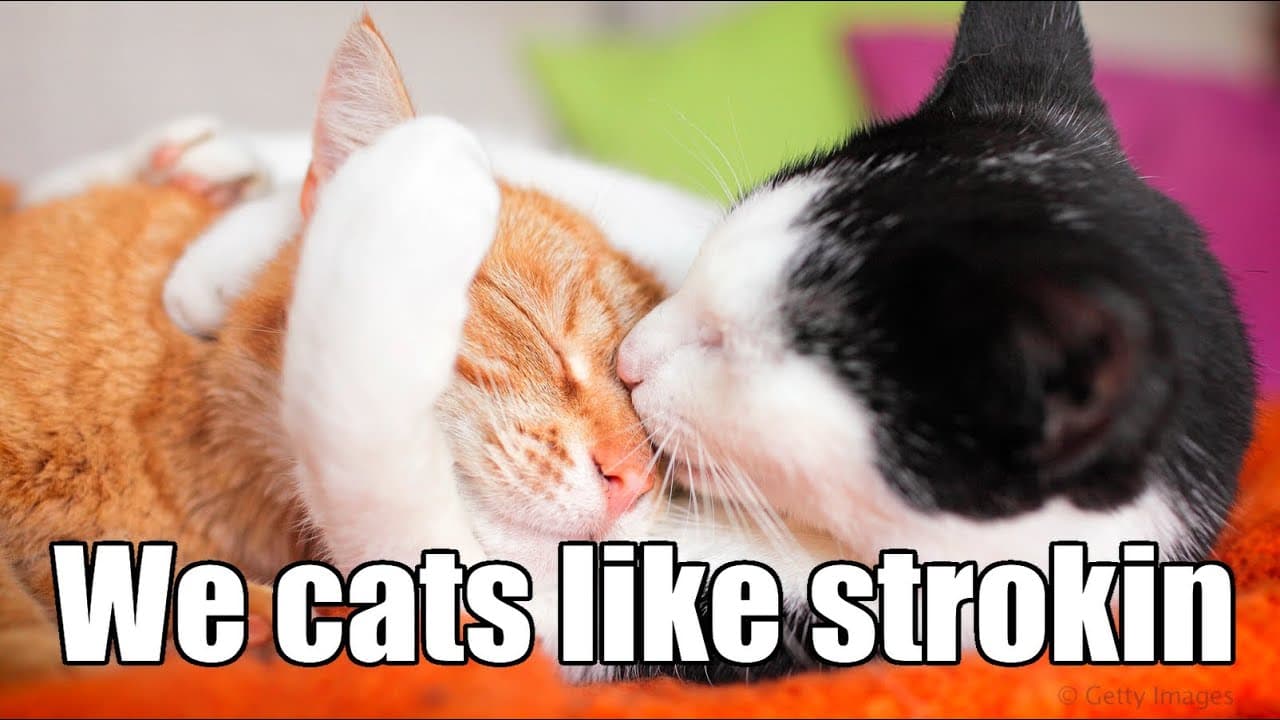
LOL cats like stroking too
TL;DR
Scientists discover neurons in mice that respond to stroking.
Transcript
many animals do it's often part of their grooming routines and can help them form bonds yes really in fact scientists at the California Institute of Technology have just discovered a rare group of sensory neurons that respond to stroking but not other kinds of touch in mice in David Anderson's lab no you can't go his team have been studying the jun... Read More
Key Insights
- Scientists at the California Institute of Technology have identified a unique group of sensory neurons in mice that specifically respond to stroking, but not to other types of touch like poking or pinching.
- The research was conducted in David Anderson's lab, where they explored the complex network of nerve endings under the skin to determine which neurons respond to different types of touch stimuli.
- Fluorescent tags were used to identify active neurons, allowing researchers to visually confirm which neurons responded to stroking versus other touch stimuli.
- An experiment was designed where mice were given a drug in one room that activated their stroking neurons, and a saline solution in another room that had no effect, to test their preference.
- The mice showed a preference for the room where their stroking neurons were activated, suggesting that the activation of these neurons produces a pleasurable sensation.
- This experiment demonstrates that stroking is positively reinforcing or rewarding, potentially explaining why many animals engage in grooming behaviors.
- The study suggests that similar neurons might exist in humans and other mammals, as the structure of mouse neurons resembles receptors found in the hairy parts of human skin.
- The findings could have broader implications for understanding how touch influences social bonding and emotional well-being in mammals.
Install to Summarize YouTube Videos and Get Transcripts
Explore YouTube Video Summarizer or Get YouTube Transcript Extractor
Questions & Answers
Q: What was the main discovery in the research conducted by the California Institute of Technology?
The main discovery was the identification of a rare group of sensory neurons in mice that specifically respond to stroking. These neurons were found to be distinct from those that respond to other types of touch, such as poking or pinching, and are linked to producing pleasurable sensations.
Q: How did researchers identify which neurons respond to stroking?
Researchers used fluorescent tags to identify active neurons. These tags glow when neurons are active, allowing scientists to visually confirm which neurons responded to stroking. By comparing the neurons' responses to different types of touch stimuli, they were able to distinguish the specific neurons that reacted to stroking.
Q: What method did the researchers use to test the mice's preference for stroking?
The researchers conducted an experiment where they alternated exposing mice to a drug that activated their stroking neurons in one room and a saline solution in another room. On the test day, the mice were allowed to choose freely between the rooms, and they showed a preference for the room where their stroking neurons were activated.
Q: What conclusion can be drawn about the mice's preference for the room with the drug?
The mice's preference for the room with the drug suggests that the activation of stroking neurons produces a pleasurable sensation. This indicates that stroking is positively reinforcing or rewarding, which may explain why animals, including mice, enjoy grooming behaviors.
Q: What implications does this study have for understanding touch in mammals?
The study implies that similar stroking-responsive neurons might exist in humans and other mammals, as the structure of these neurons resembles receptors found in the hairy parts of human skin. This could enhance our understanding of how touch influences social bonding and emotional well-being across different mammalian species.
Q: How do the findings relate to human experiences with touch?
The findings suggest that humans may have similar neurons that respond to stroking, which could explain why people enjoy massages and other forms of gentle touch. The study highlights the potential role of these neurons in providing pleasurable sensations and contributing to social bonding.
Q: Why is the discovery of stroking neurons significant for animal behavior research?
The discovery is significant because it provides a biological basis for understanding why animals engage in grooming behaviors. By identifying neurons that respond to stroking, researchers can better comprehend the mechanisms behind social bonding and the emotional rewards associated with such behaviors.
Q: What potential broader impacts could this research have?
This research could have broader impacts on understanding the neural mechanisms underlying touch and its effects on social interactions and emotional health in mammals. It may lead to new insights into how touch can be used therapeutically to enhance well-being and social connections in both animals and humans.
Summary & Key Takeaways
-
Scientists at the California Institute of Technology have discovered a group of sensory neurons in mice that specifically respond to stroking. This finding was made using fluorescent tags to observe neuron activity under different touch stimuli, such as poking and stroking, in controlled experiments.
-
In experiments, mice were exposed to a drug that activated their stroking neurons in one room and a saline solution in another. The mice preferred the room with the drug, indicating that stroking neurons produce a pleasurable sensation, making stroking a rewarding experience.
-
The study suggests that similar stroking-responsive neurons may exist in humans and other mammals, as the structure of these neurons resembles receptors found in the hairy parts of human skin. This could explain the enjoyment of grooming and massages across different species.
Read in Other Languages (beta)
Share This Summary 📚
Summarize YouTube Videos and Get Video Transcripts with 1-Click
Try YouTube Summary with ChatGPT & Claude or YouTube Transcript Generator
Explore More Summaries from nature video 📚

Summarize YouTube Videos and Get Video Transcripts with 1-Click
Try YouTube Summary with ChatGPT & Claude or YouTube Transcript Generator