How Do Fish Ladders Aid Migratory Fish?
TL;DR
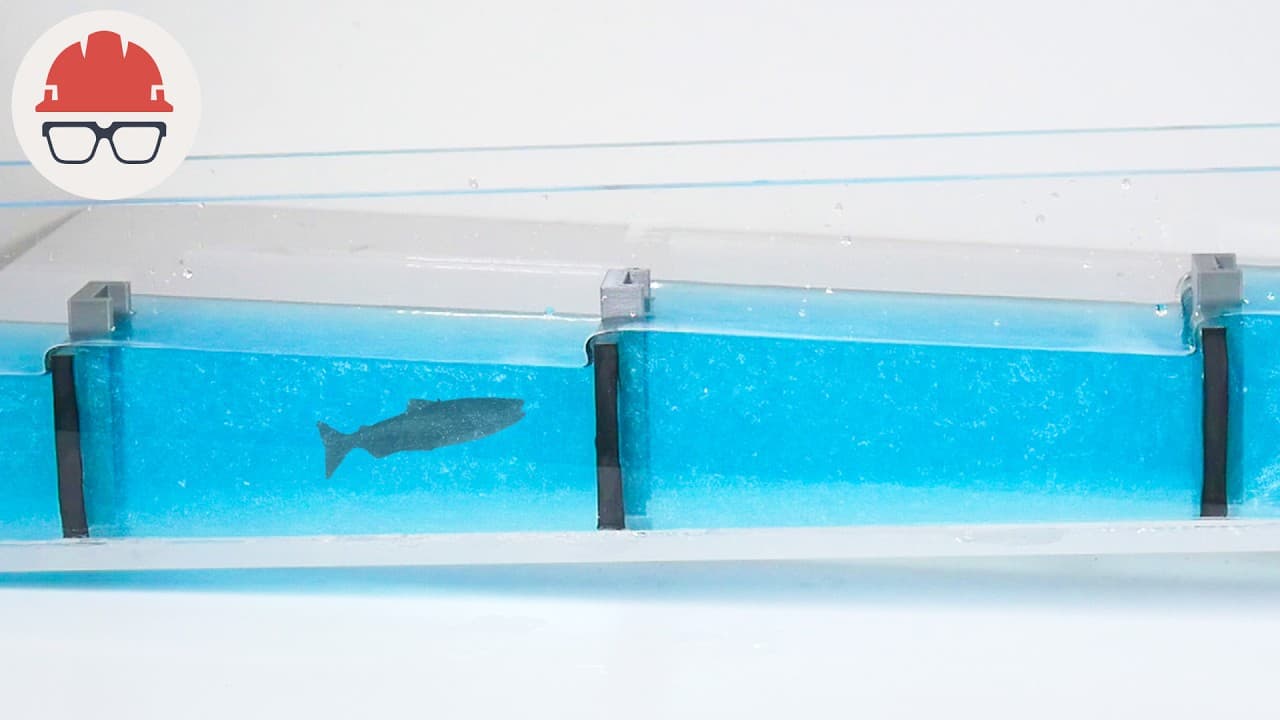
Fish ladders help migratory fish overcome dams by providing a passage that mimics natural river conditions. These structures are designed with biological criteria in mind, such as flow velocity and water conditions, to ensure fish can navigate them effectively. Engineers use various designs, like pool-and-weir and vertical slot fishways, to accommodate different species and environmental conditions.
Transcript
Building a dam imparts a stupendous change to the environment, and as with any change, there are winners and losers. The winners are usually us, people, through hydropower generation, protection from flooding, irrigation for farming, and a stable water supply for populated areas. But, we've known for a long time, probably since we started building ... Read More
Key Insights
- Fish ladders are designed to mimic natural river conditions, allowing migratory fish to bypass dams.
- Engineers must consider biological factors like fish swimming speed, motivation, and environmental preferences.
- Different fishway designs, such as pool-and-weir and vertical slot, cater to various species and conditions.
- Flow rate is crucial; it must be balanced to ensure fish can navigate the ladder without exhaustion or disorientation.
- Attraction flow is used to guide fish to the ladder entrance, often requiring auxiliary water systems.
- Fish ladders can be species-specific, with designs tailored to the needs of particular fish like salmonids.
- The effectiveness of fish ladders is measured through tagging studies and fish counting stations.
- Innovations like fish elevators and Whooshh fish cannons are explored where traditional ladders aren't feasible.
Install to Summarize YouTube Videos and Get Transcripts
Explore YouTube Video Summarizer or Get YouTube Transcript Extractor
Questions & Answers
Q: How do fish ladders help migratory fish bypass dams?
Fish ladders provide a passage that mimics natural river conditions, allowing migratory fish to swim over dams. They are designed with biological criteria in mind, such as swimming speed and environmental preferences, ensuring fish can navigate them effectively. Engineers use various designs to accommodate different species and environmental conditions, facilitating fish migration and maintaining biodiversity.
Q: What factors do engineers consider when designing fish ladders?
Engineers consider biological factors like fish swimming speed, motivation, and environmental preferences, such as temperature, dissolved oxygen, pH, and salinity. They also account for the flow rate, ensuring it is balanced to allow fish to navigate without exhaustion or disorientation. Additionally, attraction flow is important to guide fish to the ladder entrance, often requiring auxiliary water systems.
Q: What are the different types of fishway designs?
Common fishway designs include pool-and-weir and vertical slot fishways. Pool-and-weir designs allow fish to swim up fast-moving flows and rest in pools, while vertical slot fishways use slots for consistent velocity under various flow conditions. These designs accommodate different species and environmental scenarios, ensuring effective fish passage over dams.
Q: Why is flow rate important in fish ladder design?
Flow rate is crucial because it must be balanced to ensure fish can navigate the ladder without exhaustion or disorientation. If the flow is too high, fish struggle to swim against it; if too low, they may become disoriented or unable to swim through. Proper flow rate also aids in attraction flow, guiding fish to the ladder entrance.
Q: How is the effectiveness of fish ladders measured?
Effectiveness is measured through tagging studies, where fish are tagged and tracked to see if they successfully navigate the ladder. Fish counting stations, often with windows into the ladder, record the number and type of fish passing through. This data helps assess the ladder's success in facilitating fish migration and maintaining populations.
Q: What is attraction flow in fish ladder design?
Attraction flow is the use of water flow to guide fish to the entrance of a fish ladder. It involves creating sound and turbulence that fish use to determine the upstream direction. Auxiliary water systems may be employed to enhance attraction flow, ensuring fish find the entrance and navigate the ladder effectively.
Q: How do fish ladders accommodate different species?
Fish ladders are often species-specific, with designs tailored to the needs of particular fish, such as salmonids. Engineers consider species-specific swimming abilities and environmental preferences. By using diverse designs like pool-and-weir and vertical slot fishways, ladders can accommodate various species and ensure effective passage over dams.
Q: What innovations are explored for fish passage where ladders aren't feasible?
Innovations like fish elevators, Whooshh fish cannons, and fish barging are explored where traditional ladders aren't feasible. These methods provide alternative means for fish to bypass barriers, ensuring migration continues in challenging scenarios. Such innovations highlight ongoing efforts to balance infrastructure with wildlife conservation.
Summary & Key Takeaways
-
Fish ladders enable migratory fish to bypass dams by providing passages that mimic natural river conditions. Engineers design these structures considering biological factors like fish swimming capabilities and environmental preferences. Various designs, such as pool-and-weir and vertical slot fishways, are used to accommodate different species and conditions.
-
Flow rate and attraction flow are critical components in fish ladder design, ensuring fish can navigate effectively without exhaustion or disorientation. Auxiliary water systems and specific entrance designs help guide fish to the ladder and maintain suitable conditions throughout their journey.
-
Effectiveness of fish ladders is assessed through tagging studies and fish counting stations, with innovations like fish elevators and Whooshh fish cannons explored for non-traditional scenarios. These efforts highlight the balance between engineering and wildlife conservation in maintaining fish populations amid human infrastructure.
Read in Other Languages (beta)
Share This Summary 📚
Summarize YouTube Videos and Get Video Transcripts with 1-Click
Try YouTube Summary with ChatGPT & Claude or YouTube Transcript Generator
Explore More Summaries from Practical Engineering 📚




Summarize YouTube Videos and Get Video Transcripts with 1-Click
Try YouTube Summary with ChatGPT & Claude or YouTube Transcript Generator