How To Plot Inequalities on a Number Line
TL;DR
Learn how to graph and represent inequalities on a number line using open/closed circles and interval notation.
Transcript
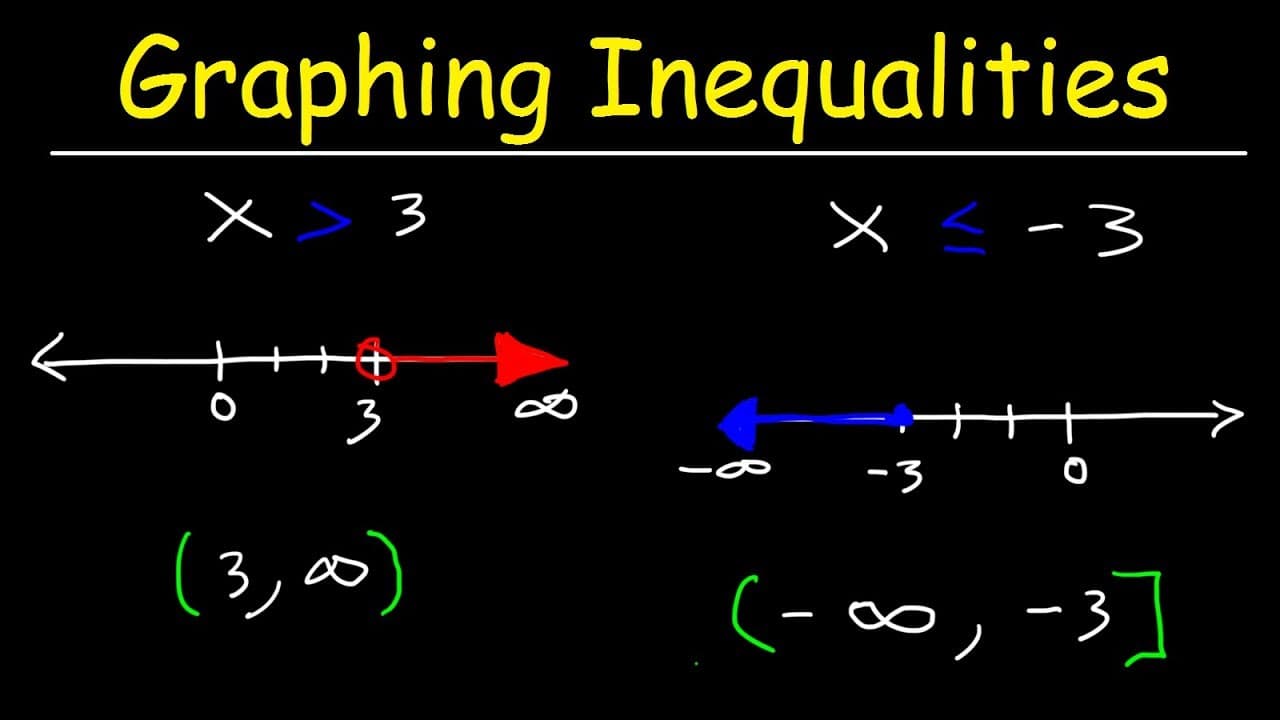
in this lesson we're going to talk about how to graph inequalities on a number line so let's start with x is greater than three how can we graph it on a number line so here's zero and here's three now if it's greater than all you have is an open circle now let's say if it was greater than or equal to which is represented by this symbol you would ha... Read More
Key Insights
- 😚 Graphing inequalities on a number line involves using open/closed circles and shading.
- 💨 Interval notation is an alternative way to represent the solution of an inequality.
- ⭕ Closed circles on a number line are represented with brackets in interval notation, while open circles are represented with parentheses.
- 🫥 The direction of shading on the number line depends on the relationship in the inequality (greater than or less than).
- ♾️ Infinity is represented with the symbol ∞ and negative infinity is represented with -∞.
- 🙂 Graphs may vary slightly depending on whether open or closed circles are represented with parentheses or brackets.
- 😒 It is important to use the correct notation and symbols when graphing and representing inequalities.
Install to Summarize YouTube Videos and Get Transcripts
Explore YouTube Video Summarizer or Get YouTube Transcript Extractor
Questions & Answers
Q: How do you graph an inequality on a number line if x is greater than three?
Start with an open circle at three and shade towards the right. In interval notation, the answer is represented as 3 to infinity.
Q: What is the difference when x is equal to or greater than two?
In this case, use a closed circle at two and shade towards the right. The interval notation would be from 2 to infinity.
Q: How do you graph x is less than one?
Use an open circle at one and shade towards the left. The interval notation is from negative infinity to 1.
Q: What if x is less than or equal to negative three?
Use a closed circle at negative three and shade towards the left. The interval notation is from negative infinity to -3, including -3.
Q: How do you graph x is greater than three or x is less than negative one?
Use an open circle at three and shade towards the right. Use an open circle at negative one and shade towards the left. The interval notation is negative infinity to -1 union 3 to infinity.
Q: How do you graph x is greater than negative one but less than or equal to five?
Use an open circle at negative one and shade towards the right. Use a closed circle at five and shade towards the left. The interval notation is -1 to 5.
Summary & Key Takeaways
-
Inequalities can be graphed on a number line by using open circles for "greater than" relationships and closed circles for "greater than or equal to" relationships.
-
The shading on the number line should be towards the direction of higher values for "greater than" and towards lower values for "less than" inequalities.
-
Interval notation can also be used to represent the solution, with the lowest and highest values indicated using parentheses or brackets depending on whether the circle on the number line is open or closed.
Read in Other Languages (beta)
Share This Summary 📚
Summarize YouTube Videos and Get Video Transcripts with 1-Click
Try YouTube Summary with ChatGPT & Claude or YouTube Transcript Generator
Explore More Summaries from The Organic Chemistry Tutor 📚



Summarize YouTube Videos and Get Video Transcripts with 1-Click
Try YouTube Summary with ChatGPT & Claude or YouTube Transcript Generator