How AI Agents Coded a C Compiler in 2 Weeks
TL;DR
Claude Opus 4.6 represents a significant leap in AI capabilities, enabling autonomous coding for two weeks to produce a fully functional C compiler. This advancement highlights the rapid evolution from 30-minute coding limits to extended autonomous sessions, demonstrating AI's potential to transform software development and organizational workflows, including managing teams and discovering vulnerabilities.
Transcript
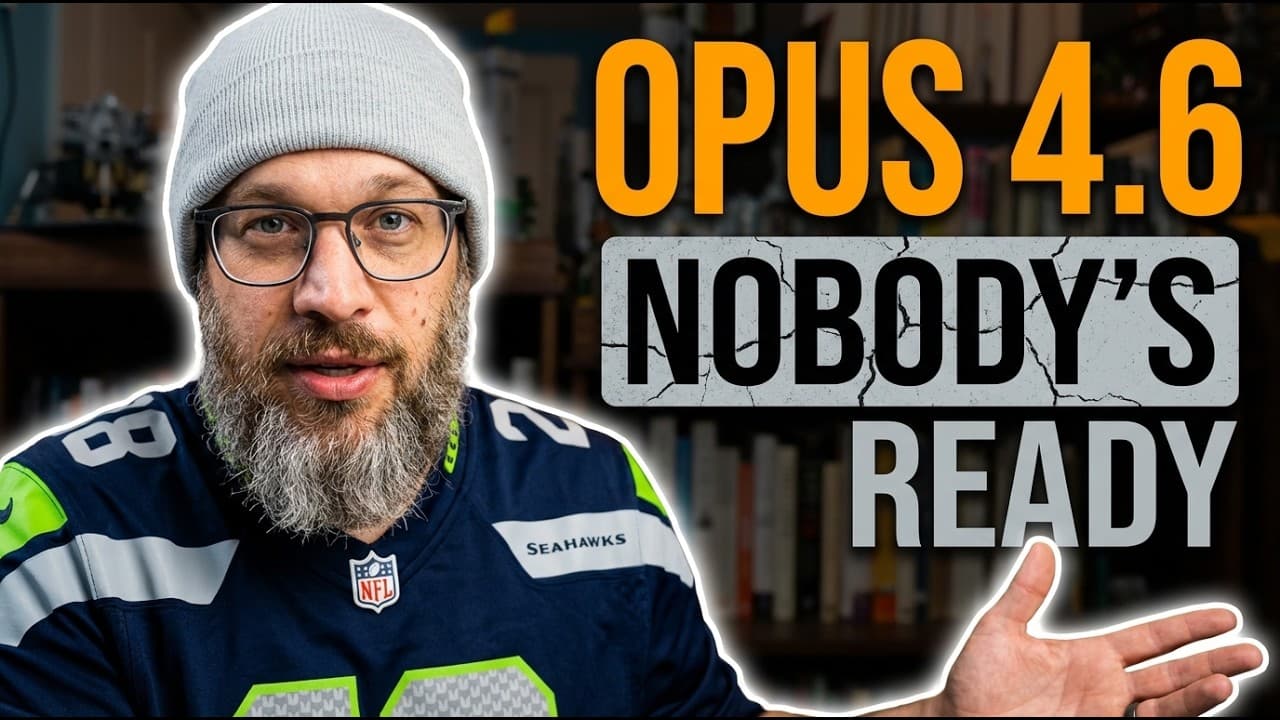
Claude Opus 4.6 just dropped and it changed the AI agent game again because 16 Claude Opus 4.6 agents just coded and set the record for [snorts] the length of time that an AI agent has coded autonomously. They coded for two weeks straight. No human writing the code and they delivered a fully functional C compiler. For for reference, that is over a ... Read More
Key Insights
- Claude Opus 4.6 achieved a record by coding autonomously for two weeks, resulting in a fully functional C compiler.
- The model's context window expanded from 200,000 to a million tokens, enhancing its ability to manage large codebases.
- Opus 4.6's needle-in-haystack retrieval score improved to 76%, significantly boosting its efficiency in complex tasks.
- Rakuten's deployment of Opus 4.6 managed 50 engineers, autonomously closing and assigning issues.
- The AI discovered 500 zero-day vulnerabilities without specific instructions, showcasing advanced reasoning capabilities.
- Agent teams in Opus 4.6 illustrate the emergence of hierarchical coordination as a structural necessity.
- Non-technical users can now create personal software applications rapidly, marking a shift in software development.
- AI-native companies achieve higher revenue per employee by leveraging AI agents for execution and coordination.
Install to Summarize YouTube Videos and Get Transcripts
Explore YouTube Video Summarizer or Get YouTube Transcript Extractor
Questions & Answers
Q: How did Claude Opus 4.6 achieve autonomous coding for two weeks?
Claude Opus 4.6 achieved autonomous coding for two weeks by leveraging its expanded context window, which grew from 200,000 to a million tokens. This allowed the model to manage and process large codebases more efficiently. Additionally, its improved needle-in-haystack retrieval score of 76% enabled it to find and utilize information within the context window effectively, facilitating complex and extended coding tasks without human intervention.
Q: What is the significance of the needle-in-haystack retrieval score in Opus 4.6?
The needle-in-haystack retrieval score in Opus 4.6 is significant because it measures the model's ability to find, retrieve, and use information within its context window. With a 76% retrieval score, Opus 4.6 can efficiently locate specific data within a large set of information, enhancing its performance in complex tasks. This capability is crucial for managing extensive codebases and executing sophisticated operations autonomously.
Q: How did Rakuten utilize Opus 4.6 in their engineering operations?
Rakuten utilized Opus 4.6 in their engineering operations by deploying it to manage a team of 50 developers. The AI autonomously closed 13 issues and assigned 12 issues to the appropriate team members in a single day. It effectively managed multiple code repositories and knew when to escalate issues to human engineers, demonstrating both code and management intelligence, and automating tasks typically handled by engineering managers.
Q: What are agent teams in Opus 4.6, and why are they important?
Agent teams in Opus 4.6 refer to multiple instances of autonomous software agents working together as a coordinated unit. Each agent specializes in different tasks, with a lead agent managing the overall project. This setup allows for efficient parallel processing and collaboration, mimicking human organizational structures. The importance lies in its ability to manage complex projects more effectively, reducing the need for human intervention in coordination and execution.
Q: How did Opus 4.6 discover zero-day vulnerabilities autonomously?
Opus 4.6 discovered zero-day vulnerabilities autonomously by using basic tools like Python and debuggers on an open-source codebase. Without specific vulnerability hunting instructions, the AI analyzed the codebase's git history to understand its evolution and identify security-relevant changes. This innovative approach allowed it to find over 500 high-severity vulnerabilities, demonstrating advanced reasoning and problem-solving capabilities beyond traditional static analysis methods.
Q: What impact does Opus 4.6 have on non-technical users in software development?
Opus 4.6 impacts non-technical users by enabling them to create personal software applications without writing code. This is achieved through AI agents that can build tools and dashboards based on user descriptions of desired outcomes. The ability to rapidly develop custom software solutions democratizes software development, allowing non-technical individuals to create and utilize tools that were previously inaccessible, thus expanding the scope of personal and organizational productivity.
Q: How are AI-native companies leveraging Opus 4.6 for increased efficiency?
AI-native companies are leveraging Opus 4.6 by using AI agents to handle execution and coordination tasks, allowing human employees to focus on strategic decision-making and judgment. This shift results in significantly higher revenue per employee compared to traditional companies, as AI agents perform routine and complex tasks efficiently. The integration of AI into workflows enables these companies to scale operations rapidly and maintain a competitive edge in the market.
Q: What does the future hold for AI agents in software development and organizational management?
The future for AI agents in software development and organizational management involves further autonomy and efficiency. As AI models like Opus 4.6 continue to improve, they are expected to handle more complex projects over extended periods, such as building complete applications with minimal human intervention. This evolution will likely lead to a redefinition of traditional organizational structures, with AI agents taking on roles in coordination, execution, and management, thereby transforming how businesses operate and scale.
Summary & Key Takeaways
-
Claude Opus 4.6 has revolutionized AI capabilities by enabling agents to code autonomously for two weeks, producing a fully functional C compiler. This achievement marks a dramatic shift from previous autonomous coding limits of just 30 minutes, highlighting the rapid pace of AI advancement and its potential to transform both software development and organizational management.
-
The model's enhanced context window, now capable of holding up to a million tokens, allows for better management of large codebases, while its needle-in-haystack retrieval score has improved to 76%, significantly boosting task efficiency. These advancements enable AI to manage complex projects, such as Rakuten's deployment, where Opus 4.6 autonomously managed 50 engineers and closed issues.
-
Opus 4.6 also discovered 500 zero-day vulnerabilities without specific instructions, showcasing its advanced reasoning capabilities. This advancement indicates a shift towards AI-native companies achieving higher revenue per employee by leveraging AI agents for execution and coordination, ultimately transforming traditional organizational structures and workflows.
Read in Other Languages (beta)
Share This Summary 📚
Summarize YouTube Videos and Get Video Transcripts with 1-Click
Try YouTube Summary with ChatGPT & Claude or YouTube Transcript Generator
Explore More Summaries from AI News & Strategy Daily | Nate B Jones 📚




Summarize YouTube Videos and Get Video Transcripts with 1-Click
Try YouTube Summary with ChatGPT & Claude or YouTube Transcript Generator