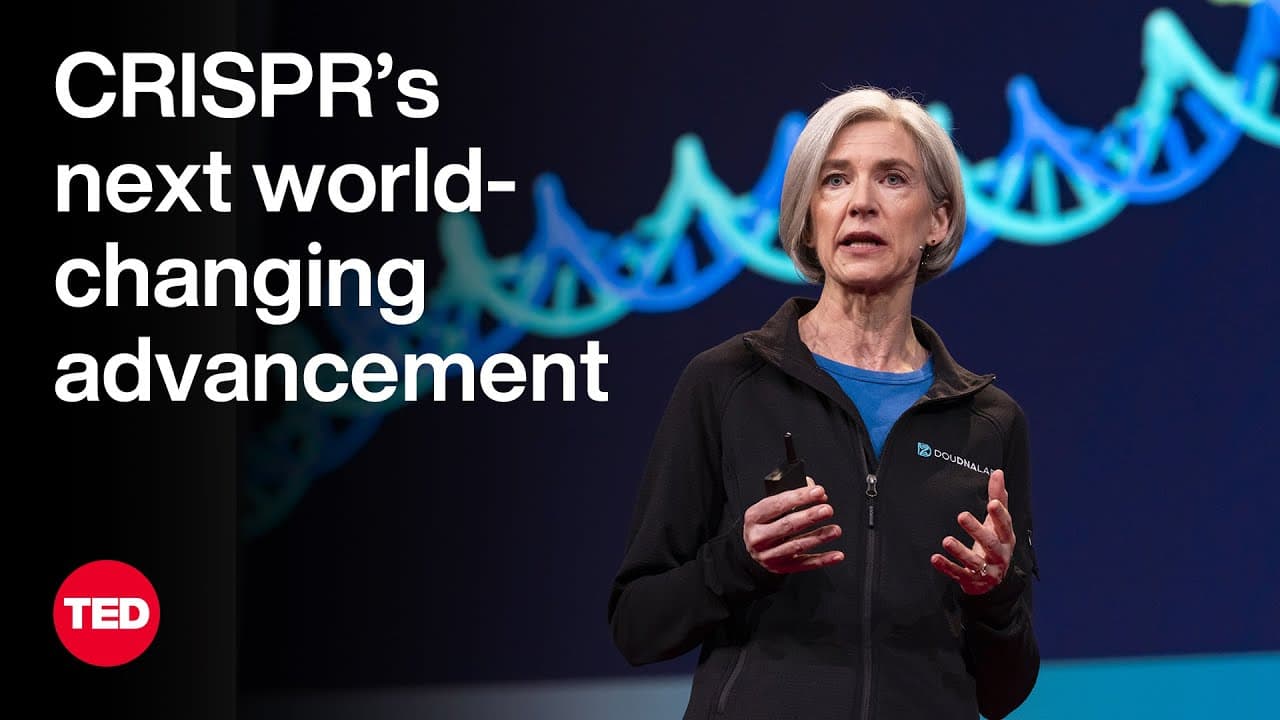
CRISPR's Next Advance Is Bigger Than You Think | Jennifer Doudna | TED
TL;DR
Precision microbiome editing using CRISPR technology can help solve global challenges like disease and climate change by manipulating the genes of bacteria and other microbes that live in and on our bodies.
Transcript
The essence of being human is that we solve problems. And when we're faced with enormous problems like disease and climate change, we need to solve them by collaboration. I'm excited to tell you about a new kind of collaboration that will absolutely create solutions to these big problems. It's a collaboration that's unexpected because it's between ... Read More
Key Insights
- 🌍 Collaboration between humans and bacteria can lead to solutions for big problems like disease and climate change. (Paragraph 1)
- 🧬 CRISPR technology allows us to precisely edit DNA in living organisms, creating the potential to cure diseases and enhance traits in plants. (Paragraph 2)
- 🔬 Using CRISPR to edit entire populations of microbiomes in our bodies could lead to improved health and prevent diseases like Alzheimer's and asthma. (Paragraphs 3 and 4)
- 💉 Antibiotics, diet, and probiotics have limitations in controlling microbiomes, but CRISPR works like a scalpel, targeting specific genes in specific bacteria. (Paragraphs 5 and 6)
- 👥 Metagenomics, a breakthrough technology, allows us to study the other 99% of microbial species not grown in the lab, providing a detailed blueprint of complex microbiomes. (Paragraphs 7 and 8)
- 🔎 Precision microbiome editing, combining metagenomics and CRISPR, creates a new field of science that can discover links between dysfunctional microbiomes and disease or greenhouse gas emissions. (Paragraphs 9 and 10)
- 🌱 Precision microbiome editing can reduce methane emissions in livestock and other sources by modifying microbiomes, leading to a significant impact in the fight against climate change. (Paragraph 11)
- 💚 Precision microbiome editing presents opportunities to treat or prevent diseases linked to the gut microbiome, such as asthma, obesity, diabetes, and Alzheimer's. (Paragraph 12)
Install to Summarize YouTube Videos and Get Transcripts
Explore YouTube Video Summarizer or Get YouTube Transcript Extractor
Questions & Answers
Q: How does CRISPR technology work and what makes it unique?
CRISPR technology allows scientists to precisely edit DNA by targeting and modifying specific genes in living organisms. It works like a word processor, enabling researchers to cut, paste, and replace genes. What sets CRISPR apart is its ability to edit genes in a wide range of organisms, including humans and bacteria, making it a versatile tool for genetic manipulation.
Q: What are some potential applications of precision microbiome editing?
Precision microbiome editing can have significant implications for human health and the environment. It can help reduce methane emissions from livestock and other sources by modifying the microbiomes of animals or waste systems. In terms of human health, precision microbiome editing holds promise for treating and preventing diseases linked to the gut microbiome, such as asthma, obesity, diabetes, and Alzheimer's.
Q: What challenges exist in controlling microbiomes, and how does CRISPR address them?
Microbiomes are complex and difficult to manipulate. Antibiotics affect the entire microbiome and can lead to drug resistance, while diet and probiotics are often nonspecific and ineffective. Fecal transplants face challenges in terms of effectiveness and acceptance. CRISPR, however, acts like a precision tool by allowing scientists to target and modify specific genes in bacteria without affecting other species. This enables more precise control over microbiomes.
Q: How can precision microbiome editing contribute to addressing climate change?
Microbiomes are responsible for a significant portion of global methane emissions. By using precision microbiome editing, it is possible to modify the microbiomes of livestock, landfills, wastewater systems, and rice paddies to reduce methane production. This can have a substantial impact on combating climate change by mitigating one of the major contributors to rising global temperatures.
Summary & Key Takeaways
-
CRISPR technology allows precise editing of DNA in living organisms, including people and plants.
-
CRISPR has already cured diseases like sickle cell and created drought-resistant rice.
-
Using CRISPR, we can now edit entire populations of microbes in our bodies, which has implications for preventing diseases and reducing methane emissions.
Read in Other Languages (beta)
Share This Summary 📚
Summarize YouTube Videos and Get Video Transcripts with 1-Click
Try YouTube Summary with ChatGPT & Claude or YouTube Transcript Generator
Explore More Summaries from TED 📚






Summarize YouTube Videos and Get Video Transcripts with 1-Click
Try YouTube Summary with ChatGPT & Claude or YouTube Transcript Generator