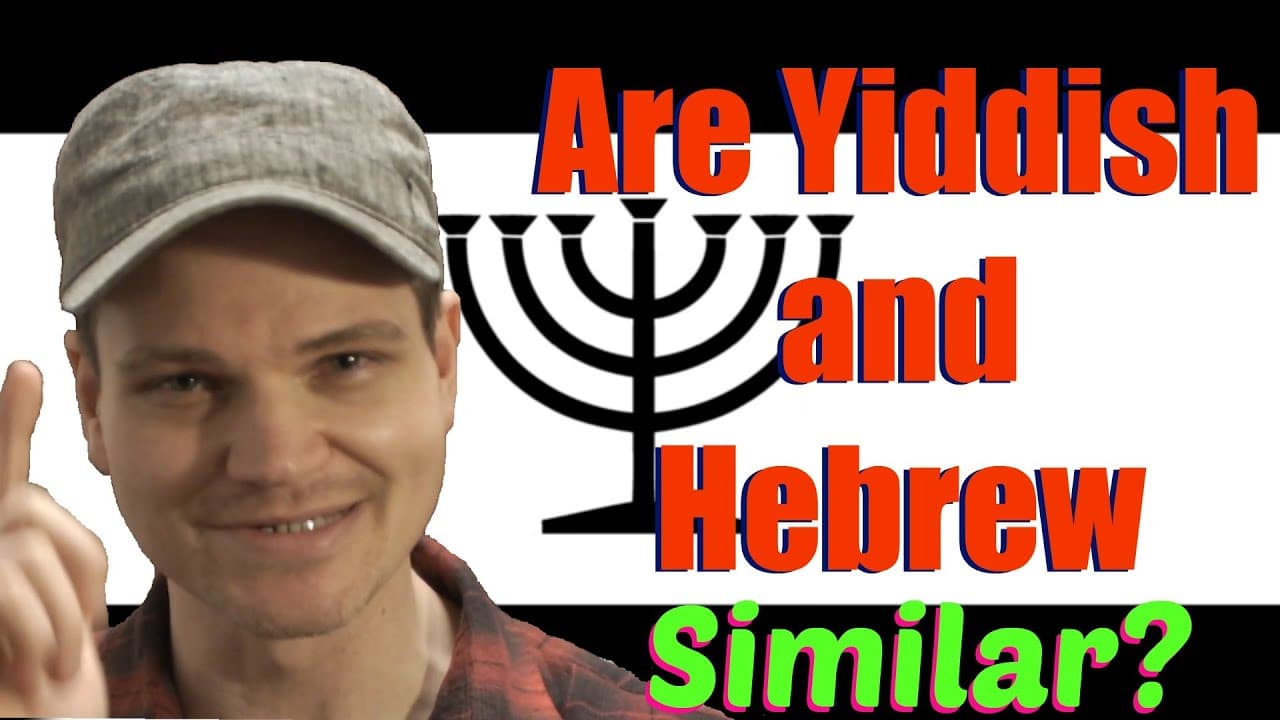
Are Yiddish and Hebrew Similar?
TL;DR
Yiddish and Hebrew are distinct languages with different origins.
Transcript
Hey look, Mom, I'm studying Yiddish. So I can talk to Grandma. [Klezmer music] Good day, guys. This is just a quick video to answer a question that I got. And I decided to make it into a video because I've had this question before and maybe, it's something that a lot of people are wondering. The question is : "Are Hebrew and Yiddish similar?" O... Read More
Key Insights
- Yiddish and Hebrew are often confused due to their shared Hebrew script, but they are distinct languages with different roots.
- Hebrew is a Semitic language, primarily associated with Jewish religious texts such as the Torah and the Old Testament.
- Yiddish is a Germanic language, closely related to medieval German, and was spoken by Jews in Europe.
- While Yiddish incorporates some Hebrew vocabulary, it has been significantly influenced by German in terms of pronunciation and structure.
- Modern Hebrew has been influenced by Yiddish, especially in syntax and phonology, due to early Zionist settlers who spoke Yiddish.
- Yiddish speakers can partially communicate with German speakers due to the languages' similarities, unlike with Hebrew speakers.
- Hebrew was primarily a literary language for centuries until its revival as a spoken language in modern times.
- Despite their differences, both languages are integral to Jewish culture and history, each serving distinct roles.
Install to Summarize YouTube Videos and Get Transcripts
Explore YouTube Video Summarizer or Get YouTube Transcript Extractor
Questions & Answers
Q: How are Yiddish and Hebrew related?
Yiddish and Hebrew are related primarily through their shared use of the Hebrew script and their connection to Jewish culture. However, they are different languages; Yiddish is a Germanic language, while Hebrew is Semitic. Yiddish has borrowed some vocabulary from Hebrew, but the two languages are distinct in structure and origins.
Q: What is the historical significance of Hebrew?
Hebrew holds significant historical importance as the language of Jewish religious texts, including the Torah and the Old Testament. It served as a literary and religious language for centuries. Although it ceased to be a spoken language for some time, Hebrew was revived in modern times and is now the official language of Israel.
Q: Why is Yiddish often confused with Hebrew?
Yiddish is often confused with Hebrew because it uses the Hebrew alphabet, much like how Farsi and Urdu use the Arabic script. Additionally, both languages are closely tied to Jewish culture, leading to the misconception that they are similar or the same language. However, they have different linguistic roots and structures.
Q: How has Yiddish influenced Modern Hebrew?
Yiddish has influenced Modern Hebrew particularly in terms of syntax and phonology. This influence is largely due to the early Zionist settlers in Palestine who spoke Yiddish. As they worked to establish Hebrew as a modern spoken language, elements of Yiddish inevitably shaped its development, reflecting their native linguistic background.
Q: Can Yiddish speakers understand Hebrew?
Yiddish speakers generally cannot understand Hebrew, as the two languages are fundamentally different. Yiddish is a Germanic language, while Hebrew is Semitic. However, Yiddish speakers might recognize some Hebrew vocabulary within Yiddish due to historical borrowing, but this does not enable full understanding between speakers of the two languages.
Q: What is the primary linguistic influence on Yiddish?
The primary linguistic influence on Yiddish is medieval German, as Yiddish is a Germanic language. While it incorporates vocabulary from Hebrew and Aramaic due to historical and cultural interactions, its grammar, syntax, and core vocabulary are largely derived from German, making it more closely related to German than to Hebrew.
Q: Why did Hebrew stop being a spoken language?
Hebrew ceased to be a spoken language around the 2nd century CE, primarily due to the dispersion of the Jewish people and the dominance of other languages in the regions where they resided. It survived as a religious and literary language until its revival in the late 19th and early 20th centuries as part of the Zionist movement.
Q: How do Yiddish and German speakers communicate?
Yiddish and German speakers can communicate to some extent because Yiddish is closely related to German, particularly its medieval form. They share similar vocabulary and grammatical structures, allowing for partial mutual intelligibility. However, differences in pronunciation and the influence of other languages on Yiddish can limit full comprehension.
Summary & Key Takeaways
-
Yiddish and Hebrew, though both connected to Jewish culture, are distinct languages. Yiddish is a Germanic language, while Hebrew is Semitic. They share the Hebrew script, leading to confusion about their relationship.
-
Hebrew has historical significance as the language of Jewish religious texts, while Yiddish was spoken by European Jews and is related to medieval German. Yiddish incorporates Hebrew vocabulary but remains distinct.
-
Modern Hebrew's development was influenced by Yiddish due to the linguistic background of early Zionists. However, communication between Yiddish and Hebrew speakers remains limited compared to Yiddish and German speakers.
Read in Other Languages (beta)
Share This Summary 📚
Summarize YouTube Videos and Get Video Transcripts with 1-Click
Try YouTube Summary with ChatGPT & Claude or YouTube Transcript Generator
Explore More Summaries from Langfocus 📚



Summarize YouTube Videos and Get Video Transcripts with 1-Click
Try YouTube Summary with ChatGPT & Claude or YouTube Transcript Generator