Electron Volt Explained, Conversion to Joules, Basic Introduction
TL;DR
Electron volts (eV) are a unit of energy that relate to the movement of electrons through a potential difference, and they can be converted to joules by multiplying by 1.6 x 10^-19. The mechanical energy of electrons is conserved despite changes in their kinetic and potential energies.
Transcript
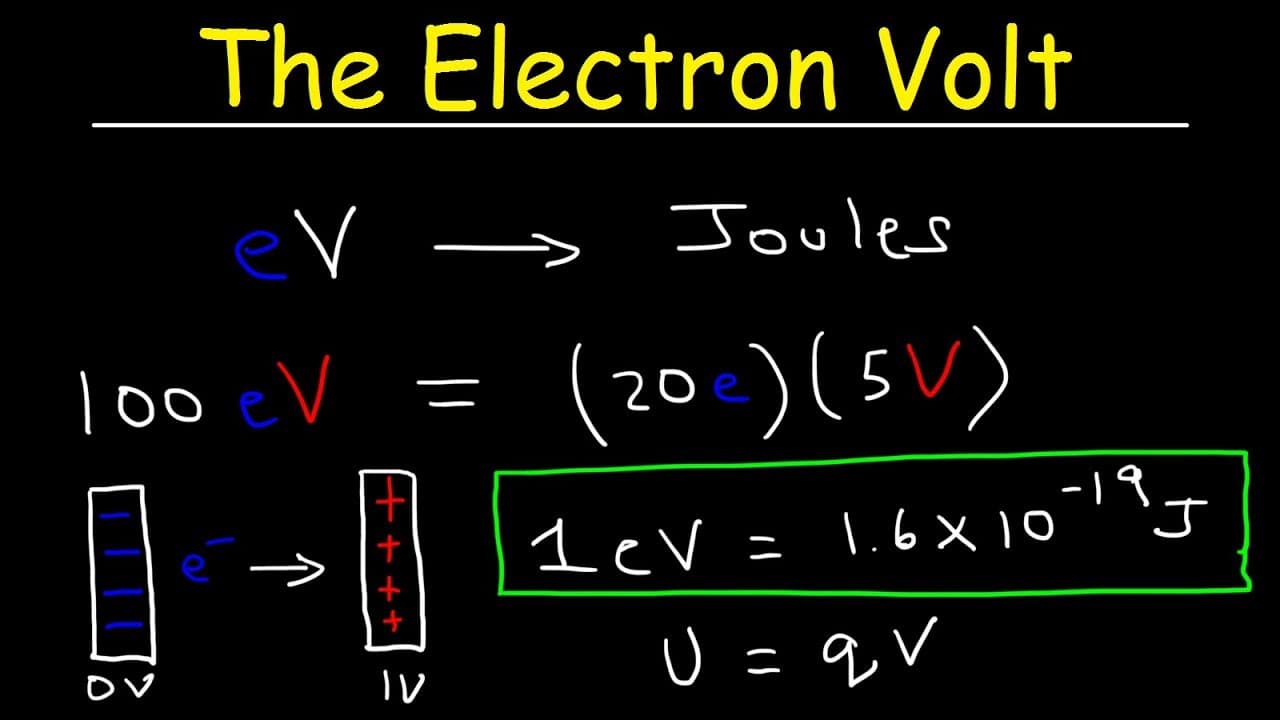
now before we talk about how to convert electron volts to joules let's talk about what an electron volt is electron volts is basically a unit of energy and it relates to the electron so let's say if we have two plates and let's say this is a negatively charged plate and this is a positively charged plate and these two plates differ by one volt so l... Read More
Key Insights
- ⚡ Electron volts (eV) measure the energy acquired by an electron as it moves through a potential difference.
- ☺️ One electron volt is equal to 1.6 x 10^-19 joules.
- 🦾 The mechanical energy of an electron is conserved despite changes in its kinetic and potential energies.
- ⚡ Converting electron volts to joules involves multiplying by 1.6 x 10^-19 and dividing to convert joules back to electron volts.
- ⚡ The voltage on each electron decreases as the number of electrons increases, in order to maintain the same total energy.
- ⚡ The potential energy change in electron volts is equal to the negative product of the charge of the electrons and the potential difference they move through.
Install to Summarize YouTube Videos and Get Transcripts
Explore YouTube Video Summarizer or Get YouTube Transcript Extractor
Questions & Answers
Q: What is an electron volt and how does it relate to energy?
An electron volt (eV) is a unit of energy that represents the energy acquired by a single electron as it moves through a potential difference of one volt. It is equal to 1.6 x 10^-19 joules.
Q: How can electron volts be converted to joules?
To convert electron volts to joules, multiply the given value by 1.6 x 10^-19. For example, 250 electron volts would be equal to 4 x 10^-17 joules.
Q: How does the mechanical energy of an electron change as it moves through a potential difference?
As an electron moves from a negatively charged plate to a positively charged plate, its kinetic energy increases by one electron volt, while its potential energy decreases by the same amount. However, the mechanical energy of the electron remains constant.
Q: Can electron volts be converted back to joules?
Yes, to convert joules back to electron volts, divide the given value by 1.6 x 10^-19. For example, 4 x 10^-18 joules would be equal to 25 electron volts.
Summary & Key Takeaways
-
Electron volts (eV) are a unit of energy related to the movement of electrons through a potential difference.
-
The energy acquired by a single electron as it moves through a potential difference of one volt is equal to one electron volt (1 eV).
-
Converting electron volts to joules involves multiplying the given value by 1.6 x 10^-19.
Read in Other Languages (beta)
Share This Summary 📚
Summarize YouTube Videos and Get Video Transcripts with 1-Click
Try YouTube Summary with ChatGPT & Claude or YouTube Transcript Generator
Explore More Summaries from The Organic Chemistry Tutor 📚
Summarize YouTube Videos and Get Video Transcripts with 1-Click
Try YouTube Summary with ChatGPT & Claude or YouTube Transcript Generator