How Do Different Types of Bridges Work?
TL;DR
Bridges are essential for overcoming challenging terrains, employing various designs like beam, truss, arch, and suspension to manage forces and span distances. Each type has unique structural features and advantages, such as trusses for longer spans and arches for efficient material use. Understanding these designs reveals the complexity and creativity in bridge engineering.
Transcript
The Earth is pretty cool and all, but many of its most magnificent features make it tough for us to get around. When the topography is too wet, steep, treacherous, or prone to disaster, sometimes the only way forward is up: our roadways and walkways and railways break free from the surface using bridges. A lot of the infrastructure we rely on d... Read More
Key Insights
- Beam bridges are simple structures with horizontal members across two supports, often using steel or concrete girders.
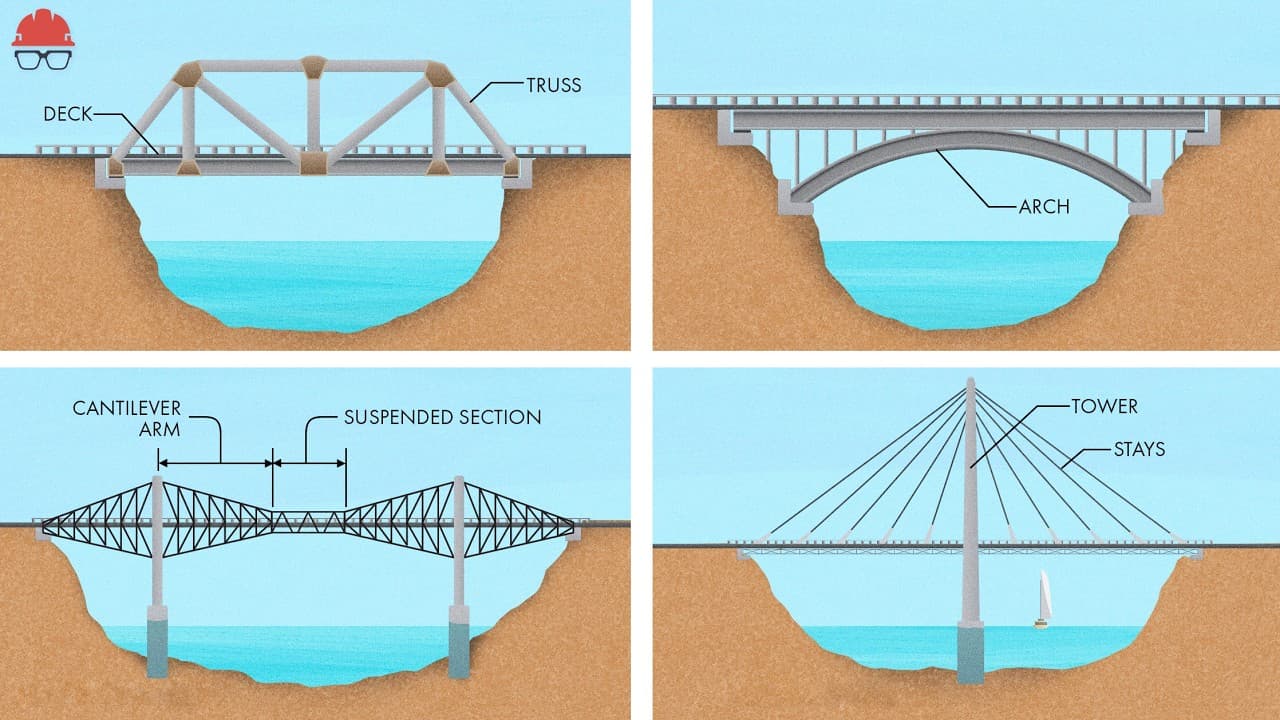
- Truss bridges use assemblies of smaller elements that create rigid, lightweight structures, allowing them to span greater distances.
- Arch bridges transfer weight to supports using compression, making them efficient but challenging to construct until complete.
- Cantilever bridges use beams or trusses projecting horizontally, balancing weight above supports for effective spanning.
- Cable-stayed bridges support the deck with cables attached to towers, offering unique and dramatic shapes for long spans.
- Suspension bridges use cables or chains to dangle the deck below, suitable for the longest spans with iconic appearances.
- Moveable bridges, like bascule and swing types, accommodate ship passage by rotating or lifting sections of the deck.
- Floating bridges use buoyant supports to eliminate the need for foundations, often employing hollow concrete pontoons.
Install to Summarize YouTube Videos and Get Transcripts
Explore YouTube Video Summarizer or Get YouTube Transcript Extractor
Questions & Answers
Q: How do beam bridges support weight?
Beam bridges support weight through horizontal members placed across two supports, typically using steel or concrete girders. These girders act as the primary load-bearing elements, transferring the weight of the deck and any traffic directly to the supports. Beam bridges are simple and cost-effective but are limited in span due to the weight of the girders themselves, which can become too heavy to support beyond certain distances.
Q: What is the advantage of truss bridges over beam bridges?
Truss bridges offer the advantage of spanning greater distances compared to beam bridges by using a framework of smaller elements that form a rigid and lightweight structure. This design reduces the weight of the bridge, allowing it to extend further without the need for large, heavy girders. The truss elements primarily experience axial forces, simplifying the design and making it easier to predict the forces within each member.
Q: How do arch bridges transfer loads?
Arch bridges transfer loads through a curved element that utilizes compression forces to distribute the bridge's weight to its supports. This design allows for efficient use of materials, as the arch shape inherently channels forces along its curve, minimizing the need for additional support structures. The challenge lies in construction, as temporary supports are often needed until the arch is complete and self-supporting.
Q: How do cable-stayed bridges differ from suspension bridges?
Cable-stayed bridges differ from suspension bridges in their method of supporting the deck. Cable-stayed bridges use cables attached directly to towers to support the deck, often forming a fan pattern. This allows for a variety of dramatic shapes and configurations. In contrast, suspension bridges use main cables to suspend the deck below, with vertical hangers transferring weight to the cables, allowing for longer spans but requiring more complex anchoring systems.
Q: What are the characteristics of suspension bridges?
Suspension bridges are characterized by their use of main cables or chains that suspend the deck below, supported by towers on either side. These bridges are known for their long spans and slender, graceful appearances. The main cables transfer most of the bridge's weight into the foundation through the towers, while the remaining forces are managed by anchorages that prevent the cables from pulling out of the ground. Due to their complexity and cost, they are used when no other design suffices.
Q: What is a moveable bridge and how does it function?
A moveable bridge is designed to accommodate ship passage by altering its configuration. Types include bascule bridges, which hinge to rotate the deck upward; swing bridges, which rotate horizontally; and vertical lift bridges, which raise the entire deck like a table. Each type is customized for specific locations, allowing ships to pass without requiring high fixed spans or long approaches, making them versatile solutions in areas with navigational needs.
Q: How do floating bridges remain stable?
Floating bridges remain stable by using buoyant supports, such as hollow concrete pontoons, that float on water, eliminating the need for traditional foundations. These pontoons are equipped with pumps to prevent water ingress and maintain buoyancy. While primarily used in military applications, permanent floating bridges also exist, presenting unique engineering challenges due to their reliance on buoyancy and the dynamic nature of water surfaces.
Q: What is a low-water crossing and when is it used?
A low-water crossing is a type of bridge designed to be submerged during high water levels, typically used in areas prone to flash floods. Unlike traditional bridges built above flood levels, low-water crossings are constructed at or near stream level, allowing them to be cost-effective solutions for small streams. They are intended to be inaccessible only during heavy rainstorms, but they can pose safety risks and disrupt aquatic life by acting as barriers during floods.
Summary & Key Takeaways
-
Bridges are crucial for navigating difficult landscapes, employing diverse designs like beam, truss, and arch to manage forces and span distances. Beam bridges, using concrete or steel girders, are simple yet limited in span. Truss bridges, with their lightweight assemblies, allow for longer spans without bending forces.
-
Arch bridges efficiently transfer weight through compression, offering material efficiency but requiring temporary supports during construction. Cantilever bridges balance weight above supports, enabling effective spanning using beams or trusses. Cable-stayed bridges use cables attached to towers for unique shapes and long spans.
-
Suspension bridges, iconic for their long spans, use cables to dangle the deck below, while moveable bridges accommodate ship passage with rotating or lifting sections. Floating bridges use buoyant supports, eliminating foundations, and are often constructed with hollow concrete pontoons for stability.
Read in Other Languages (beta)
Share This Summary 📚
Summarize YouTube Videos and Get Video Transcripts with 1-Click
Try YouTube Summary with ChatGPT & Claude or YouTube Transcript Generator
Explore More Summaries from Practical Engineering 📚



Summarize YouTube Videos and Get Video Transcripts with 1-Click
Try YouTube Summary with ChatGPT & Claude or YouTube Transcript Generator