What Is the Gilman Reagent and How Is It Used?
TL;DR
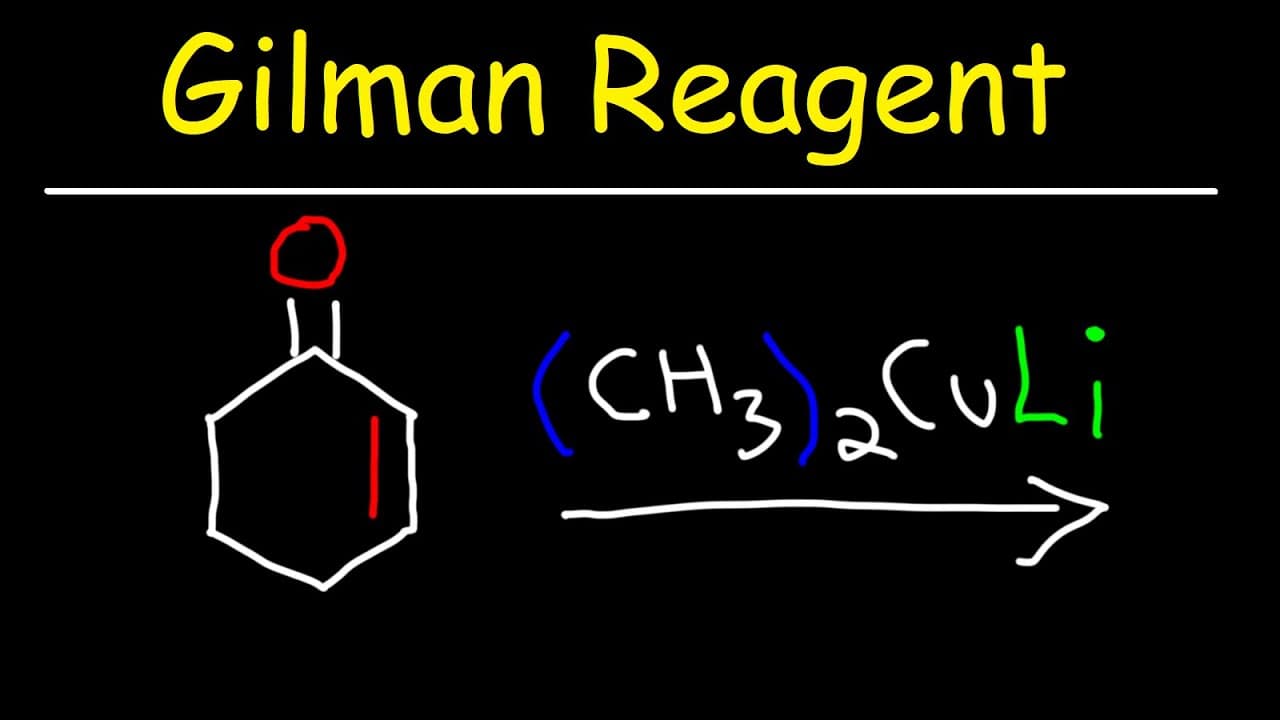
The Gilman reagent is created by reacting an organolithium compound with copper iodide and is essential for converting alkyl halides into alkanes by replacing halogen groups. It also works with venallic and aryl halides and facilitates 1,4-addition reactions in alpha-beta unsaturated ketones, allowing for selective substitution without affecting carbonyl groups.
Transcript
in this video we're going to focus on the gilman reagent also known as an organocuprate so let's begin by talking about how it's made so first we need the organolithium compound and we're going to react it with copper iodide in thf this is going to produce the gilman reagent and then lithium iodide will be a side product so the typical formula of t... Read More
Key Insights
- 🧪 The Gilman reagent, made from an organolithium compound and copper iodide, is useful for converting alkyl halides into alkanes by replacing the halogen group with an R group.
- 💡 It can also replace the halogen in venallic halides, while retaining the configuration at the double bond.
- 🔬 The Gilman reagent is effective in replacing leaving groups in aryl halides, which are resistant to SN2 reactions.
- 👉 When reacting with aldehydes or ketones, the Gilman reagent displaces the halogen leaving group without affecting the carbonyl group.
- ⚗️ In the case of alpha-beta unsaturated ketones, using the Gilman reagent leads to a 1,4 addition product, conjugating the R group to the beta carbon.
- 🌿 Alternatively, using a Grignard reagent with an alpha-beta unsaturated ketone will result in reduction of the ketone to an alcohol and the R group added to the tertiary carbon, leaving the double bond unaffected.
Install to Summarize YouTube Videos and Get Transcripts
Explore YouTube Video Summarizer or Get YouTube Transcript Extractor
Questions & Answers
Q: How is the Gilman reagent made?
The Gilman reagent is made by reacting an organolithium compound with copper iodide in THF, producing the reagent and lithium iodide as a side product.
Q: What is the main use of the Gilman reagent?
The main use of the Gilman reagent is to convert alkyl halides into alkanes by replacing the halogen group with an R group.
Q: Can the Gilman reagent replace the halogen in veno and aero halides?
Yes, the Gilman reagent can replace the halogen in veno and aero halides, allowing for the formation of different organic compounds.
Q: Are the reactions with the Gilman reagent stereo specific?
Yes, the reactions with the Gilman reagent are stereo specific, meaning that the configuration at the double bond remains unchanged.
Q: Can the Gilman reagent react with aldehydes or ketones?
No, the Gilman reagent does not react with aldehydes or ketones. It only replaces the halogen group, leaving the ketone group unaffected.
Q: How does the Gilman reagent react with alpha beta unsaturated ketones?
When reacting with alpha beta unsaturated ketones, the Gilman reagent performs a 1,4-addition, adding the R group to the beta carbon and leaving the ketone unaffected.
Q: What happens if a greener reagent is used instead of the Gilman reagent?
If a greener reagent is used instead of the Gilman reagent, the ketone will be reduced to an alcohol, and the R group will be added to the tertiary carbon, while the double bond remains unaffected.
Summary & Key Takeaways
-
The Gilman reagent is made by reacting an organolithium compound with copper iodide, resulting in a molecule with two R groups, a copper atom, and a lithium atom attached to it.
-
It is useful for converting alkyl halides into alkanes, replacing the bromine group with an R group.
-
The Gilman reagent can also replace the halogen in veno and aero halides, and it can perform 1,4-addition reactions on alpha beta unsaturated ketones.
Read in Other Languages (beta)
Share This Summary 📚
Summarize YouTube Videos and Get Video Transcripts with 1-Click
Try YouTube Summary with ChatGPT & Claude or YouTube Transcript Generator
Explore More Summaries from The Organic Chemistry Tutor 📚
Summarize YouTube Videos and Get Video Transcripts with 1-Click
Try YouTube Summary with ChatGPT & Claude or YouTube Transcript Generator