Is THIS English? (Tok Pisin)
TL;DR
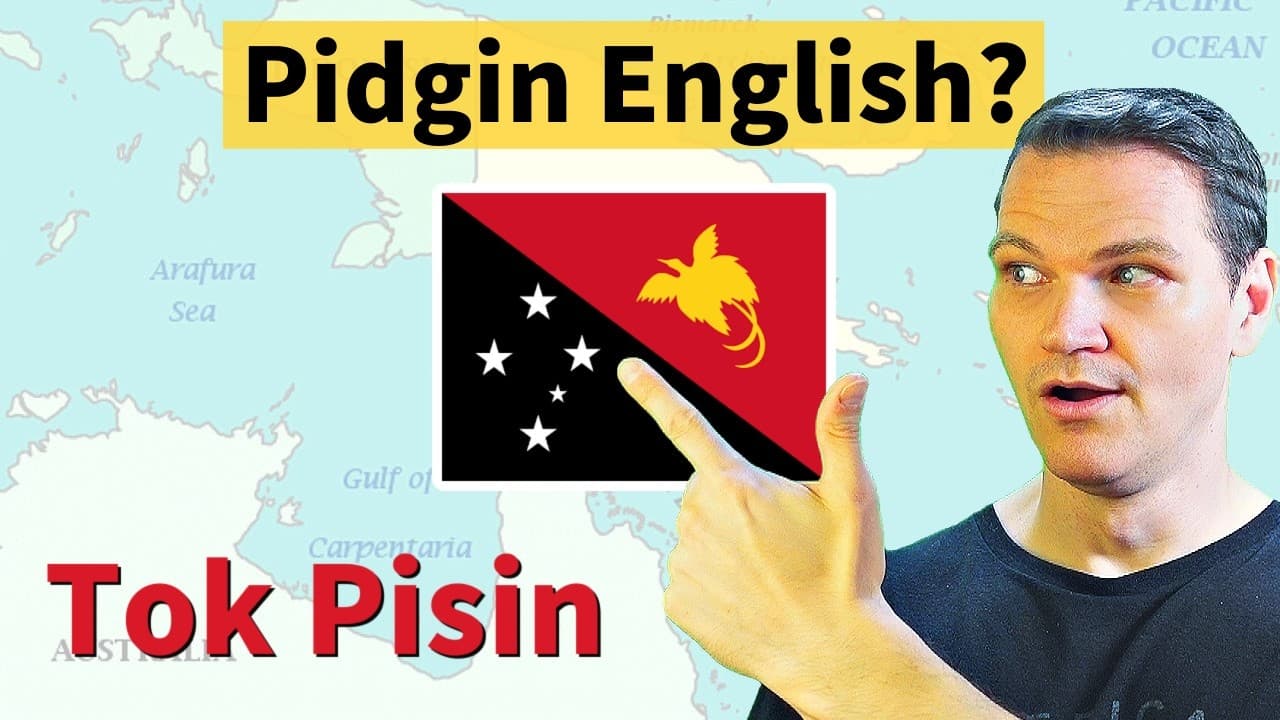
Tok Pisin is a creole language in Papua New Guinea with English roots.
Transcript
hello everyone welcome to the langfocus channel and my name is paul today we're going to talk about a language that partially descended from english but is not actually english the language is tok pisin an english-based creole language sometimes referred to as pidgin or pidgin english tok pisin is one of the official languages of papua new guinea w... Read More
Key Insights
- Tok Pisin is one of Papua New Guinea's official languages and serves as the primary lingua franca in a country with over 800 languages.
- The language has its roots in English but has evolved significantly with influences from German, Malay, Portuguese, and Austronesian languages.
- Tok Pisin vocabulary predominantly comes from English, but words often have different meanings or broader applications.
- The grammar of Tok Pisin reflects Austronesian languages, with unique features like predicate and transitive verb markers.
- Tok Pisin lacks definite and indefinite articles, using context and specific markers to convey these meanings.
- The language has a simplified verb structure, using auxiliary words to indicate tense and aspect.
- Tok Pisin is used in various formal settings in Papua New Guinea, including media and government, but is not widely used as a literary language.
- There is debate about whether Tok Pisin should play a larger role in literary and educational contexts, given its widespread use as a spoken language.
Install to Summarize YouTube Videos and Get Transcripts
Explore YouTube Video Summarizer or Get YouTube Transcript Extractor
Questions & Answers
Q: What is the origin of Tok Pisin?
Tok Pisin originated as a pidgin language on the plantations of German Samoa between 1880 and 1914. It was developed by laborers from New Guinea who needed a common language for communication. The vocabulary primarily comes from English, with influences from Melanesian languages.
Q: How does Tok Pisin's vocabulary differ from English?
While Tok Pisin's vocabulary is largely derived from English, the meanings of words can be different or broader. For example, 'place' in Tok Pisin can mean village or region, and 'cross' can mean any degree of anger or annoyance, not just mildly annoyed as in English.
Q: What are some grammatical features of Tok Pisin?
Tok Pisin grammar includes a predicate marker 'e' for third-person sentences, a transitive verb marker 'im', and two main prepositions 'long' and 'belong'. The language lacks definite and indefinite articles, and verbs are not conjugated but use auxiliary words to indicate tense.
Q: How is Tok Pisin used in Papua New Guinea?
Tok Pisin is used as a lingua franca and is one of the official languages of Papua New Guinea. It is used in government, media, and everyday communication. However, its use as a literary language is limited, with English often preferred for formal and educational purposes.
Q: What influences have shaped Tok Pisin?
Tok Pisin has been shaped by various languages, including German, Malay, Portuguese, and several Austronesian languages. These influences are evident in its vocabulary and grammatical structures, making it distinct from English despite its English roots.
Q: Why is Tok Pisin important in Papua New Guinea?
Tok Pisin is crucial in Papua New Guinea due to the country's linguistic diversity, with over 800 languages spoken. It serves as a common language that enables communication across different linguistic groups, facilitating social, economic, and political interactions.
Q: What is the debate surrounding Tok Pisin's role in education?
There is debate about whether Tok Pisin should play a larger role in education and literature. Some argue it should be used more widely due to its prevalence as a spoken language, while others believe English should remain the primary language for formal and educational contexts.
Q: How does Tok Pisin handle verb tenses?
Tok Pisin verbs are not conjugated for tense. Instead, auxiliary words like 'bin' for past actions or 'bai' for future actions are used to indicate tense. The context and time words, such as 'asde' for yesterday, also help convey the timing of actions.
Summary & Key Takeaways
-
Tok Pisin is an English-based creole language spoken in Papua New Guinea, serving as a common lingua franca in a linguistically diverse country. Its vocabulary is mostly derived from English, but words often have different meanings or broader applications.
-
The grammar of Tok Pisin is influenced by Austronesian languages, featuring unique markers for predicates and transitive verbs. The language is used in formal settings like government and media, though its role as a literary language is limited.
-
There is ongoing discussion about expanding Tok Pisin's use in education and literature, as it is widely spoken across Papua New Guinea. Despite its English roots, Tok Pisin has evolved into a distinct language with influences from several other languages.
Read in Other Languages (beta)
Share This Summary 📚
Summarize YouTube Videos and Get Video Transcripts with 1-Click
Try YouTube Summary with ChatGPT & Claude or YouTube Transcript Generator
Explore More Summaries from Langfocus 📚





Summarize YouTube Videos and Get Video Transcripts with 1-Click
Try YouTube Summary with ChatGPT & Claude or YouTube Transcript Generator